
Wall Street has spent the better part of two years focused on one problem at Johnson & Johnson: the Stelara patent cliff. The immunology blockbuster that once accounted for roughly 12% of companywide sales has been hit by U.S. biosimilar entry in 2025, and competitive pressure is intensifying further in 2026 as biosimilars to Simponi arrive and Opsumit sees generic entry. That story is real. It has also pulled attention away from something potentially more important happening one floor down in the corporate hierarchy: a medical device business quietly positioning itself for a decade of structural growth.
Do you own oil and gas stocks? Or are you thinking about buying some?
If so, you need to see my #1 oil play for 2026 But it’s NOT oil stocks, futures, or anything you’ve likely heard about.
Rather, it’s an unusual way to potentially bank monthly income from the oil and gas markets.
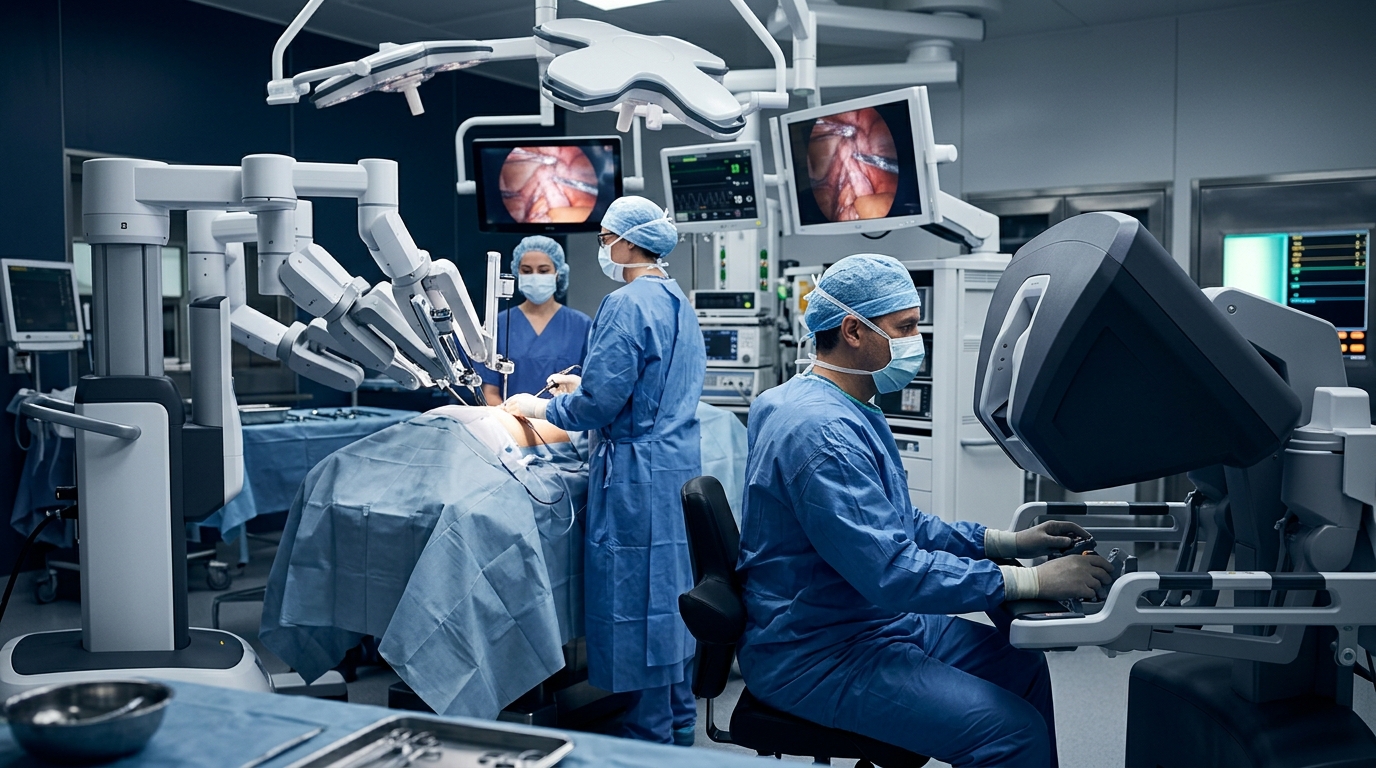
The pivot point arrived on July 22, when the FDA granted De Novo marketing authorization for Ottava, the world’s first table-integrated soft-tissue robotic surgical system. The authorization covers ten upper-abdominal general surgery procedures, including Roux-en-Y gastric bypass, gastrectomy, cholecystectomy, and hiatal hernia repair. J&J has begun a controlled U.S. commercial launch with select customers, and management takes the stage Monday at Morgan Stanley’s 24th Annual Global Healthcare Conference at 11:30 a.m. Eastern. That fireside chat is the week’s sharpest catalyst for how J&J frames the robotics opportunity.
The Architecture That Changes the Argument
Intuitive Surgical’s installed base of more than 12,100 systems at year-end 2025, with about 3.15 million da Vinci procedures performed in 2025 and roughly 18% year-over-year da Vinci procedure growth, represents a moat that cannot be bought quickly. J.P. Morgan analyst Robbie Marcus said in a note that physician relationships and entrenched hospital workflow integration continue to favor Intuitive as “the clear favorite.”
J&J is not trying to win on those terms. Ottava’s four robotic arms integrate directly into the operating table rather than mounting on external carts or ceiling booms, cutting the OR footprint by 30% to 50% compared to traditional systems. The pivotal clinical study, presented at the American Society for Metabolic and Bariatric Surgery annual meeting in May, found that the system was successfully installed across operating rooms spanning 243 to 694 square feet. In five of the six participating hospital sites, procedures were performed in rooms that had never previously been used for robotic surgery at all, including rooms historically considered too space-constrained for any robotic platform.
Global energy demand is surging and one overlooked power source is quietly returning to the spotlight. New policy support and supply constraints are setting the stage for a surprising shift in the energy markets.
That is a different competitive argument. J&J is not asking hospitals to swap out an Intuitive system. It is targeting the vast majority of surgeries that are still performed without a robot, and specifically the hospitals that could not accommodate conventional robotics in the first place.
The MedTech Segment Deserves More Credit
MedTech accounts for roughly 36% of J&J’s total revenues. In 2025 the segment delivered $33.8 billion in sales, growing 5.4% on an operational basis across 15 major product launches. Q2 2026 MedTech sales came in at $8.9 billion, growing 3.6% operationally despite cardiovascular headwinds. The cardiovascular franchise remains the segment’s fastest mover, with Q1 2026 cardiovascular sales up 13% to $2.38 billion, driven by Abiomed at plus-16.3% and Shockwave at plus-18.5%.
Ottava adds a third pillar to that acceleration story. A U.S. clinical trial for inguinal hernia, one of the most common procedures performed in the country, is already underway, and J&J’s surgery chairman has signaled fast-follow regulatory submissions in Japan and Western Europe. The company is also planning a potential separation of its DePuy Synthes orthopedics franchise by mid-2027, which could meaningfully lift overall MedTech margins and growth rates.
While investors chase the next tech story, one long-ignored sector is quietly heating up. A mix of global policy, rising demand, and tightening supply could reignite this market before 2026. See what the latest research reveals.
Risks Worth Naming
Entrenched incumbency is the central obstacle. Intuitive’s razor-and-blade model generates the majority of revenue from recurring instruments, accessories, and service contracts. That recurring stream reinforces hospital lock-in year after year. Ottava’s clinical dataset remains early, built on 30 patients. Tariff costs of approximately $500 million are expected to pressure MedTech margins in 2026. Urology indications, which could unlock the largest addressable procedure volume, are not yet authorized.
What Monday’s Conference Reveals
The question management will be asked, directly or indirectly, is pacing. A controlled launch with select U.S. customers is prudent, but investors will want to understand the cadence for broadening indications, the pricing model relative to the da Vinci, and the international regulatory timeline. How J&J’s leadership frames those answers could reframe the entire investment case for a stock that the market still reads primarily through a pharma lens.
If Ottava converts even a fraction of the procedures that sit outside Intuitive’s current reach, J&J’s device business may prove to be the growth engine this company has been building toward for years. That story may be worth watching closely, starting Monday morning.
 Rising Star Stocks