
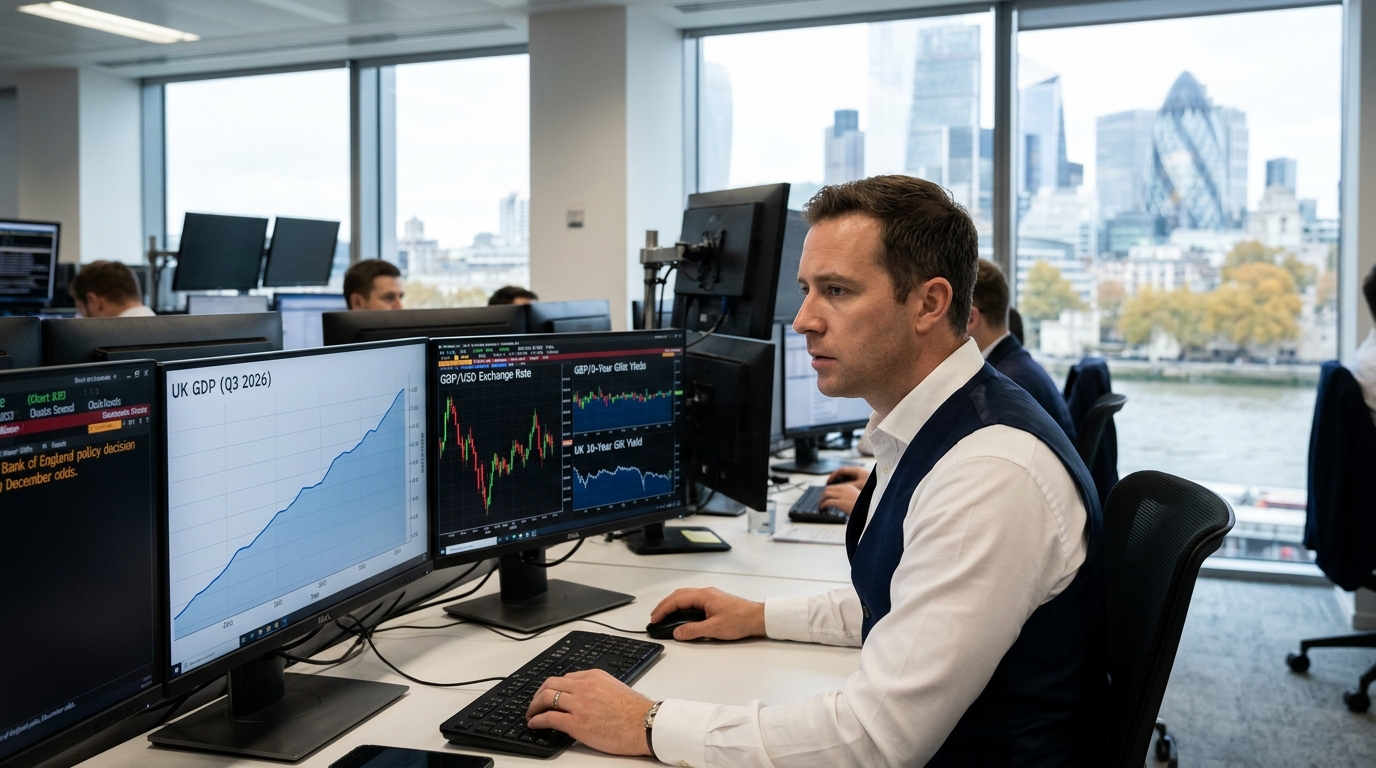
The number was fast, the market reaction was not. Britain’s economy grew 0.7% in the third quarter of 2026, faster than its second-quarter growth, and the strongest quarterly pace since early 2024. Yet sterling barely flinched, gilts held their range, and traders nudged their December bets only modestly higher. That is the gap worth reading.
Services output expanded 0.9%, a gain that outweighed 0.1% growth in production and a 0.7% fall in construction. The standout inside that number: computer programming and consultancy rose 4.4% in the quarter, which the ONS links to AI and cloud computing activity. That single sub-sector contributed 0.15 percentage points to the quarterly total. September alone rose 0.2% from August, against a forecast of zero, with construction output recovering 0.8% after four straight monthly falls.
The context matters. The Bank of England announced its first interest rate hike in over three years on November 5, raising Bank Rate by 25 basis points to 4%, marking its first hike since August 2023. Policymakers said they now expected UK inflation to rise to about 5% by the middle of 2027. Today’s GDP figure is the first hard growth reading since that decision landed, so the question it raises is direct: does resilience of this kind give the MPC enough cover to go again in December?
Markets assign roughly a 75% chance of another Bank of England rate hike in December, while money markets price in three more increases by December 2027 and about a 50% chance of a fourth. That is a meaningful step up from where pricing sat the morning the November hike was announced. Interest-rate swap markets had moved to imply a chance of around 50% of another quarter-point hike in December, up from 30% before the November decision.
Sterling’s response was deliberately quiet. Sterling was down 0.06% at $1.3271 after UK GDP grew 0.7% in the third quarter, matching expectations. The figures had little immediate impact on sterling but supported the Bank of England’s decision last week to raise interest rates, said Kenneth Broux, FX and rates strategist at Societe Generale. The muted reaction is partly mechanical: a number that lands exactly on consensus rarely moves spot rates. But it also reflects genuine uncertainty about what comes next. Against the euro, the pound had given up its gains even after a fifth consecutive upside surprise in monthly GDP. Lloyds sees a reason why sterling traders may wait for next week’s figures before taking a stronger view on December.
The yield on 10-year UK government bonds held around 5.23%, steadying after a selloff in the previous session. The 10-year yield is about 21 basis points lower than a month ago, suggesting the move was a longer-run decline rather than a fresh surge. Gilts, in other words, are not screaming tightening: they are sitting with it.
The complication the headlines skip is the composition. Some economists expect slower growth in the final quarter of the year as higher energy prices and borrowing costs weigh on activity. The AI-linked IT sector that drove Q3 showed sequential softness within September itself, leaving open whether the sub-index has peaked. Business investment rose only 0.4% in the quarter, its strongest three-quarter run in four years but still modest relative to the energy and wage cost environment firms are absorbing.
Rob Wood, Chief UK Economist at Pantheon Macroeconomics, noted that monthly GDP beat consensus for the fifth straight month and the seventh in eight, adding: “Today’s figures, at the margin, make a December hike more likely.” Capital Economics’ Ruth Gregory agreed the data raised December odds. ING, by contrast, expects the Bank to wait until February before acting again.
The Bank’s next decision is due in December. The next tests are October’s labour market and inflation data later this month, and whether September’s dip in computer services proves a blip. The next UK interest rate decision is scheduled for December 17, 2026. Those two data points, not today’s GDP, will decide what the MPC actually does. The 0.7% gave the Bank permission. It did not issue the order.
 Rising Star Stocks