
 By Rising Star Stocks
 April 21, 2026
Commodity Convergence: When AI Investors Get Forced Into Copper
The GPU boom is physical. Copper is the bottleneck – and one overlooked U.S. producer just got a real-world co-sign.
There’s a weird moment happening in markets right now.
Tech investors keep trying to price AI like it’s software: infinite scaling, clean margins, no messy inputs. But the AI data center build-out isn’t a pure code story. It’s concrete, switchgear, transformers, cooling loops, and a lot of metal. And once you look at it that way, you run into the same uncomfortable truth every industrial cycle runs into eventually: the constraint isn’t demand. It’s supply.
This is the theme I keep coming back to as 2026 unfolds: Commodity Convergence.
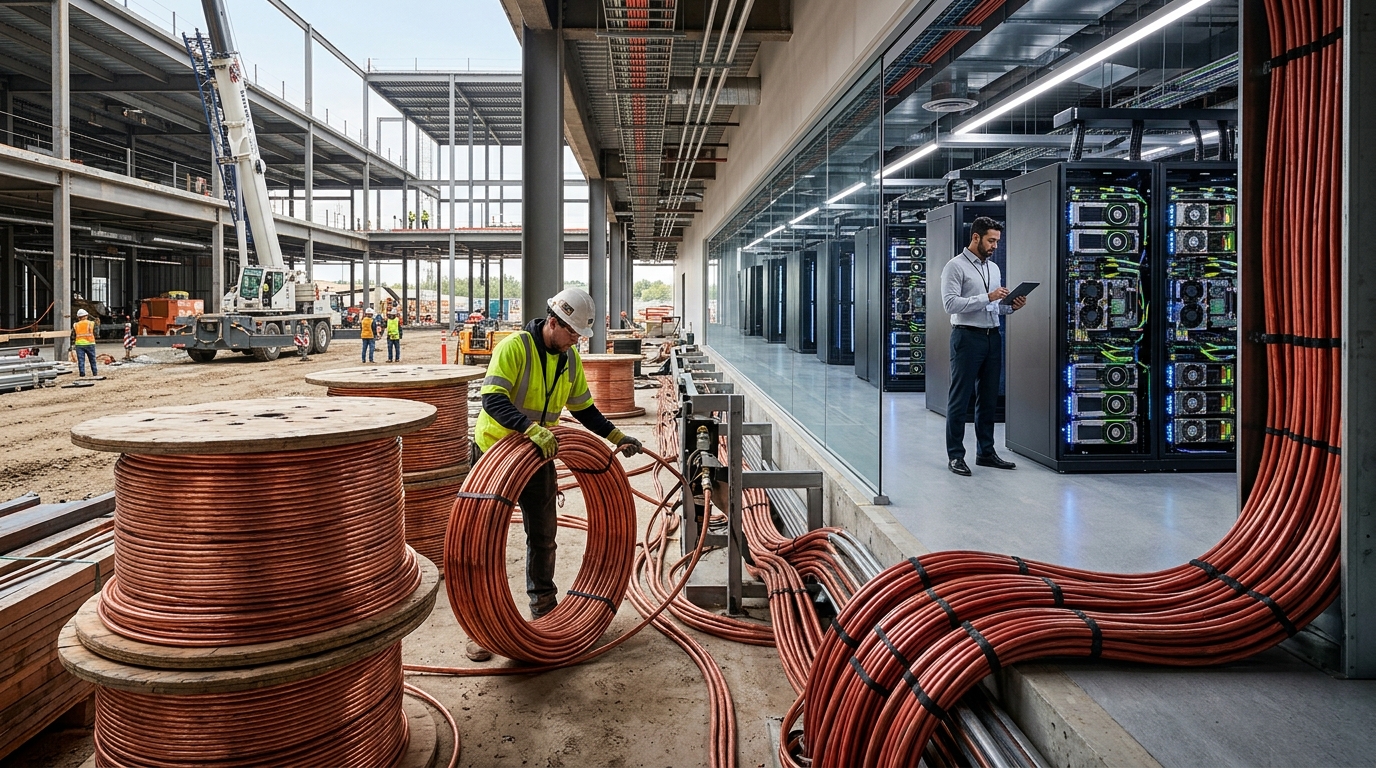
It’s what happens when “digital” megatrends smash into the physical world – and the physical world doesn’t care about your TAM slide. You can’t have a GPU cluster without high-grade copper. You can’t move that power without copper. You can’t cool dense racks without more copper showing up in plumbing, heat exchangers, cold plates, and distribution manifolds.
At first glance, this sounds like the oldest trade in the book: “buy copper.”
But here’s where it gets interesting. Not all copper exposure is the same. Some “copper” equities are really conglomerates with copper as a side dish. Others are world-class, but everyone already owns them, everyone already knows the narrative, and the stock already trades like it.
I want to talk about a name that gets far less oxygen than it probably should, despite sitting right at the intersection of two things the market is suddenly paying up for: American critical minerals and AI infrastructure.
The Playbook Every Options Trader Should Have!
Do you dream of retirement but it seems like an impossibility? Wish you knew the best moves to get you there sooner?
It’s closer than you think and you won’t have to work overtime to get it!
Hi! I’m Dave Aquino, expert options trader and my e-book, “How To Master the Retirement Trade” has helped thousands reach their goals!
Follow the link to get your copy and see what you’ve been missing!
The Rising Star: Gunnison Copper (GCU / GCUMF)
Gunnison Copper is small. It’s not the kind of ticker that shows up in a typical “AI beneficiaries” screen. It’s also not a household mining name, which is kind of the point.
What makes it stand out, right now, is that it owns and operates the Johnson Camp Mine in Arizona – and Johnson Camp has effectively become a proving ground for Nuton, the copper bioleaching technology venture backed by Rio Tinto. Gunnison has repeatedly described Johnson Camp as fully funded by Nuton for its restart and ramp, with first copper production occurring in 2025. More recently, Gunnison’s filings have discussed a production capacity framework (up to roughly 25 million pounds of copper cathode per year) tied to the Johnson Camp operation and the Nuton-funded work program.
And then the market got a very specific kind of validation: in January 2026, Gunnison announced Rio Tinto’s Nuton collaboration with Amazon Web Services, positioning AWS as Nuton’s first customer and linking the copper produced through this process to U.S. data centers.
That’s not a “maybe someday” narrative. That’s a real-world buyer signaling that copper supply lines are becoming strategic – not just a commodity input you assume will show up on time.
Slight tangent, but it matters: when you see a hyperscaler (directly or indirectly) trying to tie up physical inputs, it rhymes with the way semis and power equipment started behaving once lead times went from annoying to existential. People don’t pre-buy stuff they think is abundant.
Market temperature: “AI factories” meet a metal with no easy shortcut
Investors tend to treat copper like a macro dial: China up, copper up; China down, copper down. That framework still matters, but it’s getting less complete by the quarter.
In 2025 and into 2026, the copper conversation has started to shift toward something more structural:
- Data center electrification: building out power delivery and internal distribution at scale is copper-heavy by definition.
- Cooling intensity: as rack densities climb, cooling moves from “HVAC problem” to “plumbing and heat transfer at industrial scale,” which tends to pull more copper into the design.
- Grid upgrades: you can’t plug gigawatts of incremental load into yesterday’s grid without a lot of new physical hardware.
The part people skip is how quickly this turns into a procurement fight. It’s not just that copper demand rises – it’s that demand shows up in bursts, in clusters, and with schedules that don’t tolerate delays. That’s exactly when “commodity” starts trading like a bottleneck input.
And copper is a brutal bottleneck because you can’t flip a switch and create new supply. Permitting, capex, geology, processing, water rights, community support, power access – it’s a multi-year relay race. If anything breaks, timelines slip. If timelines slip, price has to do the balancing.
So when we say “Copper Squeeze,” I’m not talking about a cute futures setup. I’m talking about the physical reality that we’re building more electricity-hungry infrastructure faster than we’re adding high-quality copper units.
What Gunnison actually is (and what it isn’t)
Gunnison isn’t a diversified mining empire. It’s a focused copper company with a U.S. footprint, and its near-term story has centered on Johnson Camp in Arizona plus the longer-duration Gunnison Project (also in Arizona).
In plain English, the bull case isn’t “they’ll outproduce the majors.” It’s that they might be positioned to benefit from a very specific convergence:
- A domestic copper narrative that keeps getting louder in Washington and in corporate procurement.
- A new processing approach (Nuton’s bioleaching) being pushed and funded by a top-tier partner with real technical and commercial incentives.
- A demand regime where U.S. data center build-outs are no longer niche – they’re a strategic national infrastructure build.
To be clear, this is not “risk-free copper.” Small miners are messy. Ramp-ups are messy. Partnerships are helpful, but they don’t remove geology or execution risk.
But that’s also why these names can stay under-owned. Institutions can’t always size into them. Many generalists won’t touch anything that smells like “development.” And tech investors, honestly, still don’t love the idea that their AI thesis might require learning about leach pads and cathode plating.
They will if copper tightens enough. That’s the convergence.
The data-driven angle: why the partnership matters more than the ticker
When I look at the under-the-radar commodity equities, I’m less interested in the promotional headline (“AI needs copper!”) and more interested in the mechanics that can force a re-rating.
For Gunnison, the key mechanic is that Nuton is not just a marketing partner. It’s described as a funding and technology engine tied to Johnson Camp’s restart and optimization, with milestones that can move the asset from “it runs” to “it runs predictably” to “it scales.” In December 2025, Gunnison announced that Rio Tinto’s Nuton produced first copper from Johnson Camp using Nuton technology at industrial scale. That’s a different statement than “lab results looked good.”
Then in January 2026, Gunnison put out the AWS angle – and whether you love or hate that kind of press release, it tells you something about how the supply chain is being framed. AWS becoming the first customer for Nuton is effectively a signal that low-carbon, domestic copper supply is being treated like an input worth designing around.
Another detail that’s easy to gloss over: Gunnison and Nuton were selected for a 48C tax credit award (US$13.9 million) tied to expanding “Made in America” copper production at Johnson Camp. It’s not going to single-handedly change the economics of copper mining. But it’s the kind of policy tailwind that tends to compound when a project is already moving and already attached to credible operators.
Put differently: this isn’t a random junior saying “please notice me.” It’s a small company sitting inside a much larger industrial effort to unlock more copper from deposits that traditional methods don’t monetize well.
That’s the bet. And it’s a very 2026 kind of bet.
Why copper is “battery metal” again (even if your brain says lithium)
When people say “battery metals,” they usually mean lithium, nickel, cobalt, graphite. Copper gets treated like background music.
That’s a mistake. Copper is the wiring, the busbars, the connectors, the motors, the inverters, the chargers, the grid tie-ins. It’s the metal you need everywhere the electrons actually move. EV adoption alone can pull copper demand higher, but the bigger twist is that the AI build-out is acting like a second electrification wave running in parallel.
And unlike many “transition” materials, copper’s substitution options tend to be limited or impractical at scale. Aluminum can substitute in some contexts, sure. But once you get into high reliability, heat transfer, space constraints, or specialized applications, copper keeps showing up. Again and again.
So you end up with a simple picture: more electrical intensity per unit of GDP, and copper is the metal most directly connected to that intensity.
What I’d watch next (the real catalysts aren’t tweets)
If Gunnison stays on your radar, I’d focus on a few very unsexy markers. These are the things that tend to matter more than any single headline:
- Johnson Camp ramp consistency: steady-state operations and predictable cathode output are what change perception from “story” to “unit.”
- Nuton milestone updates: how the staged work program progresses, what gets funded next, and whether scale-up language becomes more concrete over time.
- Commercial offtake and customer signaling: the AWS connection matters because it suggests an end market that cares. Watch for more of that.
- U.S. permitting and policy tailwinds: not because policy fixes mining, but because it can compress timelines at the margin and improve project finance optionality.
One more thought, slightly redundant but worth repeating: small copper equities tend to get valued like they’ll perpetually be small. The re-rating happens when the market believes the operation has a repeatable path to scale or a credible route to strategic relevance. Gunnison’s setup at least gives it a chance at that conversation.
Why is the White House suddenly building a new “Fort Knox?”
Hidden inside this fortress lies a critical new resource Moody’s calls “the new oil.” Demand is doubling every 6 months, and Fox News is calling it the “new arms race.” On May 19, a major event could ignite a handful of under-the-radar stocks, setting off what could be biggest commodity boom in history.
Risks (because copper stories love to humble people)
This isn’t a “set it and forget it” name. If you’re watching it seriously, the risk list is real:
- Operational ramp risk: production curves are rarely smooth, and small disruptions matter more when the base is small.
- Commodity price sensitivity: copper helps the macro thesis, but price volatility can still swamp company-specific progress in the short run.
- Partner dependency: the Nuton relationship is a strength, but it also means Gunnison’s near-term narrative is intertwined with a larger partner’s priorities and timelines.
- Financing and dilution: smaller miners often need capital at inconvenient times. The structure of future funding matters.
None of these are deal-breakers by default. They’re just the real texture of mining exposure, which is exactly why many tech-first portfolios don’t have it – until they’re forced to.
The big picture: this squeeze isn’t about “green” – it’s about physics
It’s tempting to frame copper as an ESG trade or a clean energy trade. Sometimes it is. But the cleaner framing is simpler: copper is a throughput metal. It’s the stuff that lets you move power and manage heat, at scale, with reliability.
AI is driving a step-change in compute density. Electrification is driving a step-change in electrical build-out. And the grid is stuck in the middle trying to keep up. When those trends overlap, the market stops caring whether copper is “exciting.” It starts caring whether copper is available.
That’s the convergence trade. Tech investors becoming mining investors, not because they suddenly love mining… but because they don’t have a choice.
If you want one overlooked name to watch in that lane, Gunnison Copper is worth a closer look. Not as a clean, perfect story – as a levered, very real-world way to express the idea that copper supply chains are getting strategic.
I’m going to keep an eye on how the tape treats these “small but strategic” copper names the next time AI infrastructure headlines heat up again. The market has a habit of ignoring bottlenecks… right up until it can’t.
– RSS