 By Rising Star Stocks
 April 26, 2026
The Optimus Effect: One Robotics Supplier Quietly Positioned for Tesla’s Biggest Bet
As Tesla converts its Fremont line to humanoid robot production, the real opportunity may not be in the assembler — it’s in the components powering the machine.
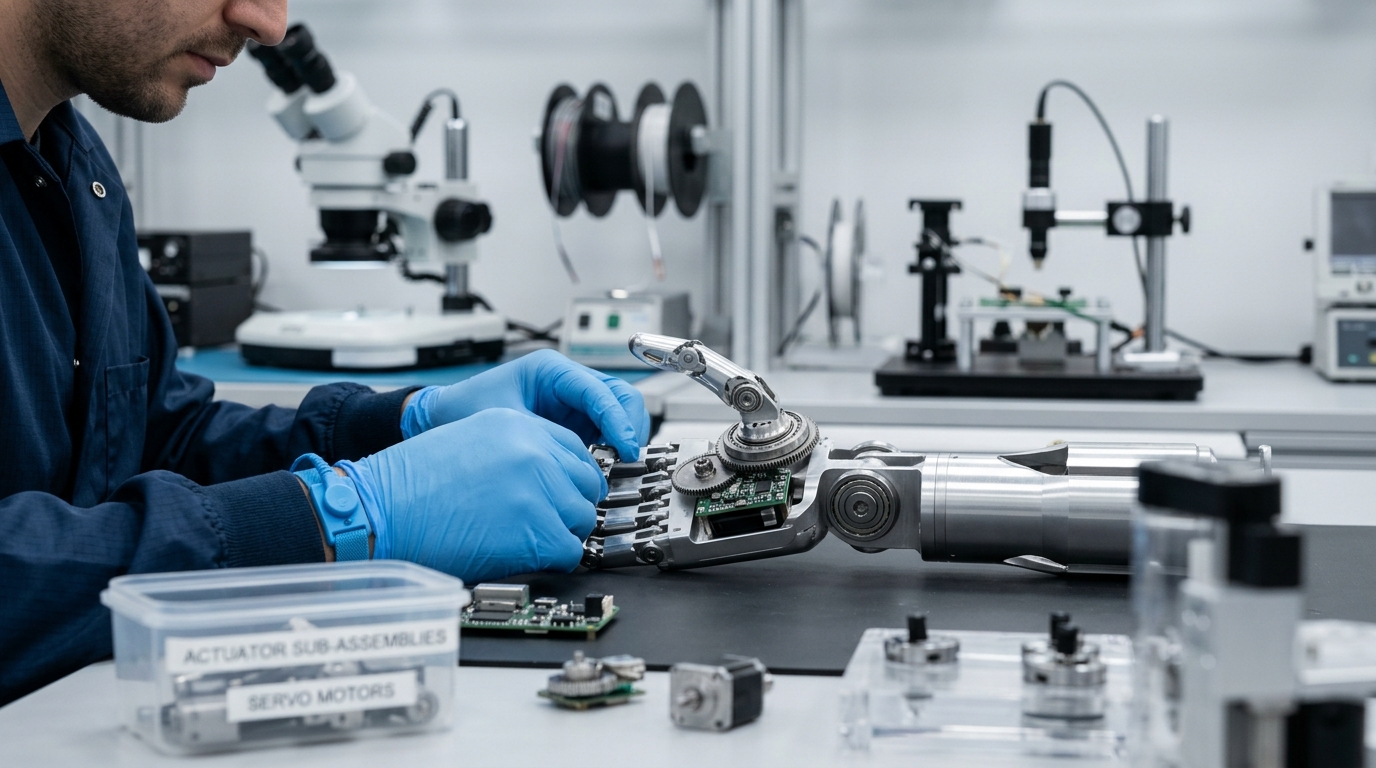
Tesla’s Optimus isn’t a concept anymore. It’s a product with a production address, a conversion timeline, and a level of executive commitment that’s hard to dismiss. During Tesla’s Q1 2026 earnings call, Elon Musk confirmed that Optimus robot production will begin at the Fremont facility in late July or August — just weeks after the final Model S and X roll off the line. That’s not a roadshow slide. That’s a factory being physically dismantled and rebuilt around a humanoid robot.
Wall Street is still largely focused on Tesla itself.
That’s a mistake.
The smarter play, historically, has been upstream. When the iPhone launched, the suppliers of precision components — not just Apple — captured outsized returns. The humanoid robotics wave appears to be setting up a similar dynamic, and one company sits at a particularly interesting intersection of that supply chain. Worth noting: Musk himself acknowledged on the call that Optimus has over 10,000 unique parts and that initial output will be “quite slow.” That’s not a red flag — it’s a signal that the supplier ecosystem is still wide open, and early-mover credibility matters enormously.
From $10M to $225M+ And Still Climbing
RAD Intel’s current Reg A+ round remains open at $0.91 per share, though that price is scheduled to change. Over the past year, RAD Intel’s share price has increased from $0.55 to $0.91. Earlier participants, entering in 2024, invested at prices as low as $0.38
The company has grown from a $10M valuation at merger to $225M+ and is backed by 20k+ investors including multiple institutional funds. RAD Intel was also selected by the Adobe Design Fund and has secured recurring seven-figure enterprise contracts across Fortune 1000 brands.
Sales contracts doubled from 2024 to 2025*, and the NASDAQ ticker has been reserved: $RADI.
This round is 90% allocated. Shares now at $0.91 — invest before the price changes 4/30.
DISCLOSURE: This is a paid advertisement for RAD Intel’s Reg A+ offering and involves risk, including the possible loss of principal. Please read the offering circular and related risks at invest.radintel.ai.
Why Curtiss-Wright Deserves a Closer Look
Curtiss-Wright Corporation (CW) is not a household name. It doesn’t trend on social media. But it manufactures ruggedized motion control systems, embedded computing modules, and precision actuation technology — the exact categories that humanoid robots like Optimus depend on for joint movement, sensory feedback, and real-time processing under load.
A slight tangent, but it matters: Curtiss-Wright traces its lineage back to aviation pioneers Glenn Curtiss and the Wright Brothers. The company has spent nearly a century engineering components that work in environments where failure isn’t an option — aircraft carriers, nuclear facilities, supersonic jets. That institutional knowledge around precision, tolerance, and durability isn’t something a startup can replicate in a product cycle or two.
The company posted full-year 2025 revenue of $3.5 billion, up 12% year-over-year, with adjusted operating margins reaching 18.6% — a multi-year high and a 110-basis-point improvement over 2024. Defense has long been its anchor segment, but management has been deliberately broadening its industrial and commercial technology exposure, which now accounts for a growing share of the backlog.
The Numbers Behind the Narrative
- Backlog entering 2026 stood at $4.1 billion, up 18% year-over-year — providing multi-year revenue visibility that few industrial companies can match
- Free cash flow came in at $554 million in 2025, representing 111% conversion — meaning the company generated more cash than its reported net earnings
- New orders totaled $4.1 billion in 2025, up 10%, with a book-to-bill of 1.2x — orders are outpacing revenue recognition
- The actuation and motion control division has seen order acceleration from non-defense clients since late 2024
- Management guides 2026 for sales of $3.71B–$3.77B, operating margin of 18.9–19.2%, and diluted EPS of $14.70–$15.15 — double-digit EPS growth on top of a record year
These aren’t robotics-pure metrics — but that’s precisely the point. Curtiss-Wright offers exposure to the humanoid robotics buildout without the speculative valuation risk of a single-theme startup. The free cash flow profile alone puts it in a different category than most names that show up on robotics watchlists.
Pentagon Just Signed $26 Billion With This Company – And You Can Get Pre-IPO Exposure+
Led by a man many are calling “the next Elon Musk”… his company is already working with every branch of the U.S. military.
What most people don’t realize is that you can still get pre-IPO exposure – for around $20.
A trusted VC just revealed how.
Click here to see the secret ticker – no email or credit card required.
Why the Timing Is Relevant Now
Tesla has repurposed the Fremont Model S/X line — a facility that previously had capacity for roughly 100,000 vehicles annually — specifically for Optimus production starting this summer. Separately, Tesla broke ground on a second Optimus factory at Giga Texas, with production of the higher-volume Gen 4 variant expected to begin around mid-2027. The implication is clear: this isn’t a single-factory bet. It’s a parallel, multi-site buildout that requires an enormous and rapidly assembled supplier network.
At scale, each Optimus unit requires dozens of precision actuators, embedded processors, and motion control components. The supplier ecosystem is still being assembled — and established manufacturers with aerospace-grade tolerances, proven production credibility, and existing institutional relationships are well-positioned to capture early contracts. What’s interesting here is that Curtiss-Wright already has exactly the kind of contract track record that major OEMs lean on when they need components fast and can’t afford quality risk. Most recently, the company was selected by Boeing to supply mission computers for the U.S. Air Force C-17 fleet modernization program — a contract with an estimated lifetime value in excess of $400 million. That’s the kind of reference point that opens doors in adjacent industries.
The Risk Side of the Ledger
This is where it gets more nuanced. Curtiss-Wright has no publicly confirmed contracts specifically tied to Optimus or any other humanoid robotics program. The robotics thesis here is inferential — built on product overlap, market timing, and the company’s track record of expanding into adjacent commercial markets from its defense core.
There’s also execution risk on Tesla’s side that shouldn’t be dismissed. Musk’s own history with Optimus timelines is checkered — in January 2025 he projected 10,000 units that year, a target that was missed entirely. The Q1 2026 tone was more measured, with Musk explicitly telling investors it is “literally impossible to predict” the production rate this year. That’s a more honest framing — but it also means the robotics demand catalyst for suppliers may materialize more slowly than the headline narrative suggests.
Add in broader macro headwinds — tariff exposure, defense budget variability, and rising input costs — and the picture is one that warrants attention rather than certainty.
The Bigger Picture
The humanoid robotics market could look very different by the end of this decade. Analysts project the sector could exceed $80 billion by 2035 — and the supply chain required to get there will dwarf what currently exists. Tesla isn’t the only one building. Boston Dynamics is shipping its electric Atlas humanoid to Hyundai factories this year. The entire ecosystem is accelerating simultaneously, which means the demand signal for precision motion control and embedded computing components isn’t tied to a single OEM’s timeline.
Curtiss-Wright may not appear on most robotics watchlists yet.
That could be exactly what makes it worth adding to yours.
This editorial is for informational purposes only and does not constitute investment advice. Past performance is not indicative of future results. Always conduct your own due diligence before making any investment decision.