June 25, 2026
GE Vernova Is Up 63% in 2026. July 22 Is Now the Whole Game.
Featured: GE Vernova Is Up 63% in 2026. July 22 Is Now the Whole Game.
Editor’s Note: With the market in turmoil, one of America’s best connected financial insiders (who called the 2000 and 2008 crises) is stepping forward with a warning everyone in our country needs to hear. Click here to get it or read more below.
Dear Reader,
A millionaire Wall Street insider just issued a dramatic new warning – and every American with money in the stock market needs to hear it today.
After running his own $200 million hedge fund firm, this Wall Street legend saw the Twin Towers fall on 9/11… the banks collapse in 2008… and the economy grind to a halt in 2020…
But now, he’s warning:
Whitney Tilson, who famously called the Tech Wreck in 2000, has a long history of eerily accurate predictions – CNBC even gave him a nickname he never asked for: “The Prophet.”
His appearance on 60 Minutes exposing the 2008 financial crisis even won an Emmy.
But he says what’s happening in America today is more dangerous than anything he’s seen before.
He’s warning millions of Americans could soon be blindsided by a permanent change coming to our country, which will be far more wide-reaching than a stock market crash or banking collapse.
Just look at what’s happening inside Gartner. For decades, it’s been at the heart of America’s white-collar economy – full of staff from top-tier Ivy League schools.
It should be one of our country’s most stable firms…
And yet, in the last year, it’s collapsed by more than 60%.
That’s why Tilson says it’s now critical you move your money today – because the next part of this story is going to make America unrecognizable.
In fact, he’s just agreed to reveal exactly where to put your money today – a new investment research vehicle his team spent years developing, ready for this moment.
Get the full details right here, while you still can.
Regards,
Matt Weinschenk
Publisher and Director of Research, Stansberry Research
P.S. Gartner isn’t the only white-collar firm in trouble. The world’s most powerful “knowledge” work firms are getting destroyed. Consulting firms. Insurance analytics. Software stocks.
Morningstar. Duolingo. Verisk. Accenture. They’re all in freefall. Duolingo has already collapsed as much as 75% in a year.
These aren’t just random examples. They’re connected. They’re warning signs. And ignoring them will be catastrophic.
FEATURED
GE Vernova Is Up 63% in 2026. July 22 Is Now the Whole Game.
Most of the conversation about the AI trade has stayed in semiconductors and hyperscalers. Meanwhile, GE Vernova has quietly become one of the year’s best-performing large caps, and the reason is simpler than most people think.
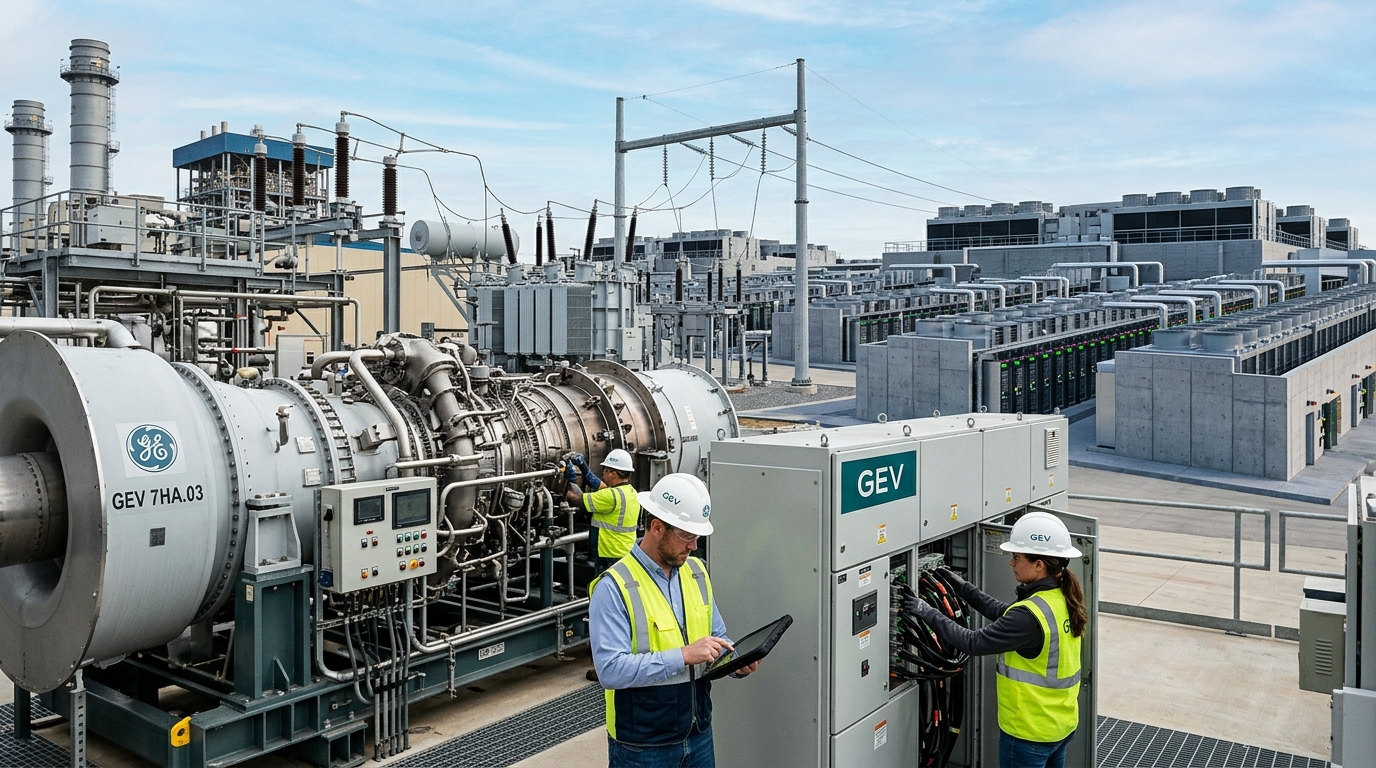
Data centers need power. A lot of it. And GE Vernova (NYSE: GEV) builds the gas turbines, grid equipment, and electrification hardware that makes all of it work. That is not a subtle story. It just did not get the same headlines as the GPU trade.
The Q1 2026 Numbers Were Striking
In Q1, GE Vernova reported revenue of $9.34 billion, a 16% year-over-year increase that beat Wall Street consensus estimates of roughly $9.26 billion. Adjusted EPS came in at approximately $2.06, ahead of expectations in the $1.88–$1.95 range. Free cash flow reached $4.8 billion for the quarter, exceeding the company’s full-year 2025 free cash flow figure of $3.7 billion in a single quarter. The company’s cash balance stood at $10.2 billion.
What really grabbed attention was the order book. GE Vernova booked $18.3 billion in new orders during the quarter, a 71% surge versus the prior year period, with a book-to-bill ratio of approximately 2x. That means the company is booking twice as much business as it is shipping. The total backlog swelled to $163 billion, up from $116 billion at the time of the company’s spin from General Electric in April 2024. In the Electrification segment alone, the company booked $2.4 billion in equipment orders specifically to support data centers in a single quarter, more than all of 2025 combined.
On the earnings call, CEO Scott Strazik noted that the company added $13 billion to its total backlog in just 90 days, and now expects to reach $200 billion in backlog in 2027, a full year ahead of prior expectations.
Elon Musk: Buy Alert
The world’s richest man just launched a new $480 billion disruption, which could make you massive gains this summer. It has nothing to do with space, robots or AI. It’s much, much bigger.
Management raised full-year 2026 revenue guidance to $44.5–$45.5 billion from a prior range of $44–$45 billion, lifted adjusted EBITDA margin guidance to 12%–14% from 11%–13%, and raised free cash flow expectations to $6.5–$7.5 billion. They also increased the company’s share repurchase authorization to $10 billion (up from $6 billion) and doubled the quarterly dividend to $0.50 per share. The stock gained roughly 14% in the week following the Q1 report, touching an all-time high of $1,181.95 on April 23, 2026.
Why This Is Not Just an Energy Stock
Here is where the positioning gets interesting. GE Vernova operates across three segments: Power, Electrification, and Wind. The Wind segment has been a persistent drag. The legal situation escalated significantly in early 2026 when GE Vernova attempted to terminate its Turbine Supply Agreement with Vineyard Wind over disputed payments exceeding $300 million. A Massachusetts court granted Vineyard Wind a preliminary injunction in April, blocking the termination. GE Vernova appealed, and in a May 29 ruling, the court denied both the reconsideration request and the company’s motion to compel arbitration. The dispute, which involves conflicting claims over hundreds of millions of dollars, remains active and unresolved.
But the Power and Electrification segments are doing the heavy lifting. AI hyperscalers, including Amazon, Microsoft, Alphabet, and Meta, are collectively projected to spend hundreds of billions on data centers and AI infrastructure over the next several years. Every one of those facilities needs power generation and grid equipment, and GE Vernova is a scaled supplier across both. The company holds the largest installed base of gas turbines of any original equipment manufacturer in the world, and every turbine shipped today adds to a long-cycle services book compounding well into the 2030s.
Slight tangent, but it matters: data centers now account for approximately 20% to 25% of GE Vernova’s backlog. CEO Strazik has been explicit that this is not a short-cycle AI story. His framing on the Bernstein conference call in June was that the demand opportunity is significant and will persist for a long time. The market is starting to price that in.
Revenue is forecast to grow at roughly 12% per year through 2030, with the Electrification segment carrying a guidance range of $14–$14.5 billion for 2026 alone. The Wind segment, by contrast, is expected to see low double-digit revenue declines this year, with EBIT losses of approximately $400 million.
Valuation – Where It Gets Complicated
GEV is not cheap. The stock currently trades in the $1,060–$1,090 range as of late June 2026, against a 52-week high of $1,181.95. The trailing P/E is around 30x. At roughly 40x forward EV/EBITDA, the stock trades at more than double the sector median.
The part people skip: that premium is increasingly supported by a backlog that is both growing and getting more profitable. Orders signed in early 2026 are priced 10 to 20 percentage points higher on a dollar-per-kilowatt basis than the Q4 2025 backlog average. That pricing improvement has not fully shown up in revenue yet. It flows through as those contracts convert in 2027 and 2028.
A few analysts are more cautious. Jefferies trimmed its price target to $1,210 from $1,350, while maintaining a Buy. Mizuho holds a more cautious position. The Wind segment uncertainty is a legitimate earnings wildcard. And CEO Strazik was measured in his tone at the Bernstein conference in June, acknowledging the high expectations baked into the stock.
Technical Picture Into Q2
GEV pulled back from its April all-time high of $1,181.95 and found footing in the $1,020–$1,060 range in mid-June before recovering. Support levels to watch on the downside: $1,048.60 and $1,015.16. A break below those levels changes the near-term picture. Volume fell on the most recent up day, a minor divergence worth monitoring.
Market cap currently sits around $284 billion.
The Death of the Nasdaq?
Wall Street legend Marc Chaikin’s award-winning system turned bearish on software stocks two months before they crashed this year. Now, he’s warning that one AI lab’s breakthrough could CRASH the Nasdaq while igniting a $500 trillion wealth transfer. He’s found a little-known $40 “pre-IPO backdoor” into the private startup behind this economic sea change.
Three Scenarios Into July 22
Bull Case: Q2 order momentum continues above 50% growth. Electrification data-center bookings match or exceed Q1’s $2.4 billion. Management reaffirms or tightens full-year guidance at the high end of the range. Stock breaks back above the $1,100 resistance zone and rechallenges the $1,181 high. Bull target: $1,200–$1,280.
Base Case: Q2 revenue grows in the mid-teens year-over-year. Orders moderate slightly from the Q1 pace but remain above expectations. Wind segment commentary remains cautious but contained. Stock range-bound between $1,000 and $1,150 ahead of earnings, with a post-earnings move toward the $1,150–$1,200 area. Base case: $1,050–$1,180.
Bear Case: Wind segment losses worsen or the Vineyard Wind legal situation escalates further. Data center order cadence disappoints versus the Q1 pace. Management maintains guidance without raising, or narrows expectations toward the lower end. Combined with the stock’s premium valuation, a miss or guidance hold could trigger a 10–15% correction. Bear target: $900–$960.
What to Watch on July 22
GE Vernova has an official Q2 2026 earnings webcast scheduled for July 22, 2026. The Q1 report set a high bar. The Electrification data center order figure is the single most watched metric going in. Q1’s $2.4 billion in a single quarter, topping all of 2025, was the line that drove the stock roughly 14% in a week. If Q2 matches or extends that, the bull case opens quickly.
The Vineyard Wind legal situation is the wildcard that does not move linearly. A court denied GE Vernova’s appeal and motion to compel arbitration in late May. The underlying payment dispute, with GE claiming it is owed more than $300 million and Vineyard Wind asserting claims above $800 million, remains in active litigation. It can surface in headlines at any point and tends to knock the stock on bad news days. Anyone holding into earnings needs a clear view on position sizing relative to that specific risk.
What’s interesting is how GEV has become the quiet consensus name among institutional energy-infrastructure allocators. The backlog milestone pulled forward. The Power segment shipping 25 gas turbines in a single quarter, up 32% year-over-year. The Electrification backlog growing from $9 billion in 2022 to $42 billion at the end of Q1 2026.
The stock is off its high. The backlog is at a record. Q2 earnings are four weeks away.
For informational and educational purposes only. Not investment advice. Trading involves risk, including loss of principal.
 Rising Star Stocks