August 9, 2026
The Restaurant Stock Rewriting Its Own Story
Toast just posted its strongest quarter ever, went live on Google Maps with agentic ordering.
First a note from Profits Run
Before you place another trade…
…make sure you use this 5-part formula that makes every trade a SAFE trade:
Why are we giving this away?
Because we think you’ll love it so much that you’ll come back to us down the road for more advanced training.
Make sense?
Click here to download the Safe Trade Options Formula…
Good Trading,
Bill Poulos
P.S. Take 5 seconds and get your free copy of the “Safe Trade Options Formula” right now before you close this email.
The Restaurant Stock Rewriting Its Own Story
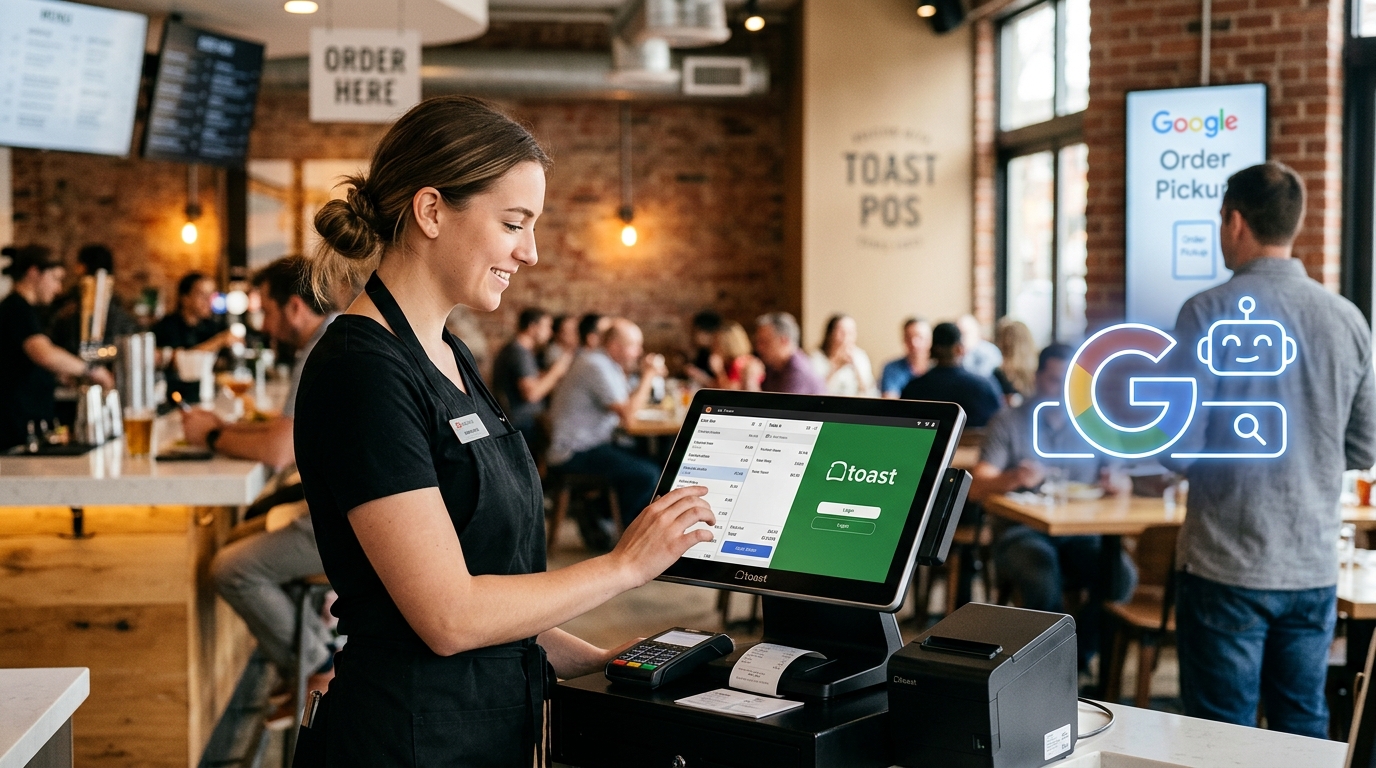
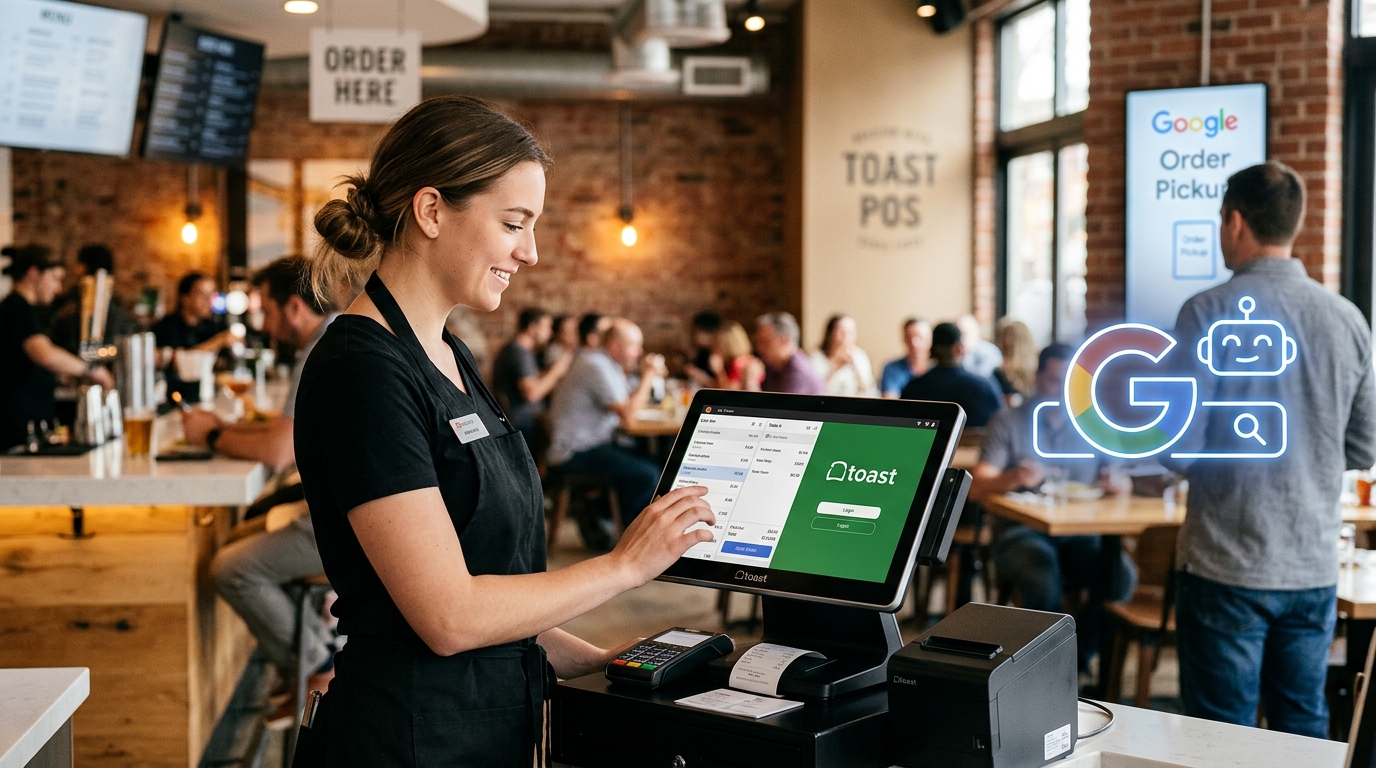
Four days ago, Toast reported the best quarter in company history. Two days after that, it went live on Google Maps with the first agentic food ordering integration the industry has ever seen. As of this morning, TOST trades near $34.50 — roughly where it sat before either event happened.
That disconnect is worth understanding. Because what is sitting on the other side of it may not look like this for long.
The Quarter That Set Records
Q2 2026, reported August 4:
- Revenue: $1.91 billion, up 23.1% year over year, beating the $1.87 billion consensus by 1.8%
- GAAP EPS: $0.26, beating consensus by 28.2%; adjusted EPS of $0.34, beating $0.32 expected
- Adjusted EBITDA: $221 million vs. $195 million expected — a 13.3% beat, with a 37% margin expanding 240 basis points year over year
- GAAP operating income: $152 million, a 26% margin — up from 5.2% in Q2 2025
- Net income: $154 million, nearly double the $80 million posted a year ago
- Annual Recurring Revenue (ARR): $2.4 billion, up 25% year over year
- Recurring gross profit streams: up 28% year over year
- Net new locations: a record 9,500 in the quarter, bringing total locations to approximately 180,000, up 22% year over year
- Full-year 2026 adjusted EBITDA guidance raised to $805 million to $825 million
- The company operated above the Rule of 50: recurring gross profit growth plus operating margin reached 57%
CEO Aman Narang put it plainly on the earnings call: Q2 net location adds were 1,000 more than the company’s previous high watermark. That is not incremental progress. It is the business breaking its own ceiling while growing more profitable at the same time.
The stock gained roughly 3% on August 5 and has since drifted sideways. The 52-week range is $22.26 to $45.64. At $34.50, you are sitting in the middle of that range on a week when both the quarter and the Google deal landed.
What Toast Actually Is
Toast began as a point-of-sale hardware company. It has spent five years systematically building something harder to replicate.
The platform today integrates POS hardware, payment processing, online ordering, kitchen display systems, drive-thru technology, payroll, scheduling, inventory management, food cost analytics, catering and events software, loyalty tools, and Toast IQ — a conversational AI assistant built directly on each operator’s own sales, labor, menu, and operational data. The product suite is deep enough that switching costs become structural.
The business model compounds two revenue streams: recurring SaaS subscription fees and a payments take rate on every dollar processed through Toast terminals. That combination produces ARR of $2.4 billion and gross payment volume of $60.7 billion running through roughly 180,000 locations. Toast earns a clip on every transaction at every one of those restaurants, and that clip grows as locations are added and as those locations do more volume.
New market segments — international, enterprise, and retail — are scaling fast. Management expects ARR across those markets to nearly double to $200 million in 2026, and Narang noted they are growing faster and carrying higher SaaS ARPU than the core business did at comparable stages of maturity. Kung Fu Tea (300-plus locations), TGI Fridays UK, and a Best Western endorsed-provider designation all landed in the most recent quarter. These are not footnotes — they are proof that the vertical playbook travels.
The Google Integration: Bigger Than It Looked at First Glance
On August 6, two days after its earnings release, Toast announced the live rollout of AI-powered food ordering directly inside Google Maps. The mechanics matter here: a diner asks Google Maps by voice or text for a recommendation or a specific dish, and Google can surface a Toast restaurant’s menu and carry that request through to a completed order — without the customer leaving Google’s interface.
But the deeper piece is what Toast’s role in the underlying protocol actually means.
Toast is a co-developer of the Universal Commerce Protocol (UCP) for Food — an open standard defining how AI agents discover, order from, and check out with restaurants across Google Search, Maps, and Gemini. The protocol is designed so restaurants retain control of their menus, pricing, and guest relationships as agentic ordering scales. Critically, orders route through first-party systems, which means no third-party commission fees for operators and payments continue flowing through Toast’s rails.
Google originally launched UCP at the National Retail Federation conference in January 2026, co-developed with retailers including Shopify, Target, and Walmart. The Food TC — the technical council that governs UCP’s food-specific extension — counts Toast alongside Block (Square), DoorDash, Google, and Uber Eats as inaugural members. Toast is not a downstream adopter of this standard. It helped write it.
There is a structural reason that matters. A scan of more than three million public websites found only 26 detectable UCP implementations as of May 2026 — adoption had stalled at the merchant-by-merchant level. Routing the food integration through platform-level POS vendors like Toast sidesteps that bottleneck entirely: one integration covers every Toast location on the network. Nearly 180,000 restaurants became UCP-capable on August 6 without a single operator lifting a finger.
This is infrastructure-layer positioning. The company co-authoring the protocol for how AI agents interact with food commerce, sitting at the center of 180,000 active locations, is not playing defense. It is defining the field.
Toast IQ Grow: AI With Revenue Attached
Beyond the Google integration, Toast’s own AI monetization is gaining real traction. Toast IQ Grow — an AI-powered marketing agent that builds websites, handles SEO, manages digital ordering, and runs social media campaigns using each restaurant’s own transaction data — is on track to become the fastest product in company history to reach $10 million in ARR.
Restaurants using it are seeing measurable same-store sales growth. Gross margins on the product are positive and improving. Management’s stated conviction is that IQ Grow is the proof-of-concept for a broader agentic AI layer — scheduling, payroll, inventory, and accounting agents are on the roadmap. Toast is not describing AI optionality. It is beginning to price it.
Data Deep Dive
Revenue and growth:
- Q2 2026 revenue: $1.91 billion, up 23.1% year over year
- Q1 2026 revenue: $1.63 billion, up 21.9% year over year
- Four consecutive quarters beating the revenue consensus
- Full-year 2026 subscription and fintech gross profit guidance: $2.325 billion to $2.355 billion, representing 23% to 25% growth
Profitability and margins:
- GAAP operating margin Q2 2026: 26%, up from 5.2% in Q2 2025
- Adjusted EBITDA Q2 2026: $221 million, 37% margin, expanding 240 basis points year over year
- Full-year 2026 adjusted EBITDA guidance midpoint: $815 million
- Q3 2026 guidance: adjusted EBITDA of $210 million to $220 million
- Long-term management target: 40%-plus adjusted EBITDA margin
- Management reiterated path to $10 billion in ARR
Platform metrics:
- Total locations: approximately 180,000, up 22% year over year
- ARR: $2.4 billion, up 25% year over year
- GPV: $60.7 billion in Q2 2026
- Take rate: 98 basis points, up 5 basis points year over year
- SaaS ARR grew 27% year over year in Q1 2026, supported by mid-single-digit ARPU growth
Capital return:
- Toast repurchased 19 million shares for $486 million in the first half of 2026
- Share buybacks continue alongside reinvestment in AI, international, and enterprise growth
Watch items:
- Free cash flow Q2 2026: $130 million, down from $208 million in Q2 2025 — driven by a strategic hardware inventory build (inventories rose from $114 million at year-end to $217 million) ahead of anticipated memory price pressure
- Hardware margin headwind: management expects the memory cost impact on its profit-and-loss statement to be greater in 2027 than 2026 due to inventory accounting, but expects optimization work to produce structurally better hardware margins once the memory market stabilizes
- Toast IQ Grow monetization: early traction is confirmed, but scale contribution to consolidated ARR is still in early innings
- Multiple executives filed Form 4 sales in early August — not a crisis signal, but worth monitoring if selling intensifies
Why the Valuation Gap Exists
Two things are holding the multiple back, and neither is a sign of a deteriorating business.
The first is free cash flow. Q2 free cash flow of $130 million looks soft against $208 million a year ago. But the decline traces directly to a deliberate inventory decision: Toast pulled hardware component orders forward to protect shipment capacity against a tightening memory market. The cash did not disappear — it became inventory. Management expects free cash flow conversion to improve in the second half of 2026 as that inventory normalizes. Q3 results, due November 10, will either confirm or challenge that guidance.
The second is spending pace. Sales and marketing rose, R&D climbed, and operating expenses (excluding bad-debt items) were up 19% year over year. That is the signature of a company still in heavy growth mode. Markets apply lower multiples to businesses reinvesting aggressively, even when the reinvestment rationale is sound. The tension resolves only when the newer investments — IQ Grow, enterprise, international, retail — start producing enough visible gross profit to make the returns legible.
At roughly $34.50, TOST carries a market cap near $20 billion. The stock trades at about 20 times 2027 analyst EPS estimates and below 8 times its 2026 ARR guidance on an EV/ARR basis. The consensus analyst price target sits at $38.62, with Bernstein raising its target to $45 after the Q2 report. ValueAct Holdings added 4.88 million shares in Q1 2026, a 60.9% increase in its position. AllianceBernstein added 8.84 million shares, also in Q1. Institutional investors in aggregate are not selling this story.
Bull, Base, Bear
Bull
The UCP for Food protocol becomes the standard rail for AI-driven restaurant ordering across Google Search, Maps, and Gemini. Toast’s 180,000 locations sit at the infrastructure center. Toast IQ Grow scales rapidly, opening a high-margin software revenue stream that the market has not yet priced. New market ARR doubles to $200 million in 2026 and continues compounding. EBITDA margins expand toward the 40% long-term target. The stock re-rates toward $50 as the market recognizes this is not a POS company anymore.
Base
Location growth continues at 7,000 to 9,000 per quarter. ARR compounds at 22% to 25% annually. Memory chip headwinds weigh on hardware margins through 2026 and into early 2027 but leave recurring gross profit growth intact. The Google integration delivers modest GPV uplift but takes several quarters to show in reported figures. The stock drifts toward consensus targets over the next 12 months as new market ARR becomes visible in financials.
Bear
Restaurant consumer spending softens as macro conditions weaken, compressing GPV per location and take-rate economics. Hardware memory costs exceed management’s guidance, creating a free cash flow gap larger than investors expected. Competitors, including Square — also a UCP Food TC member — erode Toast’s differentiation in agentic ordering channels. Heavy R&D and sales spend fails to produce visible ARR acceleration. The stock revisits the 52-week low near $22.
What to Watch and When
- Google Maps agentic ordering adoption: The integration went live August 6. Watch whether Toast operators begin reporting measurable order volume through the Google channel before the company’s next earnings call on November 10.
- Location growth rate: Q2 set a record at 9,500. Sustained adds above 7,000 signal healthy core momentum. A drop below 6,000 is a warning.
- ARR growth: Currently 25% year over year. Watch for deceleration below 20%.
- Free cash flow conversion: Fell to $130 million from $208 million on inventory build. Management guided improvement in H2 2026. November confirms or denies.
- Toast IQ Grow ARR contribution: On track to be the fastest product to $10 million in ARR. The next milestone to watch is whether it reaches that threshold before Q3 earnings.
- New market ARR: On track to nearly double to $200 million in 2026. Any quarter where this decelerates materially changes the expansion thesis.
- Hardware margin: Memory chip costs are the known headwind through 2027. Watch the hardware and professional services gross profit line for evidence optimization work is narrowing the gap.
- Recurring gross profit growth: 28% in Q2. This is the cleanest signal of the platform’s underlying economics. Any sustained move below 20% is a thesis-level event.
The Bottom Line
If Toast is a POS company, $34 is a fair price for a business with a free cash flow dip and heavy spending. If Toast is the infrastructure layer for AI-driven food commerce at 180,000 locations — one of five companies co-writing the protocol for how AI agents order food across Google’s surfaces — then the current market cap of roughly $20 billion may look like the wrong frame entirely by 2028.
The Q2 numbers argue for the second framing. Recurring gross profit up 28%, GAAP operating margin at 26%, a record quarter for location adds, and a raised full-year outlook do not describe a company coasting. They describe a company accelerating. The Google integration, live this week, adds a dimension to the business that did not exist last month.
The free cash flow decline and memory chip costs are real. Both are management-explained and both are tied to finite decisions, not structural damage. The next quarterly report on November 10 is when those explanations either hold up or don’t.
The position worth tracking now is whether agentic food ordering through Google becomes a measurable source of volume for Toast operators before Wall Street formally models it. If it does, you will know before the estimates are revised. That is the early tell this story is evolving faster than the stock price suggests.
This article is for informational purposes only and does not constitute investment advice. All investing involves risk, including the possible loss of principal. Past performance is not indicative of future results. Always conduct your own research before making any investment decisions.
 Rising Star Stocks