July 6, 2026
SK Hynix Roadshow Is Live. The Clock Is Running.
The biggest foreign listing in U.S. history prices this week under ticker SKHY.
First a note from The Oxford Club
Dear Reader,
I am not depressed. And I have no intention of harming myself.
I joke about adding that disclaimer whenever I write about this subject.
Because for decades, Big Oil fought to keep a
And for 50 years, they succeeded.
An entire generation grew up believing this technology was dangerous, impractical, or impossible.
Yet behind the scenes, it never disappeared.
Then AI changed the math.
Microsoft needs more power.
Google needs more power.
Amazon needs more power.
Nvidia needs more power.
Not years from now – today.
That’s why some of the largest companies on Earth are suddenly moving toward the same solution.
The very technology that spent decades on the sidelines.
A compact power system capable of delivering enormous amounts of electricity from a footprint small enough to travel by truck.
The International Energy Agency called it “a game changer….”
The head of Amazon’s cloud computing division called it “an excellent source of energy.”
Even the Wall Street Journal called it a “breakthrough.”
And this August, a government milestone could bring the entire story into the spotlight.
The technology isn’t new. The demand is. And that changes everything.
At the center of this story is a small company most investors have never heard of.
That’s the company I talk about in my recent interview about the Energy Cube.
You can watch it here, while it’s still hosted online.
Yours in smart speculation,
Karim Rahemtulla
Co-Founder, Monument Traders Alliance
“The Indiana Jones of Finance”
P.S. The strangest part of this story isn’t that the Energy Cube exists.
It’s that versions of the underlying technology have been quietly used for decades.
What changed wasn’t the technology. Rather, it was the world’s need for power.
FEATURED
SK Hynix Roadshow Is Live. The Clock Is Running.
Quick Take
- SK Hynix is conducting its Nasdaq ADR roadshow July 6-9, with final pricing on July 10 and trading beginning under ticker SKHY.
- The offering targets $28.1 billion – formally the largest U.S. listing by a foreign company, surpassing Alibaba’s $25B debut in 2014 and Saudi Aramco’s $25.6B IPO in 2019.
- As of Q1 2026, SK Hynix holds a 56.4% global HBM revenue share (per its own SEC filing citing IDC data), ranking No. 1 globally in the chip category that powers every major AI accelerator.
- Q1 2026 results: $35.5B in revenue (up 198% year-over-year), 72% operating margin, net profit of $26.5B – all records.
- Three cornerstone investors – Baillie Gifford, Coatue Management, and Situational Awareness Partners – have already indicated interest in purchasing up to $7 billion of the ADRs.
- All proceeds are earmarked for physical capacity: the Yongin fab, a Cheongju advanced packaging plant, and EUV lithography equipment.
- SK Hynix reports Q2 2026 earnings on July 29 – just three weeks after listing. Buyers are implicitly making a bet on those numbers too.
- Risks include memory cyclicality, Samsung’s accelerating HBM4 competition, customer concentration around Nvidia, and a live U.S. antitrust class-action lawsuit.
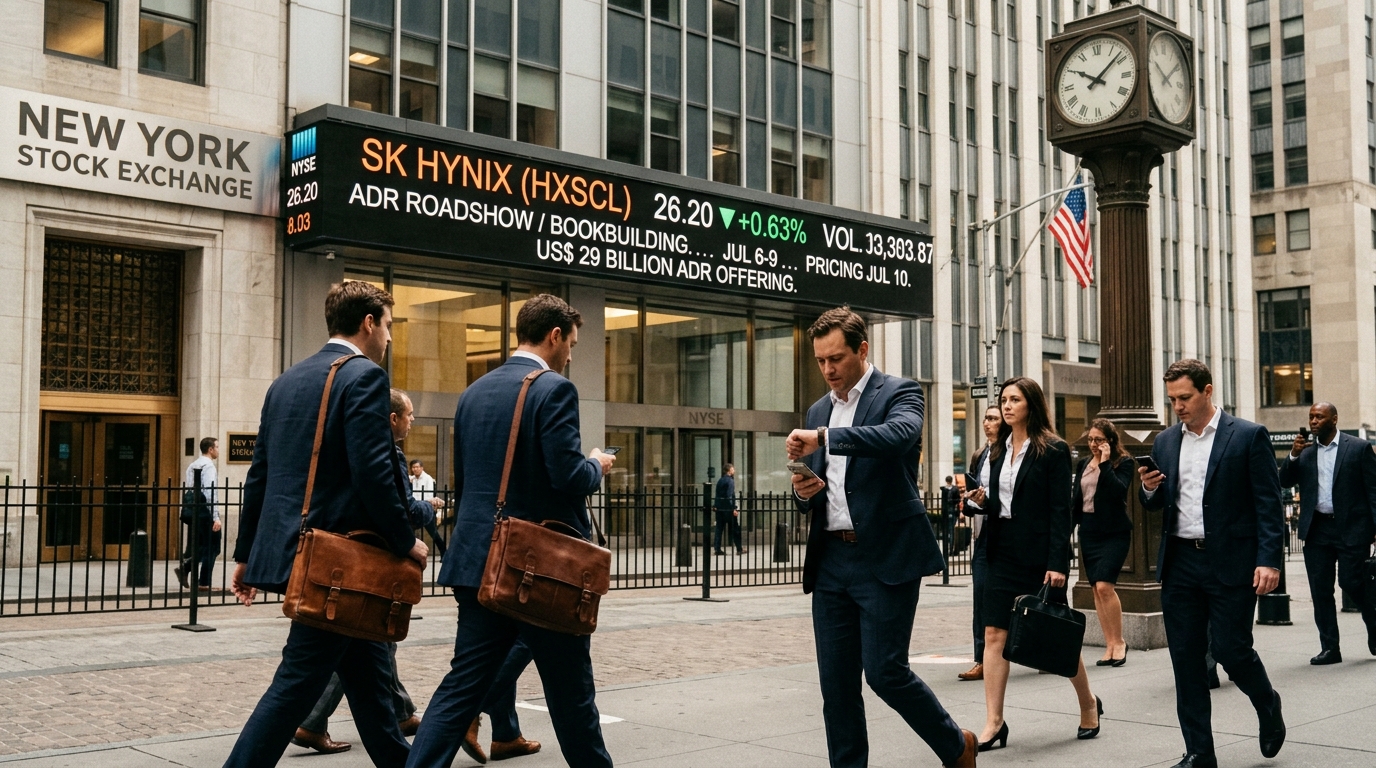
Today is not just a quiet Monday after a holiday weekend. SK Hynix is conducting its roadshow and bookbuilding process for overseas institutional investors from July 6 through July 9, with final offering price confirmation on July 10. The window is live right now.
The offering is targeting approximately $28.1 billion – formally the largest first-time U.S. listing by a foreign company ever recorded, surpassing Alibaba’s $25 billion New York debut in 2014 and Saudi Aramco’s $25.6 billion IPO in 2019. It is not a close comparison. This is a different category of event.
What is SK Hynix? Most Western investors still couldn’t answer that question with confidence, which is part of the point.
As of Q1 2026, SK Hynix ranked first globally in HBM with a 56.4% revenue share, second in DRAM with a 29.1% market share, and second in NAND flash with an 18.5% share – figures cited directly in its own SEC filing. Its customers include Nvidia, Google, and Microsoft. High bandwidth memory – the specialized chip that sits inside every major AI accelerator – is what SK Hynix makes better than anyone else on the planet.
Trump redacted 750 files while smelling Biden?
Biden’s smell hadn’t even left the Oval Office yet…
And Trump got to work immediately on the most secretive government operation since the Manhattan Project.
While the world was distracted by tariffs, Trump redacted over 750 government files.
Because Trump saw the writing on the wall: These files were about to destroy everything we love about America.
The numbers behind that claim are not vague. In Q1 2026, the company posted $35.5 billion in revenue, up 198% year-over-year and 60% quarter-over-quarter. Operating profit rose 405% year-over-year. Operating margin hit 72%. Net profit for a single quarter came in at roughly $26.5 billion – comparable to the company’s full-year 2025 net profit of $28.2 billion. In three months.
There’s already real institutional demand. Cornerstone investors Baillie Gifford, Coatue Management, and Situational Awareness Partners have collectively indicated interest in purchasing up to $7 billion of the ADRs – roughly 25% of the deal – at the same price and terms as everyone else.
The valuation gap is the whole angle here. SK Hynix currently trades at a forward price-to-earnings ratio of roughly 6.2x, compared to Micron’s 7x. HSBC analysts applied a 20% premium for the ADR listing, forecasting SK Hynix can start to close the gap with Micron in valuation terms. The rationale is straightforward: Micron has historically traded at an average 35% premium to SK Hynix, driven largely by better access to U.S. investors and a smaller earnings base. The ADR is the mechanism that closes that structural discount.
Think about what the TSMC comparison tells you. TSMC has traded on the NYSE for decades, and the years after American capital got easier access to it marked a sustained rerating in how the market valued the business. SK Hynix is attempting the same move – but entering the U.S. market with AI HBM demand locked in, supply constraints forecast into 2027, and order books already sold out for 2026.
Proceeds from the offering are earmarked entirely for domestic production facilities: the Yongin Semiconductor Cluster’s first fab, a new advanced packaging plant in Cheongju, and the acquisition of EUV lithography equipment. This is not a balance-sheet raise. It is converting a record valuation into the physical capacity the next wave of AI demand will require.
There are real risks. The ADR listing does not change the underlying business’s cyclicality – in 2023, a severe memory downturn pushed SK Hynix to an annual operating loss of nearly 8 trillion won. A slowdown in AI capital spending or inventory buildup at hyperscalers would hit SK Hynix directly. Samsung is also closing the gap on HBM; it began shipping HBM4 chips in early 2026, nearly a year after SK Hynix delivered its first HBM4 samples.
A U.S. antitrust class-action lawsuit was filed on June 25, naming Samsung, SK Hynix, and Micron, alleging that DRAM price increases led to higher prices for IT products including MacBooks and iPads. That lawsuit is now listed in the company’s risk factors. Not a dealbreaker, but it is a live overhang.
THE ENERGY CUBE
The “Indiana Jones of Finance” Believes He May Have Found his Next 10-Bagger.
What’s worth watching beyond the listing itself is Micron. In its most recent quarter, Micron posted $23.86 billion in revenue – up 196% year-over-year – confirming that the AI memory market remains supply-constrained, a positive signal for SK Hynix exposed to the exact same dynamics. When SK Hynix lists as SKHY, it will be trading alongside its closest competitor on the same exchange for the first time. That creates a real-time valuation reference that didn’t exist before.
One more thing worth noting. SK Hynix reports Q2 2026 earnings on July 29 – just three weeks after the ADR lists. Anyone buying SKHY on day one is also, whether they intend to or not, making a bet on those results. Q2 revenue is widely expected to come in well above Q1’s already record $35.5 billion. If that holds, the two events compound. If it doesn’t, the window between listing and earnings is short enough to matter.
Future inclusion in the Nasdaq-100 could trigger passive fund inflows from ETFs like QQQ. That part is not priced yet. The roadshow ends in four days.
 Rising Star Stocks