Here is where it gets interesting. Astera Labs hit $499.48 on June 30, 2026 — an all-time intraday high — and has since pulled back roughly 36%. The fundamentals have not moved. The chart has. And that gap is the only thing worth understanding right now.
Astera Labs is a fabless semiconductor company that designs and deploys connectivity solutions purpose-built for cloud and artificial intelligence infrastructure. Most investors still haven’t heard of it. That’s part of why this moment matters.
Analyst Targets
- Stifel: Buy, $460 target
- TD Cowen: Hold, $425 target (unverified)
- UBS: Neutral, $400 target (raised from $205 on June 30, 2026)
- BofA: Reiterated Hold, $450 target (June 26, 2026)
- JPMorgan: Raised to $280 (unverified)
The Business
The company’s product portfolio spans four key families: Aries PCIe retimers, Taurus Ethernet modules, Scorpio PCIe switches, and Leo CXL memory controllers.
That last number deserves a second read. 90% of AI servers. Not a niche player. Not a speculation. A supplier embedded so deep in the hyperscaler stack that switching costs would be brutal.
The Numbers
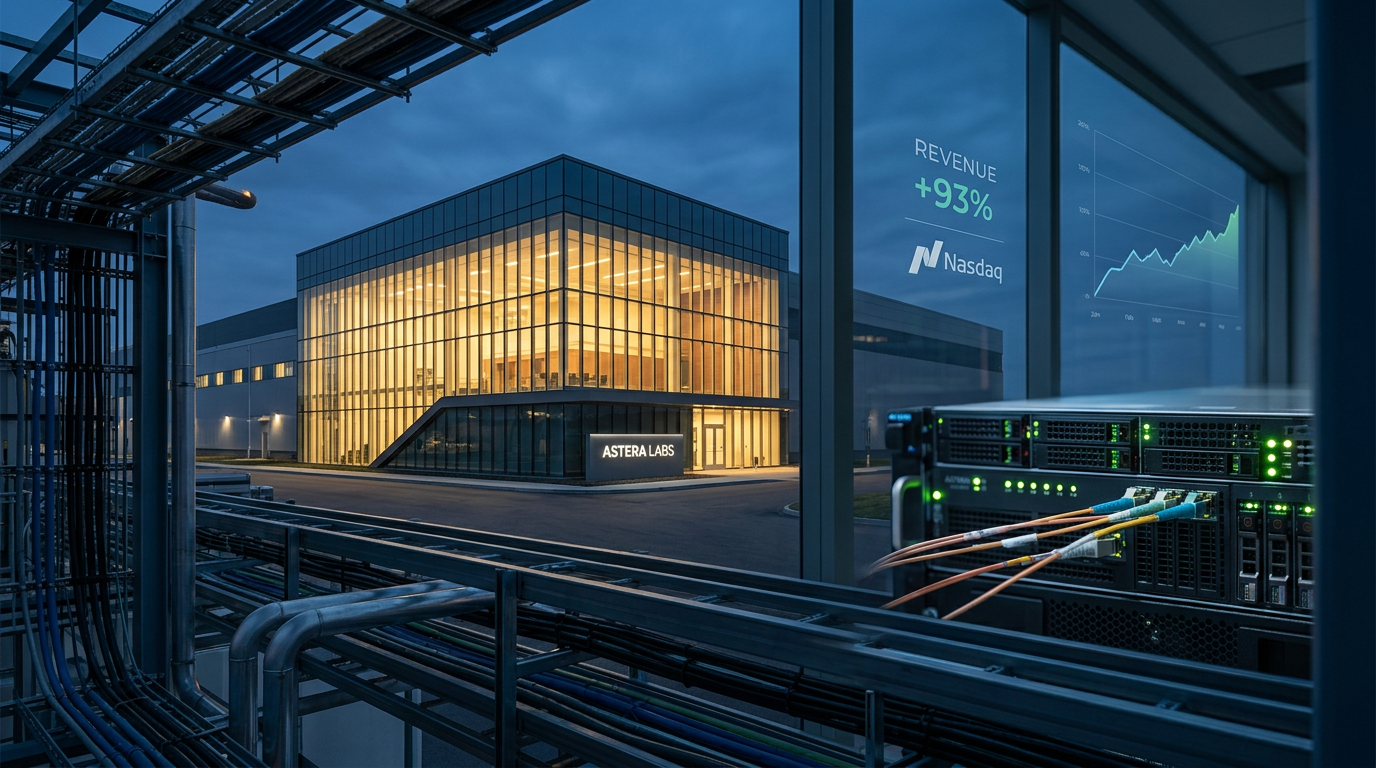
- Q1 2026 EPS of $0.61 crushed estimates of $0.18, a 238.89% beat; revenue surged 93% year-over-year to $308.4 million with 76.4% non-GAAP gross margin.
- Q2 guidance: revenue $355 million to $365 million (up 15% to 18% sequentially).
- Earnings date: August 4, 2026 (based on market calendars).
- Year-to-date performance and valuation multiples vary by data provider and date; verify with your market data source.
Why the Stock Pulled Back
A sharp pullback in early July, triggered by insider selling disclosures, was largely absorbed, highlighting resilient institutional demand. That’s notable. When insider selling triggers a 36% drop and institutional buyers keep showing up, it tells you something about who actually believes in the business.
There’s also the valuation argument. The stock trades at over 200x trailing earnings. That’s not a mistake. It’s how the market prices hypergrowth with compounding AI tailwinds. The question isn’t whether that multiple is high. It obviously is. The question is whether the revenue trajectory justifies it over the next 12 months.
What Is Actually Happening Here
Slight tangent, but it matters. PCIe Gen 6 is becoming the new default standard inside next-generation AI clusters. PCIe Gen 6 products now account for more than one-third of Astera Labs’ total sales. That share is rising. Every new rack being deployed with Nvidia’s Blackwell or the next-gen architectures behind it needs faster data movement between the CPU, GPU, and memory. That’s exactly what ALAB sells.
The company expanded its Scorpio AI fabric switch line, including the Scorpio X-Series 320-lane Smart Fabric Switch and a broader P-Series range targeting AI clusters, with management sizing the opportunity at a merchant scale-up switch silicon market projected to reach $20 billion by 2030, and with an expected production ramp in 2H 2026. Management issued Q2 guidance for revenue between $355 million and $365 million and highlighted growing traction across Aries, Taurus, Scorpio, and newer product families, alongside investments in optical interconnects and custom solutions.
The Risks Worth Naming
Marvell Technology recently introduced its Teralynx T100 switch silicon, while Credo Technology completed its acquisition of DustPhotonics, bolstering its optical interconnect capabilities. Astera Labs’ ability to maintain technological differentiation and pricing power amid intensifying competition will be a key factor shaping its valuation.
Customer concentration is also real. One customer represented 70% of Astera Labs’ 2025 revenue (customer not named in the filing).
Bull / Base / Bear
Bull: Scorpio X-Series ramps faster than expected in H2 2026, hyperscaler design wins broaden beyond a single anchor customer, and the $20 billion addressable market management has cited starts to be priced in. Stock reclaims $400 and pushes toward the all-time high.
Base: Q2 meets guidance, the PCIe Gen 6 ramp continues at a measured pace, and the stock stabilizes in the $300 to $380 range heading into the second half. The August 4 earnings call sets the tone for the next leg.
Bear: Valuation compression continues if rate expectations shift higher. Competition from Marvell or Credo accelerates. Hyperscaler spending cools. The stock breaks below $280 support and struggles to recover before year-end.
Technical Overlay
On corrections up, there will be some resistance from the lines at approximately $374 and $379. A clean break above that range would reset the chart. Below $280, the bull case needs to be reconsidered. The 52-week range includes a $499.48 intraday high and a highest closing price of $483.02 (June 30, 2026) — this is a stock that moves.
What to Watch
- August 4 earnings: Does revenue hit the top of the $355 to $365 million guidance range?
- Scorpio X-Series ramp: Commentary on the Scorpio X-Series ramp, PCIe Gen 6 adoption rates, and any new hyperscaler design wins will be pivotal for the stock’s next leg.
- Gross margin: The non-GAAP gross margin guided for Q2 was approximately 73%. Any upside would be a positive signal.
- Customer diversification: Any new names mentioned beyond the anchor customer would change the risk conversation entirely.
Bottom Line
The business is growing at 93% year-over-year and just got added to the Nasdaq-100. The stock is down roughly 36% from its intraday high amid insider-selling headlines and valuation anxiety. That gap between the operating momentum and the price action is the whole debate. August 4 is when it gets resolved.
For informational purposes only.
 Rising Star Stocks