The conversation about AI’s energy appetite has, until now, centered on how much electricity these facilities consume. That framing missed the more urgent problem. It is not the volume of power that is breaking data centers. It is the violence of how they draw it.
Today’s Gold Alert
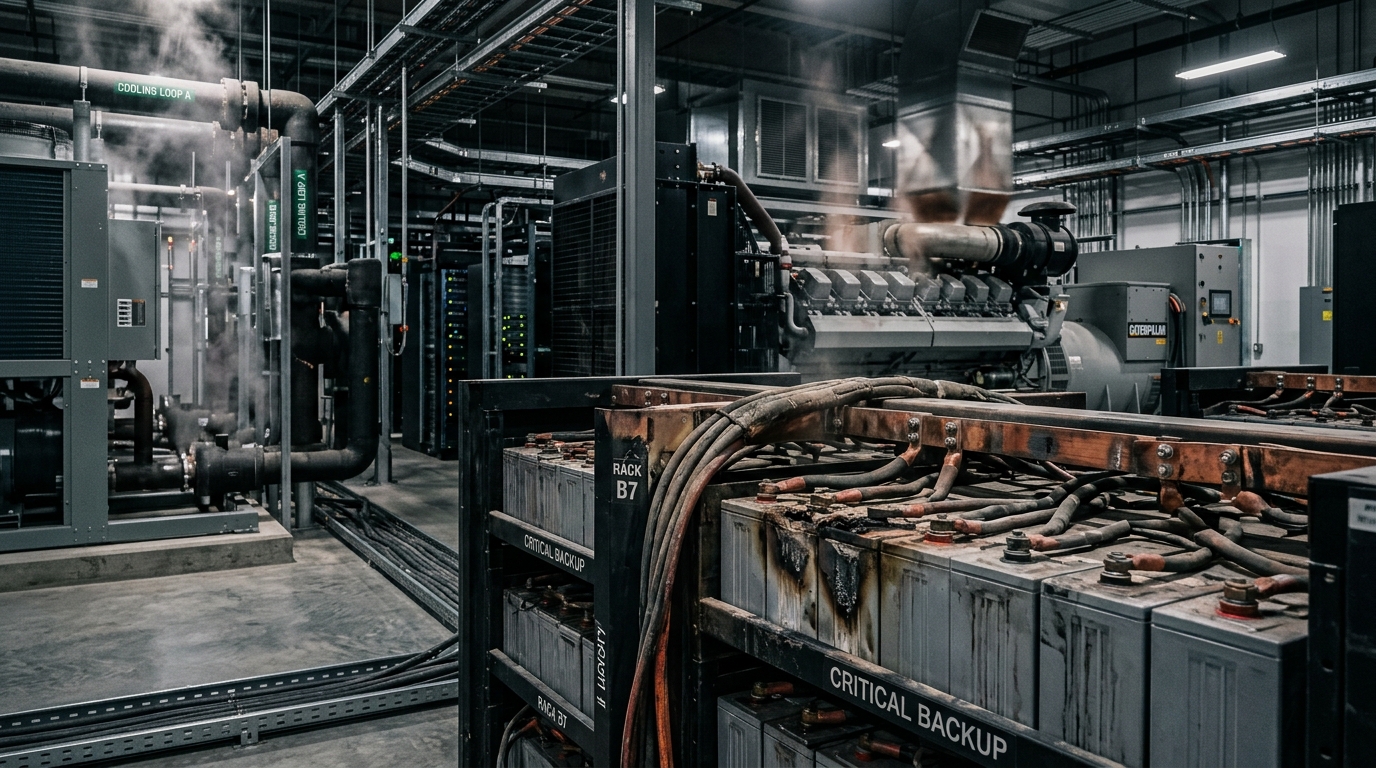
Batteries, generators, cooling units, and other critical systems are being put under such strain at AI computing facilities that they are malfunctioning or prematurely reaching the end of their lives, suggesting unforeseen costs and reliability risks at multibillion-dollar facilities. Bloomberg reported this, drawing on interviews with more than three dozen power experts across the U.S. and Europe. The issue is not a forecast. Equipment is breaking now.
AI at times sees power usage spike as much as 50% above its design capacity, meaning a 1-gigawatt facility may use 1.5 gigawatts for a split second. Most equipment is not designed for such swings. Jon Parrella, chief executive officer of energy-storage developer TerraFlow Energy, likens it to driving a Ferrari and shifting straight from sixth gear to first. “You can’t swing that fast,” he said.
What’s Driving the Market
The root of the problem is that AI computing does not behave like traditional IT. Training cycles can push equipment close to its maximum capacity for hours, followed by sudden drops in power draw, creating rapidly fluctuating load patterns and unprecedented stress on electrical systems designed for stable, predictable operation.
The physics of what happens when load swings hit the wider grid is even more alarming. Schneider Electric power-quality expert Sreemant Roy describes the loads as “extremely dynamic or fluctuating, which causes grid instability and can lead to, if not corrected, potential blackouts or power outages.” Of particular concern is a data center’s ability to cause sub-synchronous oscillations in the power flow, which can damage equipment connected to other parts of the network.
Federal regulators are no longer treating this as a theoretical risk. NERC issued a Level 3 Essential Action Alert, its highest severity level, one that is rarely used. The alert outlines seven actions that registered entities should implement and set a response deadline of August 3, 2026 for affected entities. That deadline passed three days ago.
The documented incidents make clear why NERC moved to its highest tier. NERC’s 2026 State of Reliability report documented a single February 2025 transmission fault in the Eastern Interconnection that caused 1,800 megawatts of data center demand to disconnect simultaneously, an amount roughly equal to the output of two large power plants, lost not gradually but in milliseconds. Four more Eastern Interconnection events followed in the same year: 428 MW in February, 227 MW in March, 540 MW in May, and 1,300 MW in June.
The events exposed planning gaps around customer-initiated large-load reduction behavior, where rapid computational-load disconnection can create the opposite imbalance of a generator trip by suddenly leaving generation in excess of demand. At a larger scale, or with poorly coordinated reconnection, that behavior can impact voltage control, frequency response, contingency analysis, and operator response time.
The scale of the underlying demand surge gives this problem nowhere to hide. U.S. data center electricity demand is rising quickly, and AI racks now commonly require tens of kilowatts each, with leading-edge training clusters reaching roughly 80 to 100 kilowatts per rack, compared to about 5 to 10 kW for traditional racks. NERC’s work on large loads makes the sequencing problem explicit: data centers can be developed faster than the generation and transmission infrastructure needed to support them, resulting in lower system stability.
The Investment Opportunity
Every crisis in infrastructure creates a class of beneficiaries. This one is producing them fast. The central investment question is not which hyperscaler burns the most power. It is which companies are being paid to solve the volatility problem itself.
The most direct play is Heron Power, a private company founded by Drew Baglino, who spent nearly two decades at Tesla leading its powertrain and energy groups. Heron raised $140 million in Series B financing in February 2026, co-led by Andreessen Horowitz’s American Dynamism Fund and Breakthrough Energy Ventures, to build a 40-gigawatt, highly automated U.S. manufacturing facility for its solid-state transformer product, Heron Link. The modular solid-state transformer enables renewable energy, storage, and data center developers to connect to medium voltage lines without a conventional transformer.
Heron’s solution combines medium-voltage AC to low-voltage DC conversion with integrated energy storage to stabilize GPU power ripple at the rack level and respond rapidly to grid needs and facility power transitions. That is precisely the problem that is breaking batteries and generators today.
Baglino said Heron Power didn’t need the money, but after customers expressed interest in buying more than 40 gigawatts of solid-state transformers, the company decided to raise again. “If our customers are leaning in, we need to lean in as well,” he told TechCrunch.
For investors who need publicly traded exposure, Schneider Electric (SU.PA) sits at the center of this trade as a major supplier of power management and data center infrastructure. Analysts at Gartner are projecting that power shortages will restrict 40% of AI data centers by 2027. Every facility that cannot get power from the grid turns to companies like Schneider for on-site solutions. That is a compounding revenue opportunity that does not depend on any single hyperscaler capex cycle.
The broader power-quality ecosystem, including uninterruptible power supply manufacturers, battery energy storage developers, and grid-scale power electronics firms, is being pulled forward by the same force. Data centers are shifting from passive energy consumers to grid stakeholders, co-investing in infrastructure upgrades, enabling load flexibility, and deploying on-site power generation and storage to improve reliability and manage costs. The companies supplying those solutions are no longer niche infrastructure vendors. They are critical path for AI buildout.
Risks to Monitor
The bullish case depends on the damage being real and widespread enough to force spending. There is good reason to think it is. The grid events and sudden load-loss behavior NERC has highlighted are not a warning sign. They are evidence that the system is already operating in a regime it was not designed for.
The bear case centers on timing. Data centers face a critical mismatch: while facilities can be built in under three years, power systems can take 5 to 10 or more years to deploy. Solutions that take a decade to materialize are unlikely to rescue equipment failing today. Heron Power is early, and its factory buildout carries the execution risk that any hardware startup carries.
There is also a regulatory wildcard. NERC’s own framing suggests that a gigawatt of controllable data center load, one that ramps down predictably in response to a grid signal rather than tripping offline without warning, is not a reliability liability but a reliability asset. Whether AI operators, whose training runs can cost millions of dollars per hour, will accept that trade-off in practice remains one of the central negotiations of the next decade of grid planning. If operators resist demand-response obligations, regulators may impose them, adding cost and uncertainty to a sector already straining under infrastructure pressure.
Bottom Line
AI’s power problem has entered a new phase. The conversation shifted from how much electricity these facilities need to how the way they consume it is physically destroying the infrastructure around them. Batteries and generators built for stable industrial loads are failing under GPU-driven power swings that can surge far above steady-state expectations in milliseconds.
NERC’s Level 3 Essential Action Alert, the most serious tool in the regulator’s arsenal, set a response deadline for this week. The documented incidents involve gigawatts vanishing from the Eastern Interconnection in milliseconds, repeatedly, across 2025. The physical damage inside facilities is happening today.
The investment implication is not to short hyperscalers. Their capex commitments are largely locked in. The implication is to look at what they must buy to keep those investments running: power electronics, solid-state transformers, grid-aware energy storage, and power management software. These are not ancillary bets on AI. They are now load-bearing components of the entire AI infrastructure stack.
 Rising Star Stocks