
September 5, 2026
Hybrids Stole August’s Auto Sales.
While EV incentives fell and overall sales fell nearly 7%, Toyota and Honda’s hybrid lineups posted record months.
The August auto sales numbers landed this week and they are not kind. J.D. Power and GlobalData put new-vehicle retail volume at 1,142,700 units, down 6.9% from a year ago. Total sales including fleet fell 4.8% year over year on a selling-day-adjusted basis, with the SAAR settling at 16.4 million units. MarkLines preliminary data from September 2 confirms the same broad picture: U.S. light-vehicle sales off roughly 6% for the month.
The Tech IPO Set to Be 41X Bigger Than the Google, Microsoft, and Amazon IPOs Combined
Nvidia, Google, Amazon are all loading up on shares.
Here’s a secret backdoor in for regular investors. [Free Ticker]
The EV incentive story explains a lot of it. Federal credits are gone, and dealers feel the absence. EV incentive spending per unit dropped 19.9% year over year to $9,228 in August, and EV share of new-vehicle retail sales fell 4.6 percentage points from last year’s level. Contrast that with the hybrid side, where ICE and hybrid incentives rose 26.2% to $3,140 per unit. Hybrids did not just survive the pullback. They absorbed it.
The Brands Actually Moving Metal
Toyota and Honda ran the August numbers that matter. American Honda posted 133,996 vehicles for the month, up 1.0%, and crossed 1 million U.S. sales in just eight months, a month ahead of 2025’s pace. Honda’s hybrid line set a new August record with 36,776 units sold. The CR-V Hybrid alone posted a record August. Accord Hybrid year-to-date volume stands at 61,487 units, up 17.6%.
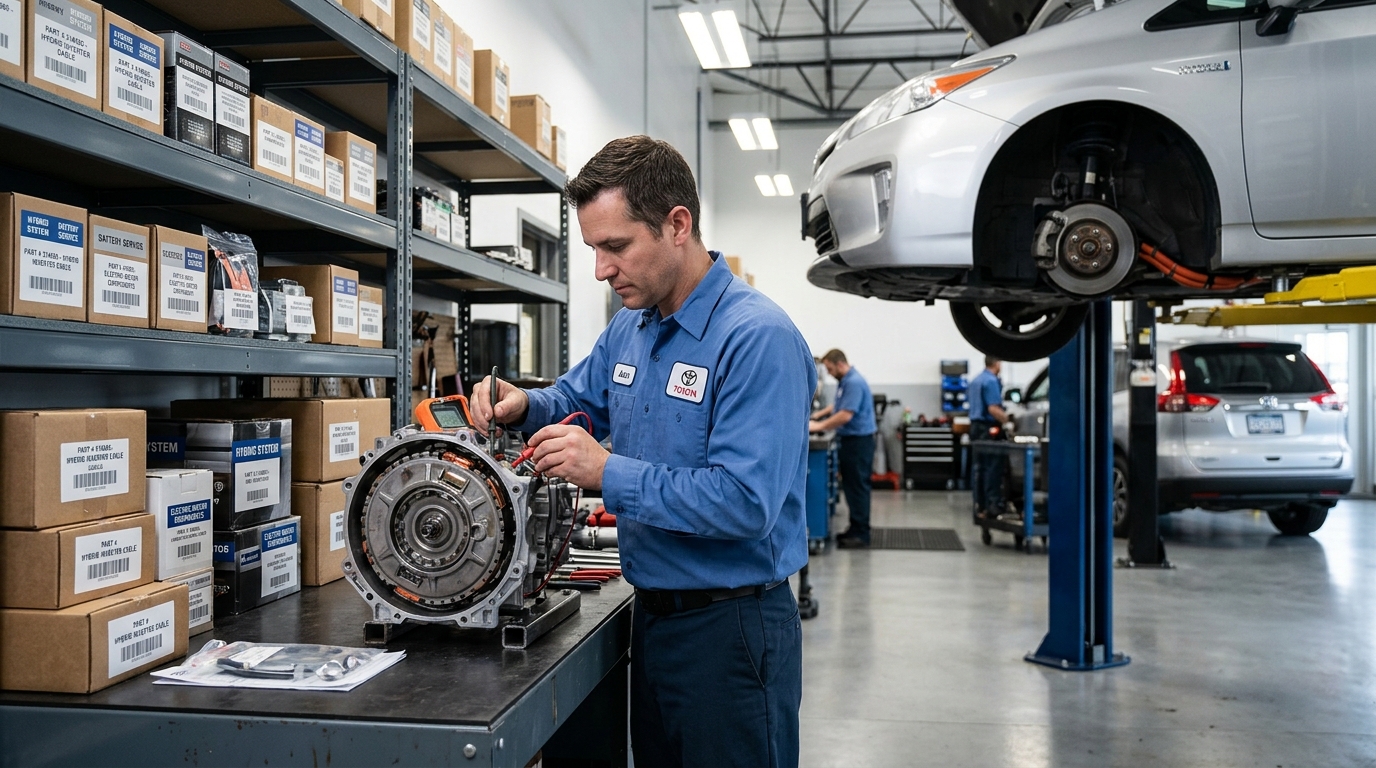
Toyota reported 215,556 U.S. vehicles for August, down 4.4% in volume, but the composition tells a different story. The 2026 RAV4 is now sold exclusively as a hybrid or plug-in hybrid, eliminating the gas-only base model for the first time. The Camry is the same: hybrid-only, and still the best-selling sedan in America. Every RAV4 and Camry that leaves a Toyota lot now carries a dual-motor powertrain, a high-voltage battery pack, and a repair profile that looks nothing like a 2019 Corolla.
Hybrids captured 15.9% of new-vehicle retail sales in July, and the August mix appears to have extended that lead further. In the first half of 2026, Americans bought 9% more hybrids even as overall new-vehicle sales dipped 2.2%, according to Kelley Blue Book data. Half-year hybrid market share hit 15.4%, up nearly 3 points in a single year.
The Stock Worth Watching: DORM
The automakers get the headlines. The parts suppliers get the recurring revenue. Dorman Products (NASDAQ: DORM) is the aftermarket supplier most directly leveraged to the aging hybrid car park that Toyota and Honda have been building for nearly a decade.
These 7 Stocks Will Be Magnificent in the rest of 2026
Every market cycle creates a small group of stocks that end up doing most of the work.
The surprise is never that they succeeded – it’s how early their trajectory was visible.
Our analysts believe the next group of leaders is already taking shape, just outside the spotlight.
In These 7 Stocks Will Be Magnificent in the rest of 2026, we highlight companies with expanding cash flows, growing market share, and the characteristics that often precede long-term leadership.
Dorman’s model is straightforward: it reverse-engineers components that were once available only from OEMs or salvage yards, then sells them through AutoZone, Advance Auto, and the repair-shop channel. The company describes itself as “drivetrain agnostic,” and management has been explicit on earnings calls that hybrid vehicle platforms, with their dual powertrain complexity, represent a broader parts-replacement opportunity than conventional ICE vehicles.
The financials reflect momentum. Q2 2026 net sales came in at $544.6 million, and gross profit expanded sharply to 46.1% of sales from 40.6% a year earlier. Adjusted diluted EPS jumped 50% to $3.08. The company generated $152.6 million of operating cash flow in the quarter and repurchased $47 million of shares. Full-year 2026 adjusted EPS guidance was raised to $8.50 to $8.80.
One signal worth noting: Dorman’s Q4 2025 earnings call highlighted a newly launched fuel pump driver module for Toyota and Lexus models, assembled in the U.S. It is a small data point. It is also exactly the kind of product that becomes a volume line item as early hybrid platforms age into the repair window. The oldest Toyota Prius hybrids are now well past 15 years on U.S. roads. The RAV4 Hybrid launched at scale in 2019. That generation is approaching the years when alternators, inverter components, and thermal management parts start failing.
Strategic Insight
Most investors watching August’s sales data will focus on the OEM read-through: Toyota volumes down, Honda up, EV makers under pressure. The smarter question is what happens 5 to 10 years from now, when millions of hybrid vehicles currently on U.S. roads need their first major repair cycle.
Dorman has been cutting China sourcing aggressively, targeting approximately 30% of total spend in 2026 from below 40% in 2025, which reduces tariff exposure while its OEM-focused peers absorb import costs. That supply chain repositioning could become a structural cost advantage as the trade environment remains unsettled.
Inside the Nuclear Revival Reshaping Energy Markets
Governments worldwide are investing billions to revive a proven energy source. Supply chains are tightening, demand is rising, and select companies stand to benefit. The Nuclear’s Second Act report explains what’s happening next.
Risks
The full-year top-line growth guidance was trimmed from 7-9% to 3-5% in Q2 due to tariff headwinds and volume softness. Dorman’s heavy-duty segment took a goodwill impairment last year. The macro backdrop for consumer repair spending is not without risk: average new-vehicle transaction prices have been hovering near $50,000, which could push more buyers to defer repairs. Tariff exposure on remaining Chinese-sourced parts has not fully resolved.
The Heavy Duty segment remains a wildcard, and the hybrid aftermarket thesis takes time to develop. Dorman is betting on a repair wave that is still 3 to 5 years from full volume. Investors need patience for that to play out.
Big Picture
August made something clear that has been building all year: the U.S. auto market is not going EV-only on any near-term schedule. It is going hybrid, and Toyota and Honda are leading that shift with structural product decisions rather than incentive-driven promotions. Every RAV4 Hybrid and CR-V Hybrid sold in 2026 is a future repair event that Dorman is engineering parts to capture.
The OEMs get the next few years of new-car revenue. The aftermarket gets the decade that follows. Dorman Products may be worth a closer look as that decade begins to take shape.
 Rising Star Stocks