
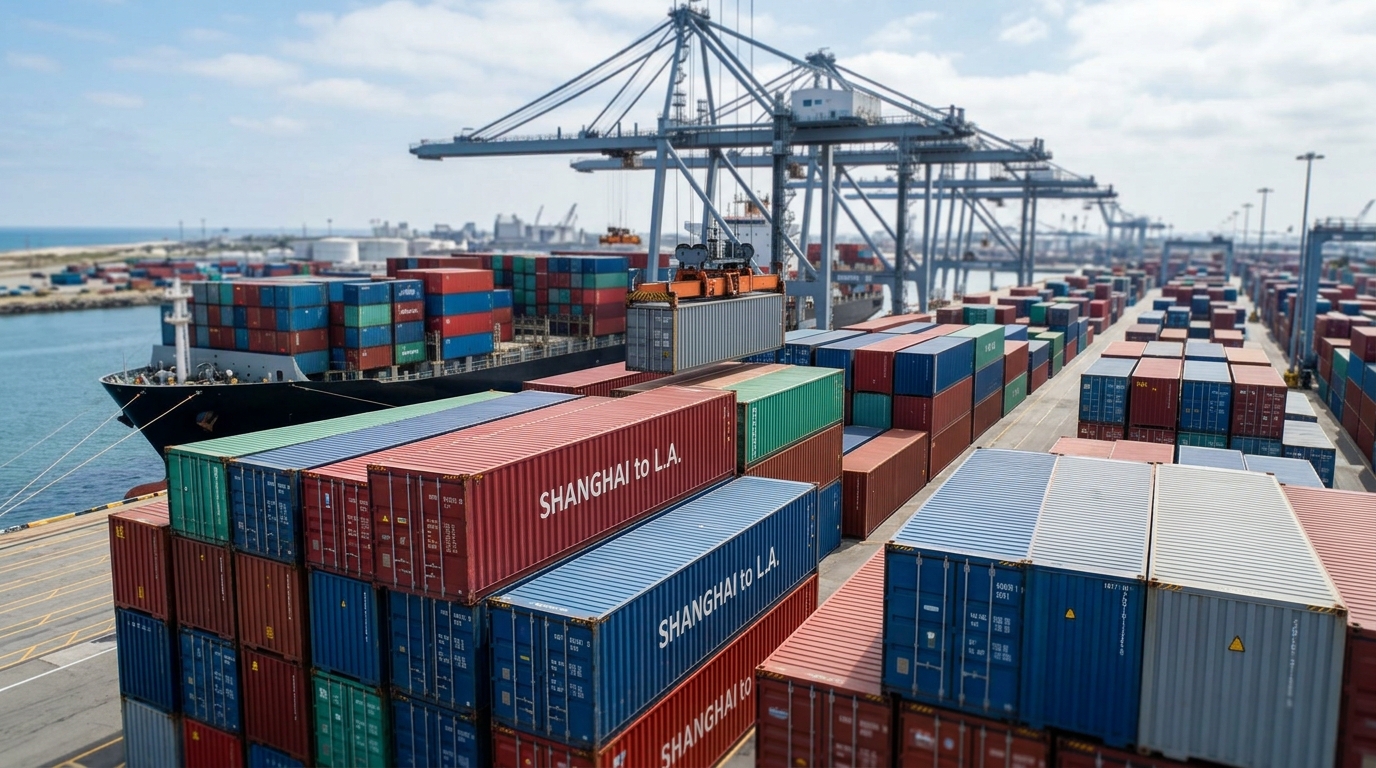
The container market is resetting again this week, and the bill lands on retailers first. Drewry’s World Container Index puts Shanghai to Los Angeles at $7,185 per 40ft container as of September 3, up roughly 12% over the past month, with the September 10 reading rising a further 2% to $7,352. That move alone is worth watching. The transpacific lane is now running at more than twice its early-2026 lows, and the mechanism keeping it there is deliberate.
Carriers have pulled capacity through blank sailings to hold the floor. Blank sailings are scheduled to rise into late September as carriers trim around China’s National Day holiday, but widely cited forwarder data in late August put transpacific blanked capacity in the low single digits through most of September, rising toward about 6% in the week of September 28. This is not a pure demand story. It is also a supply management story, and the calendar matters.
What Is Driving the Spike
Typhoon activity across Asia has caused significant port congestion, vessel bunching, and schedule disruptions. Typhoon Dolphin in particular contributed to a sharp increase in vessel backlogs and effective capacity loss out of China’s major ports. Weather disruption on top of intentional blanking means effective capacity is tighter than the headline sailing schedule alone suggests.
U.S. East Coast rates remain firmer than West Coast as Panama Canal measures tied to reduced precipitation continue to constrain effective capacity. Shippers should prepare for increased late-September demand ahead of China’s National Day holiday and secure space early. Importers landing holiday merchandise, apparel, and electronics are doing exactly that, compressing the booking window further.
Stocks in Focus
Matson (MATX) is the most direct expression of this rate environment in U.S.-listed shipping. Matson reported Q2 2026 net income of $129.4 million and revenue of $969.4 million, up 36.6% and 16.7% year over year, with diluted EPS rising to $4.27 from $2.92. Management expects third-quarter 2026 Ocean Transportation operating income to be approximately 45% higher than the prior-year quarter. That guidance was set before the most recent rate leg up. If $7,300-plus holds through September, Q3 could surprise further.
Matson’s CLX and MAX services saw higher-than-expected freight rates and demand against a backdrop of tighter supply conditions, and the company expects its China service to be at or near capacity through peak season. At or near capacity is the configuration where incremental rate increases drop almost entirely to operating income.
For Walmart (WMT) and Target (TGT), the direction is inverted. U.S. retailers are accelerating imports of holiday merchandise to avoid higher costs, and the early surge in shipments is driving ocean freight rates to their highest levels in several months. Both have large private-fleet and contract-rate programs that provide some insulation from spot moves, but spot rates set the ceiling for any re-procurement happening now for Q4 fill-in cargo.
Sector and Risk Watch
Transpacific capacity is being managed tightly enough to support rates, while Asia-Europe is seeing softer demand and more capacity returning to the trade. That divergence matters. Maersk and Hapag-Lloyd, which operate the Gemini Cooperation across both lanes, face a split dynamic: strong earnings on the Pacific, margin pressure eastbound to Europe.
The principal risk to the rate level is demand destruction. Spot rates continue to hold at elevated levels as carriers manage available capacity and operational disruptions create additional pressure across major trade lanes, but if importers have already front-loaded enough inventory, September bookings could soften faster than blanked capacity can adjust. Watch weekly blank-sailing levels. If cancellations rise into late September and hold into October, carriers are still defending the floor. If they drop sharply, rates follow.
The Cheat Sheet
- Top Theme: Carriers are engineering the transpacific rate floor through blanked sailings, not waiting for demand to do the work.
- Stock to Watch: MATX. Capacity full, rates rising, Q3 guidance set before the latest leg up.
- Sector to Watch: Container shipping. The Transpacific lane is running hot while Asia-Europe softens.
- Biggest Risk: Import pull-forward exhaustion. If retailers have already landed enough holiday goods, demand fades before blanked capacity unwinds.
- One Thing to Remember: $7,352 per box on the latest September 10 Drewry reading means the rate is still moving. Carriers have the tools to keep it there, and right now, they are using them.
 Rising Star Stocks