Hi,
Take a look at this…

It’s smaller than a fingertip…
It’s made of glass…
And it’s about to unlock the next wave of AI growth.
Jensen Huang, Nvidia’s CEO, says this “light-speed” device is shattering the limitations of AI… and without it, AI can’t scale.
Google Ventures says it’s the future of AI compute…
And Sequoia Capital – the firm that backed Anthropic and OpenAI – calls it a “holy grail.”
Already, Elon Musk, Mark Zuckerberg, Cathie Wood, and Bill Gates are moving money to prepare for what’s coming…
Yet most Americans have never heard of it.
Wall Street insider Jason Bodner – the same man who called Nvidia at $4.50 – says this device is about to launch a whole new wave of AI winners…
And to prove it, he’s giving away his #1 stock involved with it – for free.
Click here to learn more. (No purchase necessary.)
We have so much to look forward to,
Jeff Brown
Founder & CEO, Brownstone Research
P.S. Stocks tied to this “light-speed” device already surged 133%, 217%, and even 320% – in a few short months. But it’s just getting started. Click here before the mainstream catches on.
JinkoSolar Could Win China’s Solar Purge
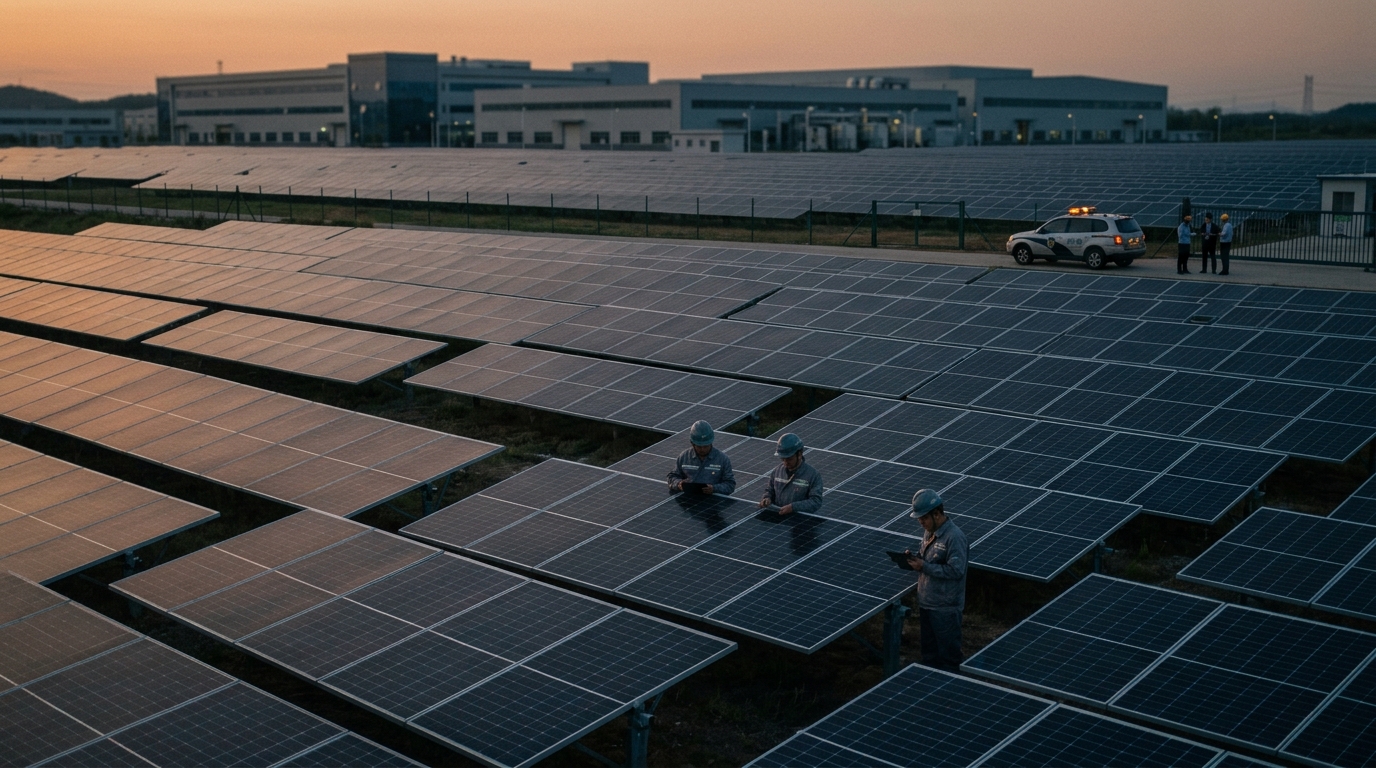
China’s market regulator said on September 21 that it intends to steer companies away from aggressive price cuts and toward quality and efficiency over the coming years, tightening price supervision, antitrust enforcement, and platform rules. For two years, the solar industry has been the poster child for what Beijing calls “involution” , the kind of self-defeating below-cost competition that destroys margins across an entire sector. Now the crackdown has teeth, and that changes the calculus for who survives.
How Deep the Damage Has Been
The numbers are brutal. Combined losses for 22 major solar supply chain companies reached roughly CNY 10.5 billion in the first quarter of 2026 alone, with revenue falling about 11.6% year-over-year. JinkoSolar itself posted a gross margin of just 8.3% in Q1 2026, recovering from a gross loss margin of 2.5% in Q1 2025, improvement, but still far from healthy. N-type polysilicon prices fell from roughly RMB 48 to 55 per kilogram at the end of 2025 to about RMB 35 to 37 per kilogram by the end of the first quarter, dragging the entire upstream chain with them.
Overcapacity is the root cause. Utilization rates have been extremely low across the industry, with some estimates putting the industry-wide average below 50% during the period. Capacity itself stopped being an advantage when every competitor had too much of it.
The Regulatory Machinery Now Moving
The anti-involution campaign has moved from rhetoric to binding infrastructure. By July 2026, SAMR had described a “1+1+N” framework covering a Price Law amendment, revised low-price dumping provisions, and sector-level cost standards. The China Photovoltaic Industry Association issued an industry-wide cost accounting model; eight major polysilicon producers signed a price-discipline initiative committing to avoid below-full-cost sales in early August 2026. Regulators followed with a solar industry price-compliance meeting in late July, instructing manufacturers to strengthen cost accounting and establish internal pricing-review systems.
The harder enforcement layer arrives in January 2027: new mandatory national standards on energy consumption and product efficiency across parts of the solar PV value chain take effect on January 1, 2027, and management teams have argued they will accelerate the phase-out of outdated capacity and shift competition from price wars to technological value.
Why JinkoSolar Is Positioned to Come Out Ahead
JinkoSolar is one of a small handful of producers already operating at the efficiency levels it expects the tightening standards environment to reward. Its Tiger Neo 5.0 modules have been presented as reaching 25.91% module efficiency with output topping 700 watts, and the company has announced a record of 26.66% for an industrial-scale TOPCon cell. It expects to have more than 40 gigawatts of TOPCon 3.0 production capacity by the end of 2026, positioned to target Level 1 energy efficiency under the new national standards. Its Tiger Neo 3.0 line has been described by management as commanding roughly a $0.10 per watt premium over conventional panels.
Management has also made a notable strategic pivot. JinkoSolar cut its full-year 2026 module shipment guidance from a prior range of 75 to 85 gigawatts down to 60 to 70 gigawatts. The message was explicit: the company is prioritizing profitability, cash flow, and order quality over volume. More than 60% of full-year shipments are expected to come from high-efficiency products. Overseas markets accounted for roughly 70% of first-half 2026 volume, which provides a degree of insulation from the domestic price collapse.
The Risks Are Real
The campaign has stumbled before. SAMR pushed back on a producer coordination attempt in early January 2026 as anti-competitive, undercutting the campaign from within. Even the mandatory capacity cuts projected under mid-2026 measures are only projections, not proven outcomes. In Q2 2026, JinkoSolar reported a GAAP loss per ADS of $1.94, and module shipments fell 34.4% year-over-year. Cash is still draining.
Trade barriers compound the picture. The U.S. opened new anti-circumvention inquiries in 2026 tied to solar cells and modules completed in third countries using parts and components manufactured in China, and broader tariff walls continue to narrow JinkoSolar’s accessible markets.
The Bottom Line
The bull case on JKS is not that the pain is over. It is that the regulatory clock is now running against the weakest competitors in a way it simply was not twelve months ago. When the 2027 standards take effect, and when price-discipline initiatives backed by enforcement finally hold, the manufacturers still standing with high-efficiency scale will capture a larger share of a reset market. JinkoSolar has the technology, the global footprint, and the explicit strategic intent to be one of them. That makes it worth watching closely as this multi-year purge enters its enforcement phase.
 Rising Star Stocks