
Dear Reader,
Elon Musk can build rockets. Satellites. Factories the size of cities.
But he cannot build minerals he does not control.
I’m Dr. Mark Skousen. My career began inside CIA headquarters, spotting patterns before they became obvious. I warned about Black Monday weeks in advance and called the March 2009 market bottom.
And on January 1, 2027, a U.S. defense restriction expands across the full supply chain for certain covered magnets and strategic materials originating in China and other covered countries.
That is not a headline. It is a countdown.
|
Because every launch system, satellite network, military contract and AI buildout ultimately comes back to physical inputs. No minerals… no machines. No machines… no empire.
One small public company is pursuing a direct line to a vast new source of critical minerals – far from the traditional chokepoints that have trapped Western industry for decades.
The company is pursuing rights to recover mineral-rich nodules from the seafloor. Think of them as loose, golf-ball-sized deposits containing metals the 21st-century economy consumes by the ton.
This could give Musk something money alone cannot guarantee: a strategic supply line beyond China’s grip.
And if he chooses to buy rather than wait? The crowd will not receive a polite warning. The ticker could be repriced before most investors finish reading the press release.
My analysis has flagged this mineral play plus two other public companies positioned at the exact pressure points Musk still needs to control: compute and satellite communications.
|
A hard deadline is colliding with a strategic bottleneck. Waiting is now a decision of its own.
Yours for peace, prosperity, and liberty, AEIOU,
Dr. Mark Skousen
Macroeconomic Strategist, The Oxford Club
P.S. The January 1, 2027, rule is already on the books. Once the countdown hits zero, the market will not care that you meant to look at this later. This obscure mineral play could become essential to Musk’s empire. Learn more details before the deadline – click here now.
Nike Makes 52% of Its Shoes in Vietnam. That 9.95% Number Matters.
Saturday’s headline out of Hanoi was hard to ignore. Vietnam’s GDP grew 9.95% in the third quarter from a year earlier, the fastest pace since Q3 2022, accelerating from 8.81% in Q2 and 8.15% in Q1. Nine-month growth now sits at 9.01%, and the government’s full-year target of double-digit expansion is still within reach. The number beat the Bloomberg median forecast of 8.65% by a wide margin.
Most investors read that and reach for a country ETF. That is the wrong move. The smarter question is: which listed company is already doing the bulk of its manufacturing inside Vietnam’s growth engine?
What Vietnam’s Growth Actually Looks Like
The surge is industrial, not speculative. Industry and construction expanded 12.50% in Q3 and contributed more than half of all value added. Fixed investment jumped 21.39% year on year. Exports of goods and services rose 23.27%. Total merchandise trade for the first nine months hit $888.02 billion, up 30.4%. This is an economy running on factory output and foreign investment, not a consumption pop.
The ADB had raised its full-year Vietnam GDP forecast to 7.8% back in September. The actual nine-month figure already blew past that. To hit the government’s 10%-plus target, Q4 growth needs to exceed roughly 12%. That is a high bar, but the direction of travel is unambiguous.
Nike: The Practical Route In
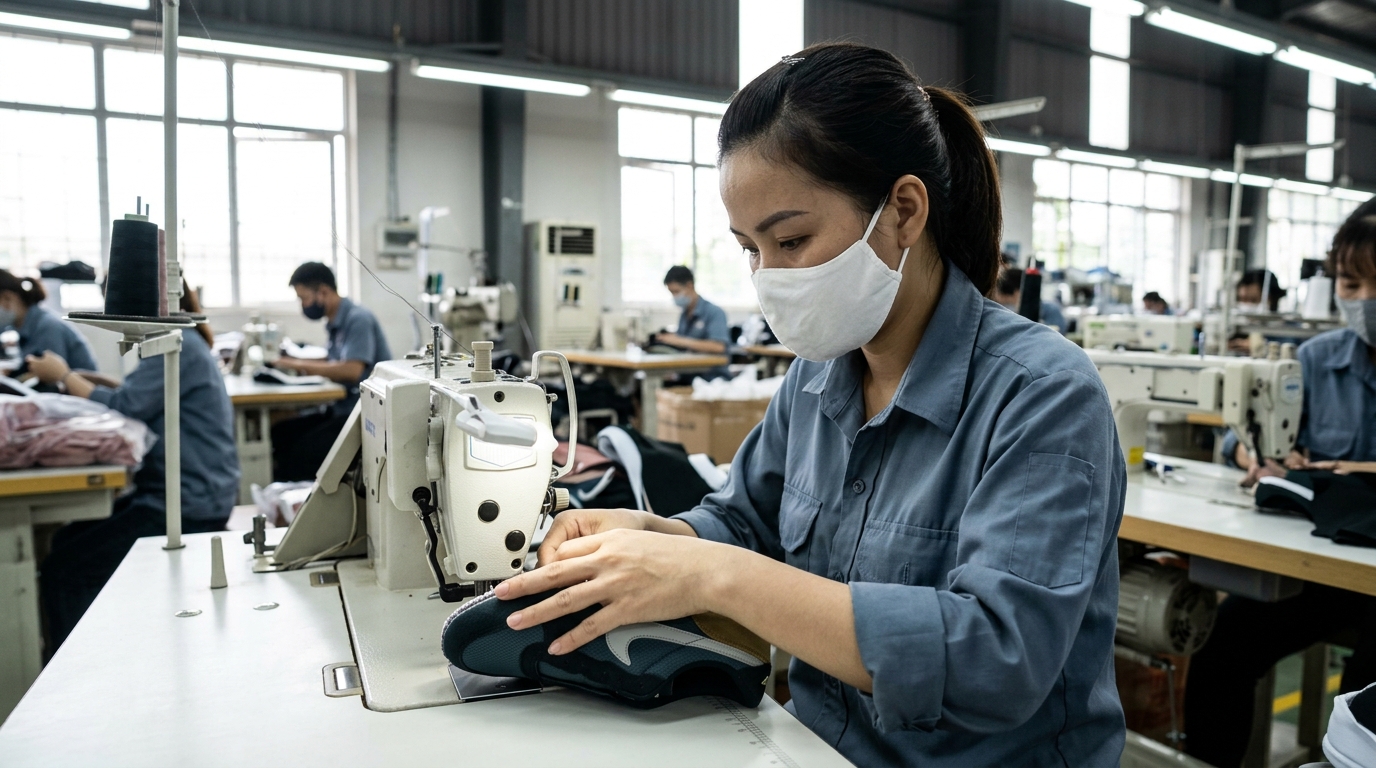
Nike (NKE) is not marketed as a Vietnam story. It is marketed as a sneaker brand. But the manufacturing reality is striking. According to Nike’s fiscal 2026 10-K filing with the SEC, Vietnamese factories produced approximately 52% of all NIKE Brand footwear in fiscal year 2026. Vietnam also accounted for approximately 34% of NIKE Brand apparel, up from 31% in fiscal 2025 and higher than fiscal 2024. The filing does not disclose a count of Nike’s finished-goods manufacturing facilities within Vietnam or a Vietnam-specific worker total.
Put plainly: when Vietnam’s industrial sector runs hot, the cost and capacity conditions for Nike’s largest production base improve. That is a direct operating link, not a thematic one.
The Stock’s Own Problems Create the Angle
Nike’s revenue was $46.4 billion in fiscal 2026, essentially flat year on year. Its most recent quarterly results, covering the three months ended August 31, showed revenue of $11.2 billion, down 4% on a reported basis. The company launched a multiyear productivity program targeting $2.5 billion in cumulative savings through fiscal 2031, and management guided for high-single-digit revenue declines in fiscal 2027.
The stock reflects all of that. NKE closed Friday at $33.87, down roughly 53% from a year ago and near a multi-year low. The 52-week range runs from $31.97 to $76.97. At current prices, the stock trades at about 16 times trailing earnings and carries a dividend yield around 4.7%.
The bear case is well understood. The contrarian case rests on a simpler observation: Vietnam’s industrial capacity, the backbone of Nike’s supply chain, is accelerating at the fastest pace in four years, gross margin in the August quarter recovered 60 basis points to 42.8%, and the average analyst price target sits at $40.52, roughly 20% above where the stock closed.
Risks Worth Weighing
Vietnam’s trade deficit widened to $19.42 billion through September as imports surged faster than exports. Hitting the full-year 10% target requires a Q4 sprint. China revenue remains a serious drag for Nike regardless of what happens in Hanoi. The restructuring is real, and execution risk comes with it.
The Bigger Picture
Supply chain diversification away from China was a trade thesis discussed for years before it actually moved the numbers. Vietnam’s Q3 figure is evidence it did. Nike made that bet early and made it large. Whether the brand’s consumer-side recovery catches up to its manufacturing advantage is the outstanding question. The manufacturing advantage itself is no longer in doubt.
This one may be worth keeping on the radar as Q4 data rolls in.
 Rising Star Stocks