
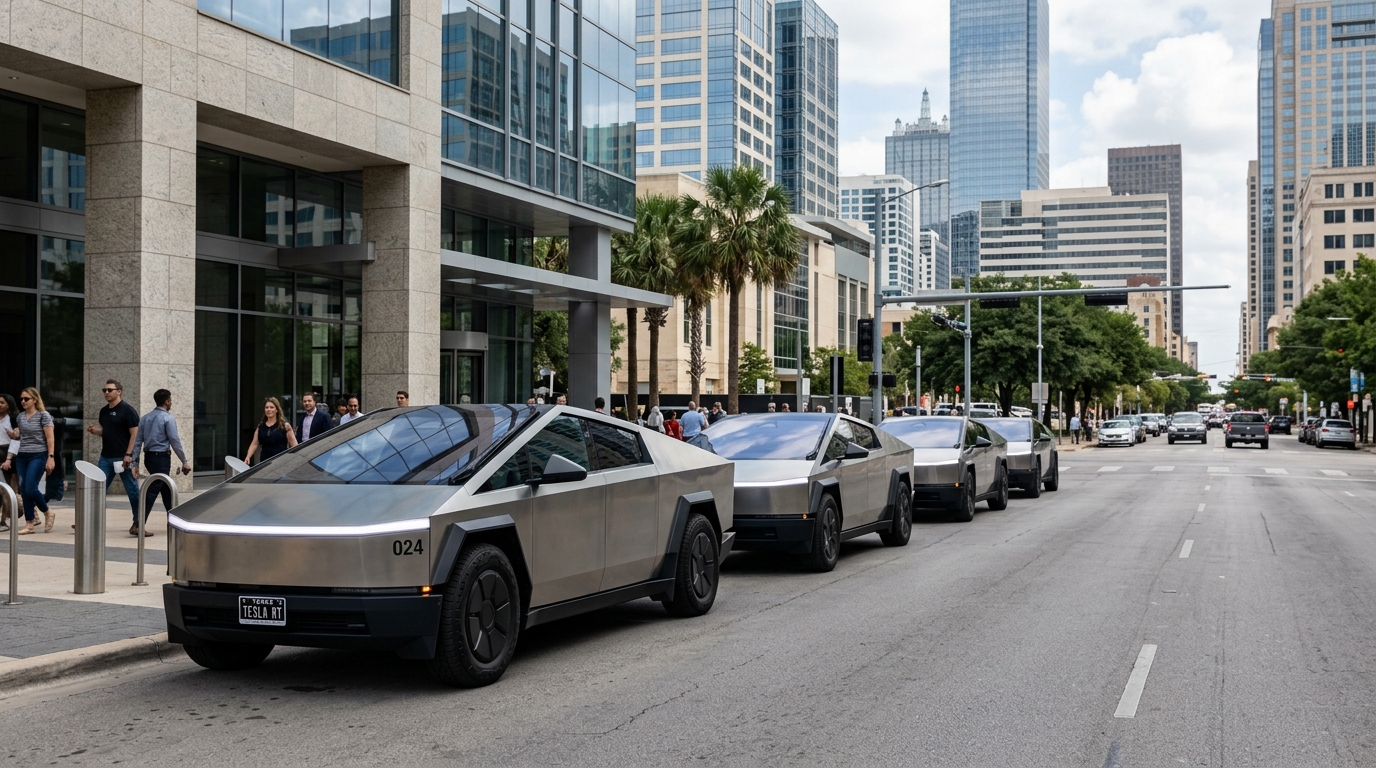
A month ago, Tesla’s Cybercab fleet in Austin was roughly 38 vehicles. As of October 10, Tesla’s official Robotaxi account said it has scaled to 300-plus Cybercabs serving Austin, an eightfold increase in a single month. The same day, Tesla AI chief Ashok Elluswamy said the cabs are “everywhere in Austin now” and pointed to Dallas as the next city. No specific launch date for Dallas has been set, but Texas registration data circulating publicly indicated 319 Cybercabs registered statewide by October 9.
That is the domestic side. On the international side, the Cybercab opens its first European showing tomorrow at the Paris Motor Show, running October 12 through 18 at Paris Expo Porte de Versailles. It is unclear from public documentation whether the Cybercab heading to Paris comes directly from Tesla’s operational Austin fleet. Attendees cannot ride in it, but European consumers and policymakers will get a close look at a two-seat robotaxi with no steering wheel and no pedals.
The catalyst stack behind TSLA right now is unusually dense. Q3 deliveries of 486,532 vehicles beat the company-compiled consensus by about 24,600 units, sending shares up about 5% on October 2. The October 21 earnings report arrives next. Paris builds European visibility this week. Dallas represents a second commercial fleet deployment that could come soon, but Tesla has not provided a timeline. Any one of those events would move most stocks on its own.
Why Wall Street Is Paying Attention
Tesla increasingly asks investors to value it on businesses beyond EV sales, particularly autonomy, robotaxis, and AI. The Cybercab was unveiled about two years ago, in October 2024, with Tesla discussing a roughly two-year window for reaching volume deployment. The market has noticed, but the specific TSLA price moves attributed to the Paris appearance vary by the dates you measure.
For context on scale: Waymo has been described as having about 1,500 vehicles in operation, though published estimates of its total fleet are not consistently updated and can differ by source. Tesla’s Austin fleet of 300-plus is smaller but is growing at a pace no competitor is matching on a percentage basis. Tesla’s bet is that a purpose-built, lower-cost vehicle combined with a camera-only autonomy stack will scale faster per dollar than lidar-equipped rivals.
What’s Driving the Opportunity
The thesis rests on three legs. First, domestic scaling is happening faster than most analysts modeled. Second, the Paris show gives Tesla access to European consumers, industry executives, and regulators simultaneously, with a possible European service launch as early as 2027. Third, the October 21 earnings call will be the first where management must address Cybercab economics in Q3 results and forward commentary, including trip volume, utilization, and unit margins.
European regulatory progress is real but slower. Reports about an October 6 vote by an EU technical committee on any EU-wide step involving FSD Supervised have been inconsistent, and the outcome is not clearly documented in public. A positive outcome would not clear the path for unsupervised Cybercab service, but it would validate the autonomy stack for the continent’s regulators. A fully driverless vehicle sits in a higher approval class, and approvals are likely to remain country-by-country.
What Could Go Wrong
The NHTSA risk is not theoretical. In September, federal regulators opened an investigation into Tesla’s self-certification that the Cybercab complies with applicable federal motor vehicle safety standards. Tesla received a 30-day extension that puts its response deadline at October 30. A forced operational pause would reset the momentum story immediately.
The fleet count itself carries ambiguity. Tesla’s 300-plus figure is a fleet figure and does not, by itself, disclose rides delivered or utilization rates. Trip volume, wait times, and revenue per vehicle have not been disclosed. Without those numbers, it is genuinely difficult to judge whether the Austin rollout is producing a functioning service business or mainly a larger deployment count. The earnings call on October 21 is when that gap either closes or widens.
Valuation remains stretched. TSLA is trading well above any straightforward EV multiple, meaning the stock already prices in considerable robotaxi success. Disappointing margins or any regulatory setback hitting during the Paris week could compress that premium quickly.
The Bottom Line
The Cybercab’s eightfold fleet expansion in 30 days, combined with Dallas pending and a European debut that begins October 12 in Paris, creates a concentration of near-term catalysts that few stocks can match this week. The October 21 earnings call will either validate the scaling story with harder utilization data, or expose a gap between vehicles in the fleet and actual revenue. Investors willing to accept regulatory risk and a premium valuation own a stock where the news flow is accelerating in the right direction. Those who need to see unit economics before committing have a clear date to wait for.
 Rising Star Stocks