Here is the question that actually moved AMD’s stock Thursday: not whether the company broke the law, but whether Washington decides to look harder.
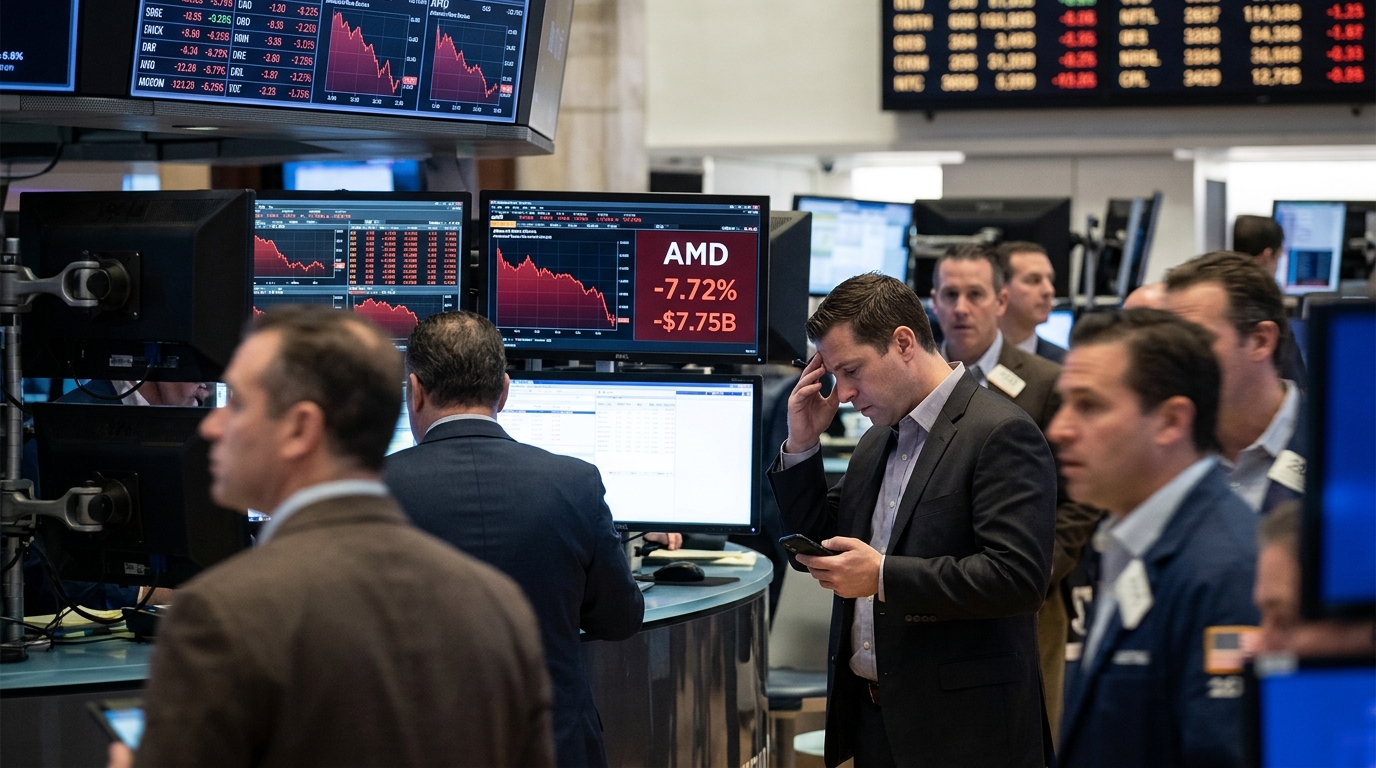
Shares of AMD closed down 7.72% to $489.19 on Thursday, November 19, 2026 after Hunterbrook Media issued a report alleging the company “has its own China problem.” That was more than twice Nvidia’s 3.3% decline on the same day. The gap tells you something: the market read this as AMD-specific trouble, not broad sector noise.
The core allegation is specific. Hunterbrook alleged that IEIT Systems, a Chinese server maker the U.S. blacklisted in March 2025, has incorporated newer versions of AMD firmware into its products, most recently in an Oct. 19, 2026 software update. The report describes the code as part of the firmware that enables servers to run AMD’s processors. Then it widens. Hunterbrook says Maginfra in China, Kaytus in Singapore, and Aivres in California post firmware files that are 99.94% identical to IEIT’s. IEIT’s 2022 annual report listed Aivres, formerly Inspur Systems, as a subsidiary, and Kaytus’s audited accounts name IEIT as its ultimate parent.
The honest summary of what that proves: not much, legally. Hunterbrook acknowledged it does not know how IEIT obtained the code or whether any license covered it, and said its findings do not on their own establish an export violation. Firmware is freely downloadable from many chip vendors’ websites. The question of how the code traveled, and whether anyone at AMD directed it toward a blacklisted entity, remains unanswered. License records the House Foreign Affairs Committee released on November 19, 2026 cover AI chip license applications, not IEIT’s firmware.
What the report does establish is a revenue exposure that is harder to dismiss. According to AMD’s fiscal 2025 financial filings, the company reported $7.751 billion of revenue from China (including Hong Kong) out of total revenue of $34.6 billion, or about 22% of annual revenue. That is not a rounding error. And the regulatory backdrop is already tightening around it. Most AMD processors face few export restrictions today, but AMD’s growth story rests on the chips that face tighter restrictions. The company has told investors it expects data center to be more than 80% of total revenue in 2027 and to drive the majority of revenue and earnings growth.
The licensing situation for AMD’s most important chips in China is already unstable. AMD previously took an approximately $800 million inventory and related charge tied to new U.S. export restrictions on its Instinct MI308 products. The company has also said fourth-quarter MI308 revenue to China was approximately $390 million.
AMD’s response was brief. The company said the “claims misrepresent AMD’s business practices and relationships.” That may be entirely accurate. But on the company’s November 3, 2026 earnings materials and filings, AMD did not directly address the Hunterbrook allegations, leaving investors with Hunterbrook’s framing and no competing explanation from the company itself.
Hunterbrook also pointed to an October 2, 2026 Bureau of Industry and Security enforcement settlement that treated automatic software updates to an Entity List party as separate exports and separate violations. That precedent is what transforms a firmware footnote into a potential compliance event.
The bull case here is straightforward: AMD has said it complies with U.S. law, Hunterbrook admits it cannot prove otherwise, and much of the $7.751 billion in China (including Hong Kong) revenue comes from chips that face minimal restrictions. The bear case is not that AMD is guilty of anything specific. It is that the company’s AI growth ambitions run directly through a geography where the rules keep changing, the regulators are watching, and a short seller just handed Congress a roadmap.
Watch for three things: whether AMD issues a more detailed public response to the firmware allegations before the weekend, whether any committee or agency requests documents, and what the company says about China on its next earnings call. Silence helped the selloff on November 19. More silence will not calm it.
 Rising Star Stocks