Dear Friend,
I’m giving you a free stock pick before December 8th.
Because getting the name after a stock takes off isn’t the same as owning it before.
Dylan believes December 8th could be the turning point for this one.
It’s not Tesla.
It’s not SpaceX.
It’s the company Elon’s been paying since 2012.
He doesn’t own its chip technology. He licenses it.
Now he’s filed plans for a million satellites.
Every chip built on this company’s designs carries a royalty back to it.
Dylan believes Elon’s bill could get 100X bigger.
You don’t need an invitation to the SpaceX IPO to own this stock.
Just the ticker. And a brokerage account.
I’m handing you the first one free.
Waiting could be the expensive part.
Get your free stock pick before December 8th here >>
The Buck Stops Here,
Kelly Maguire
Behind the Markets
P.S. December 8th is the date Dylan’s watching for a potential move. Get the name, see his case, and decide whether you want to own it beforehand.
Moratoriums Have Frozen $198 Billion in Data Centers. Who Wins?
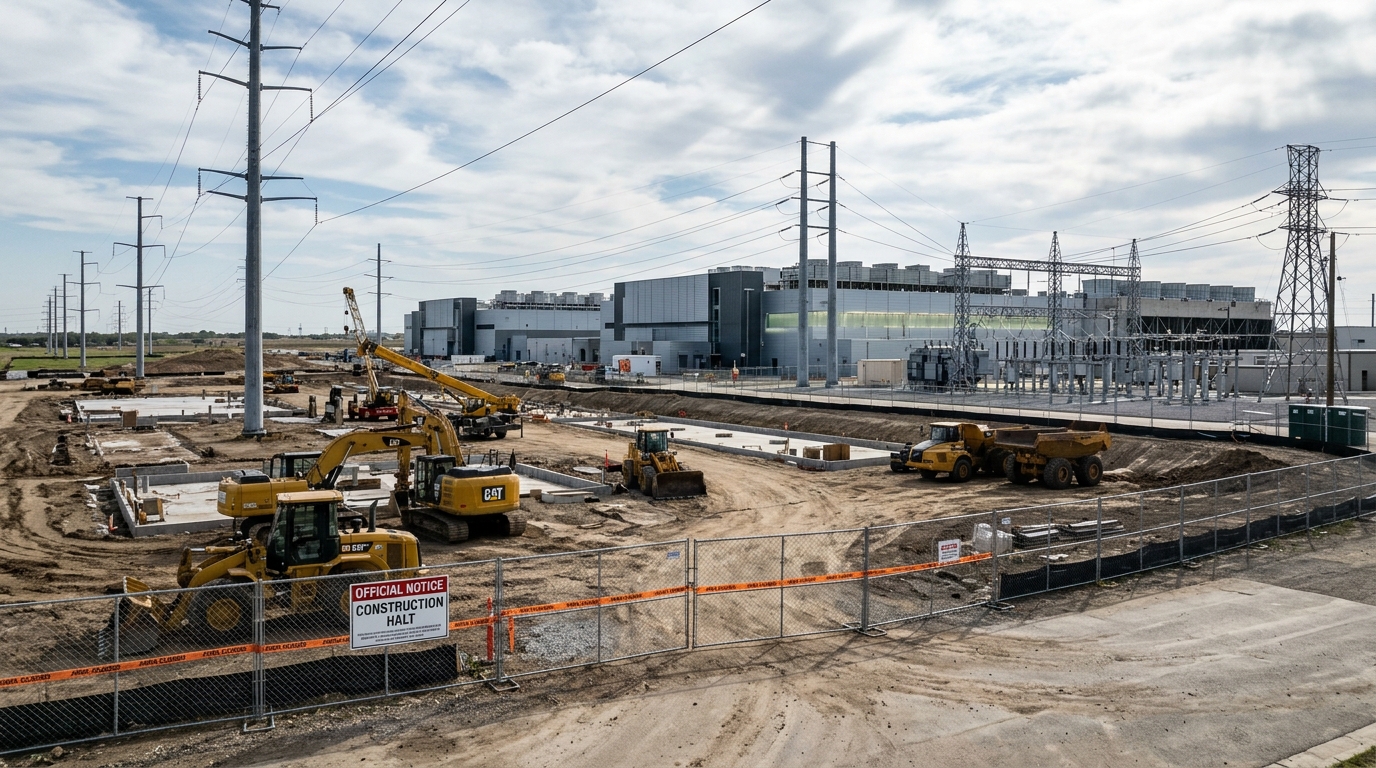
Last Monday, Aurora’s city council voted unanimously to pause new data centers across much of Colorado’s third-largest city, with the moratorium running through September 2027 and exempting projects with already accepted applications. Two days later, Wayne County ordered construction to stop on Google’s “Project Cannoli” in Van Buren Township after the developer, Panattoni, broke ground without a required county permit. Two events, two jurisdictions, one unmistakable pattern.
The constraint on AI infrastructure is no longer chips or capital. It’s the county line.
How Big the Blocked Pile Has Gotten
Recent reporting has pointed to Data Center Watch research showing that local opposition has blocked or delayed at least 120 data-center projects valued at $198 billion in the first half of 2026. That figure compounds a trend that was already severe: Data Center Watch counted at least 75 projects worth about $130 billion blocked or delayed by local opposition in Q1 2026, and a further 45 worth $68 billion in Q2.
These are not abstract regulatory delays. Vantage Data Centers said it would not pursue its initially proposed site for the Trident data center near several Green Valley Ranch neighborhoods in Aurora, stepping away from what had been described as a roughly 500-megawatt plan at that location. And Aurora is just one city in one state: along Colorado’s Front Range, multiple jurisdictions have moved to tighten standards or restrict where data centers can be built.
In Michigan, Wayne County issued a stop-work order dated November 20 to the Panattoni-linked development entity working on the data center campus for Google in Van Buren Township, saying it did not have a required county construction permit. A township vote and talk of $2 billion in investment weren’t enough. The county still had a say.
The Stock the Moratorium Wave Is Quietly Building
When new supply gets locked out by regulation, the value migrates entirely to whoever already holds the keys. That is the case for Equinix right now.
The company’s global footprint spans 282 data centers across 77 markets in 36 countries. Those locations came with permits, grid connections, and years of municipal relationships that a newcomer trying to break ground in Aurora or Van Buren Township today simply cannot replicate on any reasonable timeline. Equinix has long argued that its scale and interconnection density create a network effect that is difficult to replicate.
The financials confirm that demand is not waiting for the regulatory environment to clear. Through the first nine months of 2026, Equinix reported total revenue of about $6.8 billion, up roughly 12% year over year, with adjusted EBITDA of about $4.0 billion. The company also reported 23% growth in annualized gross bookings over that nine-month span. In its first-quarter update, Equinix said AI-related demand represented about 60% of its largest deals. Record annualized gross bookings in Q3 accompanied another guidance raise, with Q3 results released in late October.
Digital Realty tells a similar story from a different angle. Rather than a dense global colocation network, it is positioning around raw capacity: in an October filing, the company said its portfolio comprises approximately 3.2 gigawatts of IT capacity and approximately 9.8 gigawatts of buildable IT capacity under active development and held for future development. That land bank, much of it positioned for future builds, is exactly what the moratorium wave makes precious. In Q1 2026, Digital Realty moved to extend the runway further, acquiring an 873-acre parcel in the greater Atlanta metro area for $95 million, expected to support over one gigawatt of IT capacity.
The land-bank advantage is not limited to pure-play data center operators. Prologis has assembled a 5.8-gigawatt power pipeline by converting existing permitted logistics sites into energy-ready data center developments, a strategy that sidesteps the zoning fights entirely.
The Risks Worth Watching
Neither company is without exposure. The moratorium trend creates pricing power for incumbents, but it also invites scrutiny. In Colorado, Xcel Energy submitted a proposed “Large Load Tariff” to the Colorado Public Utilities Commission in April 2026, framing it as a way to ensure large new customers such as data centers pay their own way so other customers are not subsidizing them. If that model spreads, it could compress the energy economics that underpin hyperscale deals.
Permitting risk also cuts both ways. Equinix and Digital Realty are expanding too, and not every parcel they hold is fully entitled. Any project touching a county drain in the wrong jurisdiction could face the same stop-work order that just halted work in Michigan.
The Bigger Picture
What Aurora and Wayne County signal together is that the AI infrastructure buildout has reached a phase where local governments are a material variable in earnings models. That is not priced into most AI capex discussions, which still treat permitting as a footnote.
For investors, the moratorium wave is worth watching not as a threat to AI spending but as a redirector of it. Capital that cannot find new ground flows to existing ground. The companies that own the existing ground, with the permits already in hand, could find themselves in a stronger pricing position in 2027 than any analyst model currently reflects.
 Rising Star Stocks