 By Rising Star Stocks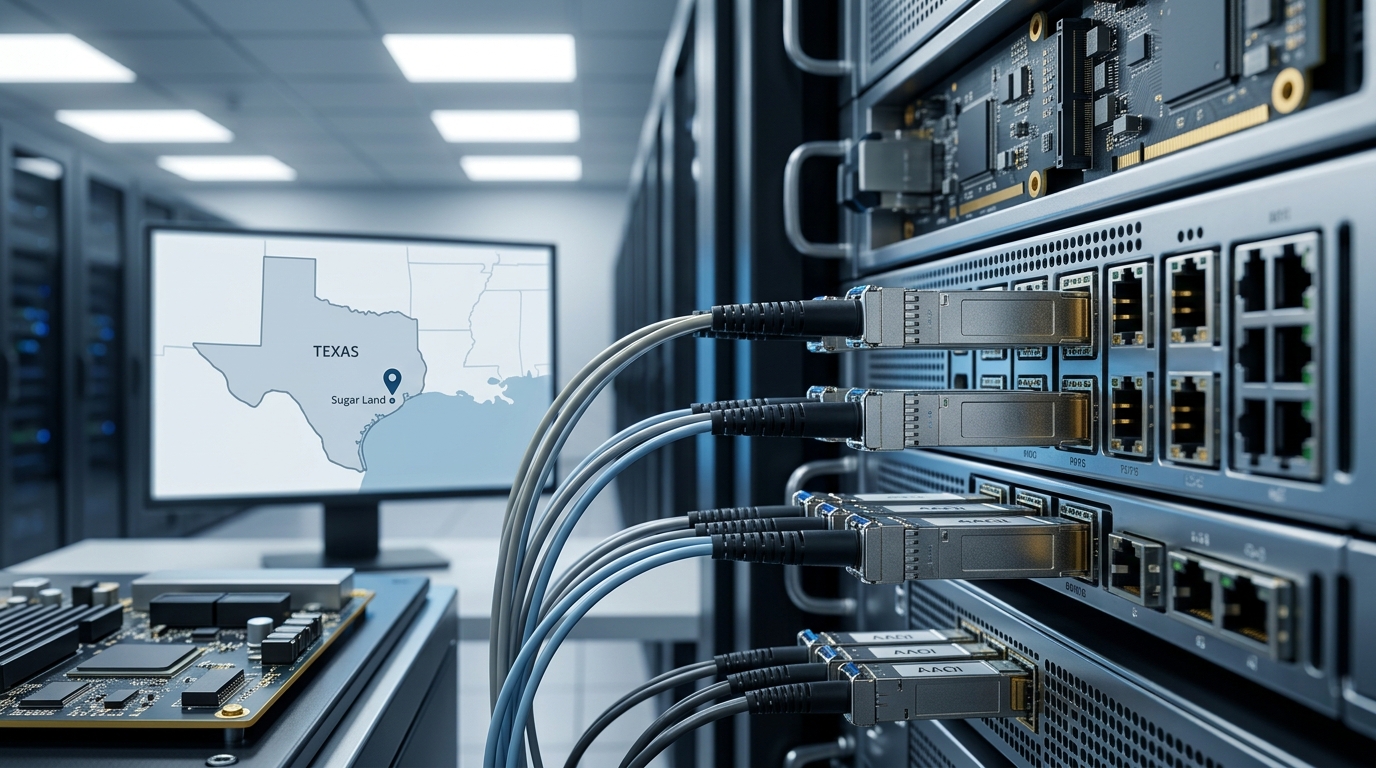
May 11, 2026
AAOI Is Guiding to $1.1B. The Real Story Is What’s Being Built in Texas.
Four record quarters, $124M in fresh orders, and a 9x production ramp that will define 2027
Most people still haven’t heard of Applied Optoelectronics. That’s actually part of what makes it interesting right now.
The company — ticker AAOI, headquartered in Sugar Land, Texas — makes the fiber-optic components that physically move data inside AI data centers. Not software. Not chips. Actual hardware: high-speed optical transceivers and semiconductor lasers that connect GPU clusters to switching fabric at speeds the rest of the market is still scrambling to keep up with. Founded in 1997 by Dr. Thompson Lin, AOI spent most of its early years selling into the cable television market. That was the bread and butter. What’s changed is where the growth is coming from — and the scale of it is hard to overstate.
The data center segment has taken over.
On May 7, 2026, AOI reported Q1 results — its fourth consecutive quarter of record revenue. Total revenue came in at $151.1 million, up 51% year-over-year and 13% sequentially. Data center revenue specifically hit $81.4 million, a 154% increase from the same quarter a year ago. CATV, the legacy business, added $66.8 million — up 4% year-over-year and 24% sequentially, which is actually better than it sounds for a mature segment. Non-GAAP gross margin was 29.2%. Adjusted EBITDA was just barely positive at $0.97 million. Cash on the balance sheet: $449.4 million at quarter-end, up from $216 million in Q4 2025, partly reflecting capital raises to fund the expansion.
Revenue missed the Street consensus of roughly $154.8 million by a few million, and EPS came in a penny light. Management called it in-line with internal targets. That framing matters — a miss that doesn’t rattle guidance is a different kind of miss. Q2 guidance was set at $180 million to $198 million. Full-year 2026 guidance is now above $1.1 billion with non-GAAP operating income projected to exceed $140 million.
To put that in context: AOI did $456 million in total revenue in 2025. That was itself an 83% increase over 2024. They are now guiding to more than double 2025 in a single year.
Is This Founder the “Next Elon Musk”?
Some early Tesla investors saw extraordinary gains by getting in before the crowd.
Now investors are watching a new founder being compared to Elon Musk as his company expands relationships across the U.S. military, secures billions tied to government contracts, and attracts backing from Peter Thiel.
The company still isn’t public.
But one little-known ticker may offer early exposure before broader Wall Street attention arrives.
Here’s where it gets interesting. The 800G transceiver market is supply-constrained right now — not demand-constrained. AOI exited Q1 with roughly 100,000 units per month of combined 800G and 1.6T capacity. The target is over 650,000 units per month by end of 2026, with more than 930,000 by end of 2027. That is a roughly 9x production increase in under two years. Most of it is being built out of Texas.
The order flow has been moving fast. In March 2026, AOI received its first volume 1.6T order from a long-term major hyperscale customer. A $71 million upsized 800G order followed in April, bringing that single customer’s total orders to $124 million since mid-March. 800G revenue in Q1 was only $4.6 million — but management expects 800G to become the largest data center revenue line starting in Q2 2026. 1.6T shipments are expected to begin in Q3 2026 and complete by Q4.
Slight tangent, but it matters: one thing AOI has that most peers don’t is vertical integration on lasers. The company makes its own semiconductor lasers using molecular beam epitaxy — an extremely precise fabrication method — rather than sourcing them externally. In a market where supply is already tight and lead times are extending, that in-house capability is functioning as a real competitive advantage, not just a talking point in investor presentations.
The Texas buildout is being taken seriously at the state level too. In April 2026, AOI was awarded a $20.9 million Texas Semiconductor Innovation Fund grant. The company is expanding its Houston-area footprint to approximately 900,000 square feet across facilities in Pearland and Sugar Land. By 2027, more than half of all production is expected to come from domestic facilities — a shift that also provides some insulation from the ongoing trade policy uncertainty that hit AOI with $1.4 million in direct tariff costs in Q1. Following the IEEPA tariff rollback, they submitted documentation for a refund expected to exceed $5.7 million.
On the product side, AOI showed up to OFC 2026 in Los Angeles in March with its 25dBm Ultra-High Power ELSFP — an external light source module aimed at co-packaged optics and next-generation AI switching infrastructure. The company is also pushing Linear Pluggable Optics, a design that removes the power-hungry DSP from the transceiver module and cuts energy consumption by roughly 50%. That’s not a minor spec improvement. Data centers running AI workloads are under serious power budget pressure, and LPO directly addresses that. AOI also has 3.2T development on its 2027 roadmap, alongside plans to increase laser fabrication capacity by approximately 350% — most of it in-house.
Your Download Link (Expiring)
If you still haven’t downloaded the free Simple Options Trading For Beginners guide…
…please take a few seconds and download it right now before your download link expires.
I eventually plan to charge money for this report, so do yourself a favor and download it now…
That way, no matter what it costs in the future, you’ll have a free copy on your computer.
Make sense?
Simple Options Trading For Beginners (Download Link Expires)
Now the uncomfortable part.
AOI is still GAAP loss-making. The heavy capex tied to the Texas expansion is compressing near-term margins, and the path to the company’s own gross margin targets — 35% to 38% by Q2 2027, 40% by Q3 or Q4 2027 — requires a production ramp that has already slipped once. Earlier 800G shipments were delayed due to firmware interoperability issues with a major hyperscale customer. That kind of delay is recoverable. A second one, at this scale of guidance, is a different conversation.
Customer concentration is real. One hyperscale customer accounted for nearly 29% of total revenue in 2025. AOI also competes against Coherent Corp. and Lumentum Holdings — both significantly larger, both better capitalized, both with broader product portfolios. If 800G pricing compresses faster than management is modeling, or if a competitor wins a key qualification round, the top-line trajectory doesn’t hold.
The 52-week range — $15.06 on the low end, nearly $191.87 on the high — says everything about the sentiment swings this stock is capable of. It moves on order announcements, guidance revisions, and any macro signal touching AI infrastructure spending. That volatility cuts both ways.
What’s interesting is that the bull case here isn’t really about market share or competitive moats in the traditional sense. It’s simpler than that: demand is already there, contracts are already signed, and the only real question is whether AOI can physically build fast enough to fulfill them. That’s a manufacturing execution story. And heading into Q3, the Texas buildout timeline is the variable that matters most — more than any earnings beat or miss, more than the macro, more than anything else on the calendar.
Worth keeping on the radar.