
 By Rising Star Stocks
 May 2, 2026
AeroVironment Is Not Just a Drone Stock Anymore
The defense-tech company is stacking contracts, expanding into directed energy, and positioning itself at the center of modern warfare.
Rising Star Stocks Editorial Team
Published May 2nd, 2026
Here’s the thing about AeroVironment (NASDAQ: AVAV) — Wall Street keeps filing it under “drone company” and moving on. That’s a mistake. What’s actually happening inside this business is a lot more interesting than the label suggests, and the numbers have changed substantially since most people last looked.
Modern warfare changed fast. The Ukraine conflict, rising Middle East tensions, and a renewed NATO buildout have collectively accelerated a multi-year supercycle in autonomous defense systems. AeroVironment didn’t just catch that wave — it helped define it. But the story is shifting to something bigger now, and the company’s recent contract cadence reflects that clearly.
Beyond the Aircraft
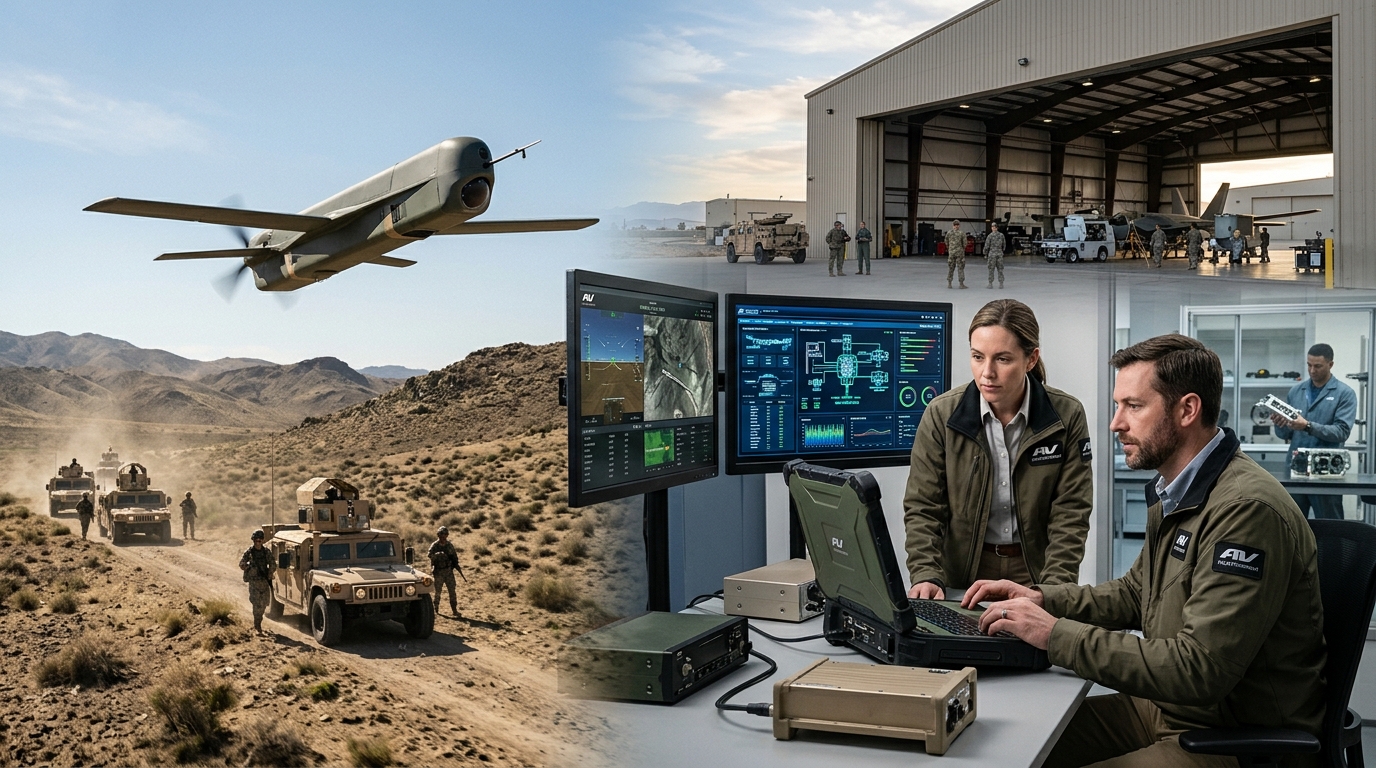
The April contract announcements alone tell a different story than the ticker suggests. AeroVironment landed a $14.6 million U.S. Army production contract for its VAPOR Compact Long Endurance all-electric VTOL platform — adding to a growing backlog of programs of record rather than one-off demonstrations. A three-year, $25 million U.S. Air Force Research Laboratory deal pushed its UES division into sensors, rugged wearables, and AI/ML analytics for warfighter performance. Then there’s the $97.4 million GENESIS contract from the U.S. Army — a next-generation hardware-in-the-loop test environment for spectral imaging and EO/IR sensor validation. And in April, the U.S. Navy selected AeroVironment to provide Contractor-Owned, Contractor-Operated ISR services using its JUMP 20-X VTOL platform — a shift toward recurring service revenue rather than one-time hardware sales.
That’s not a drone company. That’s a defense-tech platform spanning unmanned systems, human performance, directed energy, and now ISR-as-a-Service.
This Is What Modern Warfare Looks Like Now
One operator controlling multiple drones… AI identifying targets in seconds… Technology is rapidly changing the battlefield and creating new opportunities in defense.
This exclusive research highlights five companies at the forefront of this shift and explains why they are gaining attention.
The LOCUST Story — And What’s New
The LOCUST Laser Weapon System is the part most investors haven’t fully priced in yet. In April 2026, AeroVironment announced it had demonstrated LOCUST aboard the USS George H.W. Bush in a live-fire test conducted in October 2025 — neutralizing multiple drone targets from a maneuvering carrier deck. The system’s roll-on, roll-off design means it can run fully off ship power, giving it what amounts to an essentially unlimited magazine compared to traditional interceptor missiles. That’s a structural advantage in naval defense that could mean follow-on contracts for years.
And it’s already iterating. In March 2026, the company unveiled the LOCUST X3 — the third generation of its high-energy laser system, featuring AI-powered precision and a scalable output ranging from 20 to over 35 kilowatts. Production-ready, according to AV. The upgrade came with notably broader beam aperture and was reportedly designed with high-volume Iranian Shahed-type threats specifically in mind.
Slight tangent here, but it matters: the USS George H.W. Bush is currently one of three U.S. aircraft carriers operating simultaneously in the Middle East — for the first time in decades. The timing of that LOCUST announcement was not accidental.
What the Numbers Actually Say Now
The financial picture has changed substantially. After closing the BlueHalo acquisition in May 2025, AeroVironment is now a much larger business. The first three quarters of fiscal 2026 generated $1.335 billion in revenue combined — with Q3 alone at $408 million, up 143% year-over-year. Full-year fiscal 2026 guidance calls for $1.85–$1.95 billion in revenue, with non-GAAP adjusted EBITDA of $265–$285 million.
The funded backlog stands at $1.1 billion, and year-to-date total awards have reached $4.6 billion. Bookings for the first nine months of fiscal 2026 hit $2.1 billion with a book-to-bill ratio of 1.6 — that’s meaningfully more work coming in than going out the door. The unfunded backlog adds roughly another $3 billion in pipeline.
One clarification worth making: the gross margin figure has compressed. GAAP gross margin in Q3 FY2026 ran around 24% — down from the high 30s a year earlier. That’s almost entirely a BlueHalo integration artifact, driven by intangible amortization and a higher mix of service revenue. On a non-GAAP basis the underlying profitability trend is improving. Non-GAAP adjusted EBITDA in Q3 rose to $44.5 million from $21.8 million in the prior-year quarter.
The stock recovered from the mid-$170s back above $210 following aggressive dip-buying in late March and April — a move driven by the wave of contract announcements and the LOCUST carrier demo. Fifteen analysts have issued price targets over the last six months, with a median consensus of $315. Five firms hold Buy ratings. Zero have issued Sell ratings.
Elon’s New Currency (BUY NOW)
It’s bigger than SpaceX – xAI – or anything Tesla is working on. And it could launch a $480 trillion disruption, thanks to a massive rollout that’s already begun all over America. Because Elon’s new move targets the biggest market of them all – He’s now launching a CURRENCY system.
Recent Moves That Change the Narrative
In March 2026, AeroVironment acquired Empirical Systems Aerospace (ESAero) for approximately $200 million — adding AS9100-certified electric and hybrid propulsion design and manufacturing capacity in California. The deal is expected to be accretive to adjusted EBITDA in year one. That same month, it launched MAYHEM 10, a multi-role launched effects system deployable from air, ground, and maritime platforms, with interchangeable lethal and non-lethal payloads. A new CFO — Sean Woodward — stepped into the role May 1, 2026, with the outgoing CFO staying through July for transition continuity.
The company is also expanding manufacturing. A $30+ million buildout in Albuquerque and a new facility in Salt Lake City, Utah are designed to push annual production capacity above $2 billion. They’re not building ahead of guidance — they’re building ahead of demand.
The Real Risk
The SCAR program loss was real and it hurt. The U.S. Space Force terminated the existing BADGER phased array antenna agreement — not just paused it — triggering the $151.3 million goodwill impairment that drove a Q3 net loss of $156.6 million. AeroVironment is now in negotiations to potentially re-compete on a commercial item basis, but that outcome is uncertain. Revenue from SCAR is expected to account for less than 5% of total fiscal 2026 sales.
Contract concentration risk is always present in defense tech — one program cancellation can move the stock 15–20% in a day, as this one did. The BlueHalo and ESAero integrations add execution complexity. And the GAAP profitability picture, clouded by non-cash amortization from acquisitions, is not yet clean enough to satisfy fundamental-only investors.
But the defense spending backdrop heading into the back half of 2026 — driven by geopolitical tension, NATO commitments, active Middle East operations, and an accelerating counter-drone arms race — doesn’t look like it’s cooling. AeroVironment’s portfolio spans unmanned systems, directed energy, space-grade optics, ISR services, and AI-driven human performance tech. The diversification is real, and management’s confidence in a record fourth quarter appears grounded in the order flow.
Worth a closer look before the next earnings call on June 23.
This editorial is for informational purposes only and does not constitute investment advice. All investing involves risk. Past performance is not indicative of future results.