June 29, 2026
AI Just Conquered the Bond Market
Featured: AI Just Conquered the Bond Market
Editor’s Note: Marc Chaikin, the 60-year Wall Street legend who called Nvidia before it soared 45,000%, just came forward with another huge opportunity he’s spotted in the AI space. While the media is caught up in “SpaceX IPO fever” right now, the under-the-radar event Marc reveals below could give you access to three brand-new AI IPOs in a rare deal known as a “starburst.” You may never get a chance to take part in one of these again in your life… and while it’s speculative – this is your chance to get in very early while everyone’s attention is elsewhere…
Dear Reader,
A tech firm that’s been called “the unseen winner of the AI race” could soon break itself up into three separate companies.
The next Netflix… The next Tesla… And the next Amazon are all poised to spin off just from this one stock.
That would create a once-in-a-lifetime opportunity for investors who buy shares in the company before it happens.
Buy shares of this stock today, and you could get the same amount of free shares automatically deposited in your account for each spinoff.
Meaning, 10 shares could turn into 30 shares overnight.
And you could wake up with the world’s newest, hottest tech disruptors all sitting in your account – with no extra work on your part.
Believe me, when it happens, it feels like magic, but it’s actually something called a “starburst.”
This brilliant type of spinoff is especially rare in the tech industry.
And if the starburst announcement goes public (and it hasn’t yet), it’s going to be all the media talks about for a while afterward.
This potential “starburst” is my No. 1 recommendation for how average folks can set themselves up to benefit from what I’m calling AI’s “jump to lightspeed” moment.
Get the early scoop on this huge opportunity right here.
Sincerely,
Marc Chaikin
Founder, Chaikin Analytics
P.S. In 2021, GE announced a starburst when the stock traded at just $67 per share.
They rolled out the deal in stages, and when it was done, shareholders owned three companies instead of just one. The share prices on those once they were individually valued? $75… $300… $614… That means that one starburst unlocked $184 billion for investors. I predict this AI starburst will be orders of magnitude larger. See why when you click here…
AI Just Conquered the Bond Market
Most investors think of the AI trade as a stock story. Nvidia. Alphabet. Semiconductor ETFs. The debate over whether all that capital spending will ever convert into earnings.
Here’s what they’re missing: AI has quietly become the single largest sector in the U.S. investment-grade bond market. And the pipeline is just getting started.
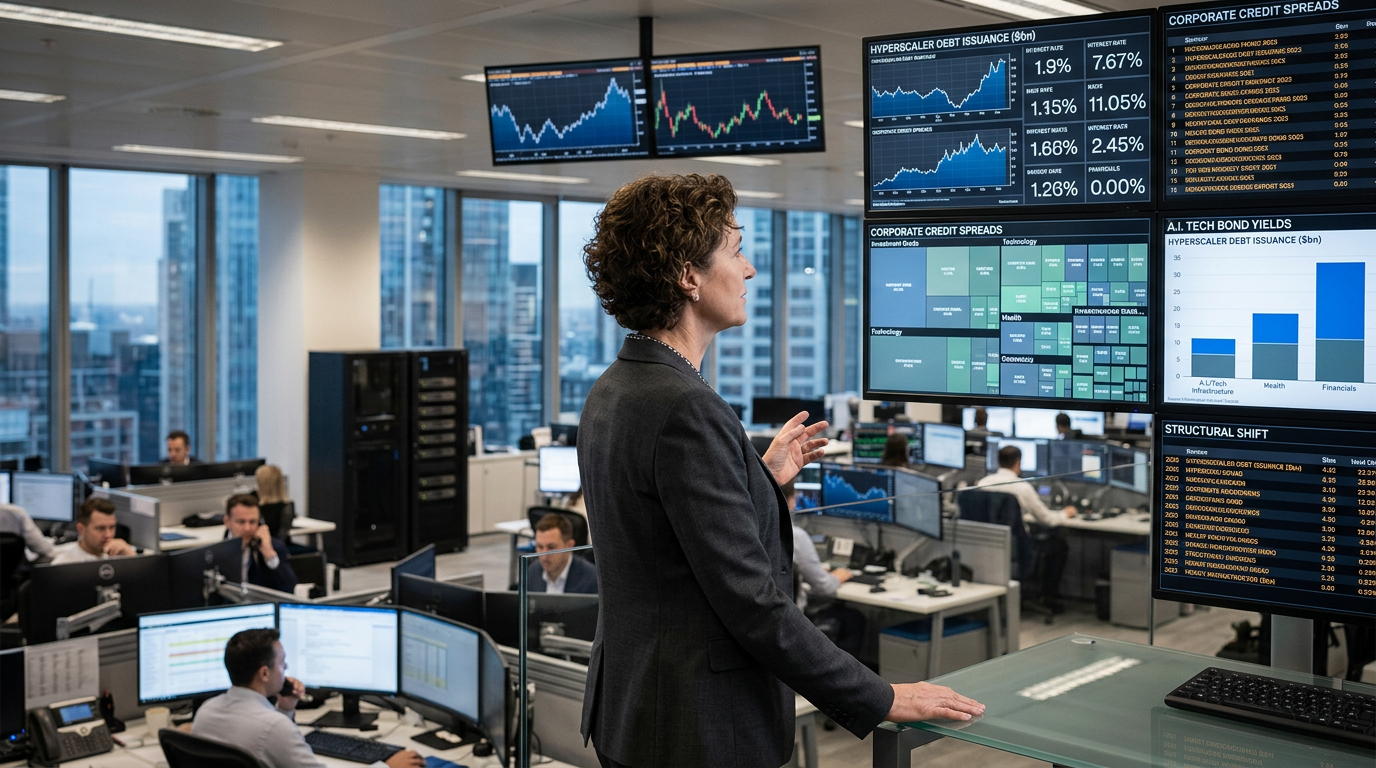
The numbers are staggering. The five largest hyperscalers collectively sold $159 billion in bonds through the first five months of 2026 — 47% more than the same window last year. From 2020 through 2024, those same companies averaged roughly $28 billion in annual U.S. corporate bond issuance. In 2025, that jumped to $121 billion for the full year. Now, barely past the midpoint of 2026, they’ve already blown past that.
Then June arrived. Nvidia priced a $25 billion investment-grade deal, drawing $85 billion in orders — upsized from an initial target of around $20 billion. SpaceX completed a $25 billion inaugural bond sale, also upsized from $20 billion after attracting nearly $90 billion in investor demand. Together, Nvidia and SpaceX represented nearly 29% of all investment-grade issuance in June. Total June volume reached $175 billion, a new all-time monthly record, and well above dealer forecasts of roughly $130 billion. Morgan Stanley now estimates global AI-related debt issuance could hit nearly $570 billion for the full year 2026, more than double last year’s figure.
Urgent Exposé on the “Mar-a-Lago Trade”
One former Goldman Sachs executive has just released an urgent investigative exposé on the $7.2 Trillion “Mar-a-Lago Trade.” It’s doubling retirement accounts across America. It has nothing got to do with AI, space, or risky IPOs. And yet, his research shows it could jump as high as 10x from here.
That’s not a financing trend. That’s a structural transformation of the credit market.
The shift from equity to debt as the primary AI financing vehicle matters for reasons that go far beyond bond investors. Hyperscaler capital spending in 2026 is on pace to consume close to 100% of operating cash flows, according to UBS, compared to a 10-year average of around 40%. These companies aren’t borrowing because they’re struggling. They’re borrowing because the scale of the AI buildout has simply outpaced what even the world’s most profitable businesses can fund from internal resources.
Total capital expenditures for the Big Five are now projected to reach approximately $725 billion in 2026 — confirmed by Q1 earnings reports across Amazon, Alphabet, Meta, Microsoft, and Oracle. About 75% of that is earmarked for AI-related infrastructure, covering data centers, custom chips, cooling systems, and power generation. The long-dated bond market, with maturities stretching 30 years or more, is now the preferred funding channel for infrastructure assets with multi-decade useful lives.
By October 2025, AI-linked debt had already reached $1.2 trillion, making it the largest segment in the investment-grade market and surpassing U.S. banks as the top sector in the JPMorgan U.S. Liquid Index. That was before the 2026 wave even got going.
Here’s the part that almost nobody is discussing: because major bond indices are weighted by market value, every eligible new AI bond increases its issuer’s share of the index. Passive funds tracking those benchmarks must buy proportionally more. Target-date funds, which held roughly $4.8 trillion in assets at the end of 2025, own those bond index funds. Millions of retirement savers now carry indirect AI infrastructure debt without ever choosing it.
This Billionaire Just Filed a Strange Document
One of the richest men in America – a Silicon Valley billionaire who helped launch $4.2 trillion in tech startups – just filed a strange report with the SEC. He quietly revealed that he’s just SOLD every single Mag 7 stock in his portfolio. Nvidia. Apple. Microsoft. Tesla. Just gone. And you won’t believe what he’s doing with that money instead. Mirror his move and you could see up to 10X returns on every dollar you invest.
The opportunity is in the inefficiency this creates. Hyperscalers, despite the sheer volume of issuance, maintain post-issuance leverage often in the 0.4 to 0.7x range — versus the investment-grade market average of around 3x. New-issue concessions have averaged about 12 basis points over Treasuries, wider than the broader market’s roughly 2.5 basis points, yet deals remain heavily oversubscribed. For fixed income investors willing to dig into the technical details, the supply volume is creating spreads that don’t always accurately reflect the underlying credit quality.
The risk is equally real. What happens to AI bonds if AI revenue disappoints? Issuers would face rising leverage and wider credit spreads just as refinancing needs grow. S&P has already warned that Amazon will likely post negative free operating cash flow for two years as its data center buildout peaks. The contagion from a tech valuation unwind into broader credit markets is a genuine tail risk — one that hasn’t been fully reflected in current spread levels.
Either way — whether this ends well or badly — the AI trade is no longer just an equity story. Bond investors are already deep inside it. The question is whether equity investors understand how much that changes the risk calculus.
 Rising Star Stocks