
July 8, 2026
Lockheed at a Discount
The war is back on. The contracts never stopped.
First a note from Resource Stock Digest
Gold is on fire – racing toward US$5,000 an ounce as governments continue piling on debt, central banks continue accumulating bullion, and investors increasingly seek hard assets in uncertain times.
One ultra low-priced explorer is launching a major drill campaign on its ALREADY huge gold discovery in one of the safest and most mining-friendly gold districts on Earth.
This exceptionally well-run small-cap currently controls a multi-million-ounce gold system in a top Canadian gold belt – all while remaining largely undiscovered by Wall Street.
Backed by a newly strengthened treasury and multiple high-priority targets, the company is now set to unlock the next phase of growth via the drill bit.
It all starts with a large, fully funded drill campaign designed to expand its already impressive gold resource.
And if the drills continue to hit paydirt as the team expects, we could be talking about an even larger gold haul at a time when large-scale gold assets in ultra-safe mining jurisdictions are becoming increasingly difficult to find and increasingly valuable to the market.
And here’s where it gets even more interesting…
In addition to its flagship gold asset, this soon-to-be-known small-cap also offers:
✔ A multi-million-ounce gold inventory with meaningful expansion potential
✔ A strong treasury capable of supporting aggressive exploration and project advancement
✔ A strategic land position in one of North America’s premier mining jurisdictions – with key infrastructure already in place
✔ Exposure to one of the strongest gold markets in history as prices race toward US$5K per ounce
In short: This is an exceptionally well-run, fully funded explorer in a top-tier Canadian jurisdiction with drilling on-deck and multiple catalysts stacked for 2H 2026 and beyond.
The market cap? Still remarkably small.
The share price? Still below US$0.25 per share.
The opportunity? A chance to get positioned before the next phase of growth begins.
This is one of those rare setups where early-stage speculators can position early and low… and then ride the momentum as the drill bit spins.
We’ve prepared a FREE online report detailing the opportunity, including:
✔ A full breakdown of the flagship gold asset
✔ An exclusive interview with the CEO bringing you directly onsite
✔ Why gold projects in safe jurisdictions are attracting increased attention
✔ The details behind the upcoming fully funded drill campaign
✔ And how to get positioned before this sub–$0.25 story goes mainstream
Funding is secured. Targets are defined. Drills are set to turn. Catalysts are stacked.
The market hasn’t noticed yet – but soon will!
Click here to get instant access and see why this ultra low-priced gold story could be one of the breakout resource opportunities of 2026-27.
FEATURED
Lockheed Martin hit $692 in early March. Today it’s trading near $530.
That 23% pullback happened while the company was signing some of the largest defense contracts in its history. A $35 billion THAAD production deal. A $4.8 billion PAC-3 missile contract. A $3.45 billion acquisition of an anti-submarine warfare firm. A memorandum of understanding with Rheinmetall to jointly produce ATACMS missiles on German soil — announced at the NATO summit in Ankara, of all places, yesterday.
And this morning, Trump sat next to NATO Secretary General Mark Rutte and said the ceasefire with Iran — the one markets had been pricing in since June 17 — is, in his words, “over.”
The contracts do not care. That’s the part worth understanding.
564% or higher when the market doesn’t move?
There’s a program with a history of finding stock winners… on the market’s quietest days.
Feb. 18, 2025, was a day of no action.
Yet this algorithm recommended a stock that went up 610%.
Oct. 18, 2021, was another boring day.
But this software recommended a 564% winner that day.
April 10, 2023?
Another tame day, another big win.
790% since then in fact.
So how did it do it?
What Actually Happened This Week
Iran struck three commercial vessels transiting the Strait of Hormuz. The U.S. launched strikes on Iranian targets from sea and land overnight. Oil tanker traffic through the strait has, by one energy analyst’s account, essentially stopped. Trump signaled a potential reimposition of the naval blockade and said the U.S. will “very probably” hit Iran again tonight.
Defense stocks are down today, which tells you something about how the market is currently reading this. Investors who sold LMT on peace in June are now watching the same thesis they abandoned come back through the door. The stock never fully recovered its war premium. Now the war is back.
But here’s where I’d push back on the reflex to make this purely a geopolitical trade. The more interesting story was signed two weeks ago and has nothing to do with what Trump said at a press conference this morning.
The June 24 Contract
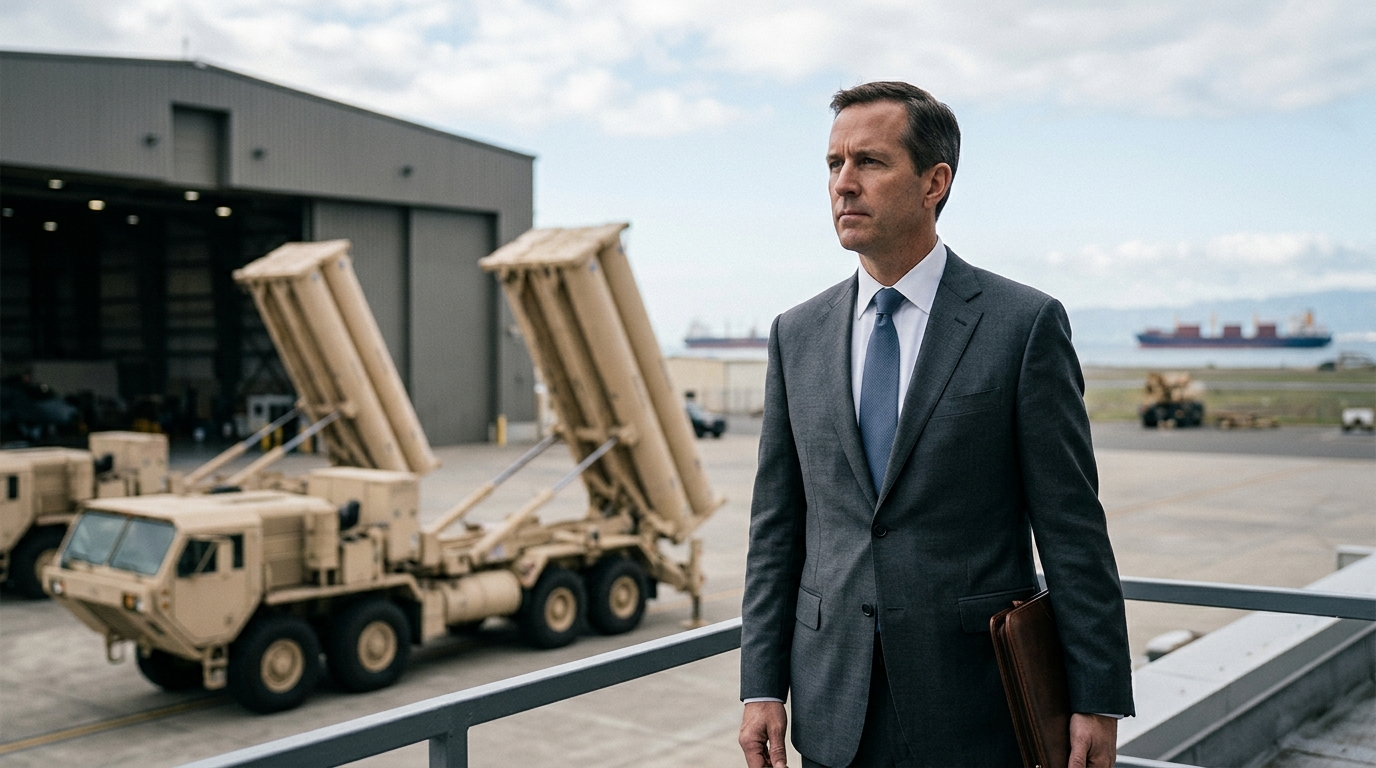
On June 24, the U.S. Missile Defense Agency awarded Lockheed Martin a seven-year undefinitized contract action worth up to $35 billion to quadruple annual THAAD interceptor production — from 96 missiles per year to roughly 400. One offer was solicited. One was received. This is not a competitive procurement. This is a sole-source award to the only company on earth that can build this specific missile at this specific scale.
At award, $842.9 million was immediately obligated. Production is ramping at a new facility in Troy, Alabama that broke ground in May, as part of a broader $9 billion capital investment program Lockheed has committed through 2030 across more than 20 production sites.
The reason the Pentagon needed this: Operation Epic Fury consumed THAAD stockpiles at a rate the existing production line could not begin to replace. THAAD interceptors cost more than $12 million each to manufacture. Restocking at 96 units per year was never going to work. The Navy fired more than 1,000 Tomahawks in the same conflict. The drawdown was historic. The replenishment is now contractually underway — and it does not require a war to continue in order to execute.
That is the difference between this and a pure geopolitical play.
The June Selloff Was a Mistake
When the U.S. and Iran signed their memorandum of understanding on June 17, defense stocks sold off sharply. Northrop Grumman dropped 6%. RTX fell. Lockheed gave back a significant portion of its spring gains. The market logic was clean: peace equals less demand for missiles.
But the interceptors had already been fired. They were already gone. The factories still had to build them back whether or not Trump and Tehran were talking. That is a procurement cycle, not a geopolitical bet. The $35 billion THAAD award — announced seven days after the MOU was signed — was the market’s first clear signal that it had read the situation incorrectly. Most investors ignored it.
Side note worth including: the White House sent Congress an $87.6 billion supplemental funding request in late June. Of that, $67 billion is earmarked for the Pentagon, including $21 billion specifically for munitions restocking. That request is politically complicated and may get modified before passing. But what’s already been contracted — the THAAD deal, the PAC-3 ramps, the HIMARS awards — requires no further congressional action. That money is already committed and obligated.
“By July 30, Elon Musk’s Prophecy Will Fulfill Itself”
The two investment legends who picked Nvidia 10 years ago are predicting that by the end of this month, Elon Musk’s new AI breakthrough they call “M.A.G.I…” will collide with a strange market pattern with a flawless 100% track record of massive market gains.
The Numbers, As of Today
Lockheed ended 2025 with a record $194 billion backlog — more than 2.5 years of sales. Management reaffirmed 2026 guidance of $77.5 to $80 billion in revenue, EPS of $29.35 to $30.25, and free cash flow of $6.5 to $6.8 billion. Q1 2026 EPS of $6.44 missed the $6.70 estimate, dragged by a $125 million F-16 program charge and a billing disruption tied to an ERP transition. Management said cash flow normalizes in the second half as billing catches up.
The forward P/E sits around 17.44 times. The PEG ratio is 1.14. Both are well below the sector average and below LMT’s own three-year historical range. Citi upgraded the stock to Buy this month with a $582 price target. Wells Fargo cut its target to $575 but kept an Equal Weight rating. The analyst consensus sits at $617, implying roughly 16% upside from current levels. The stock is at $530.
That gap — between the contracts being signed and the price sitting 23% below the March high — is where the current opportunity lives, at least on paper.
Two other items that haven’t gotten enough coverage this week. On July 6, Lockheed announced a definitive agreement to acquire Ultra Maritime for $3.45 billion. Ultra specializes in anti-submarine warfare — sonar systems, sonobuoys, torpedo defense, and autonomous maritime sensing platforms. Ultra’s revenues have grown roughly 17% annually over the past three years. The deal adds a naval warfare capability Lockheed did not have at meaningful scale, and it closes into a threat environment where submarine detection just became considerably more relevant. Then on July 7, at the NATO summit, Lockheed and Rheinmetall signed an MOU to jointly produce ATACMS missiles on German soil — the first time that system would be manufactured in Europe. Alliance demand for precision strike capability is no longer a Washington policy conversation. It is becoming a factory floor reality.
The Rest of the Sector
RTX Corporation ended Q1 2026 with a record $271 billion backlog, up 25% year-over-year, split between $162 billion commercial and $109 billion defense. Q1 adjusted EPS of $1.78 beat the $1.52 estimate by 17%, the eighth consecutive quarterly beat. The company raised full-year guidance to $92.5 to $93.5 billion in adjusted sales with adjusted EPS of $6.70 to $6.90. Its Raytheon division builds Patriot interceptors, and the Pentagon has already pushed for tripling output. Collins Aerospace and Pratt and Whitney give RTX a commercial aviation base that holds regardless of whether today’s headline reads escalation or negotiation.
Northrop Grumman carries a $95.6 billion backlog as of Q1 2026, led by the B-21 Raider and the Sentinel ICBM program. Q1 EPS of $6.14 beat estimates and net income climbed 82% year-over-year, driven partly by the absence of a prior-year B-21 loss provision. Northrop reached Air Force agreements in Q1 to increase B-21 production capacity and accelerate Sentinel’s initial operating capability. In May, ten Northrop directors made coordinated share purchases at $552 — a signal worth noting. The stock has been the weakest of the three major contractors year-to-date. Watch Q2 earnings in late July for management commentary on B-21 margin trajectory. That is where the recovery story either holds or shows cracks.
The structural budget backdrop has also shifted permanently. Trump’s fiscal 2027 defense request totals $1.5 trillion — $1.15 trillion in base spending, the first time the defense base budget has crossed $1 trillion, plus $350 billion through reconciliation. Congress has already approved roughly $24 billion for the Golden Dome missile defense program. The program director’s own cost estimate is $185 billion. The CBO puts the 20-year architecture cost at $1.2 trillion. Whatever the final figure, that procurement flows through the same production lines building THAAD interceptors today. Global defense spending hit $2.89 trillion in 2025, according to the Stockholm International Peace Research Institute — a record. The demand environment is not a temporary condition.
Missed the Gold Boom?
Think Again We found a $15 fund tied to gold that is delivering 64% in annual distributions. And the next payout is just days away.
What to Actually Watch
LMT reports Q2 on July 23. That call is where today’s events either get confirmed in the numbers or don’t. Management will either say the THAAD ramp is on schedule, PAC-3 output is accelerating, and the Q1 billing disruption has cleared — or they will hedge. Given that the THAAD contract was awarded three weeks ago, the Alabama facility broke ground in May, and PAC-3 production has been scaling since the April award, the former is the more probable outcome. But earnings calls have a way of surfacing execution details the press releases don’t.
For options traders, the structure is worth thinking through. LMT implied volatility tends to compress during ceasefire periods and expand on re-escalation. Today is a re-escalation day. That means IV is likely rising into a fundamental thesis that just got stronger, not weaker. Call spreads positioned ahead of the July 23 report give a defined-risk way to participate in what could be a double catalyst: fresh conflict urgency and a THAAD-driven earnings confirmation. The bear case is that the supplemental funding request stalls in Congress, re-escalation fades within days, and rising oil from a disrupted Strait of Hormuz reignites inflation, pulling forward Fed rate hike expectations and compressing multiples across the sector. That is the scenario where the backlog holds but the stock still doesn’t move until macro clears.
The stock is 23% off its high. The backlog is at a record. Three major contracts have been awarded or announced in the past 45 days. The ceasefire that caused the selloff is now gone.
At some point the price has to catch up with the paperwork. The question is whether that happens before July 23 or after.
 Rising Star Stocks