
August 25, 2026
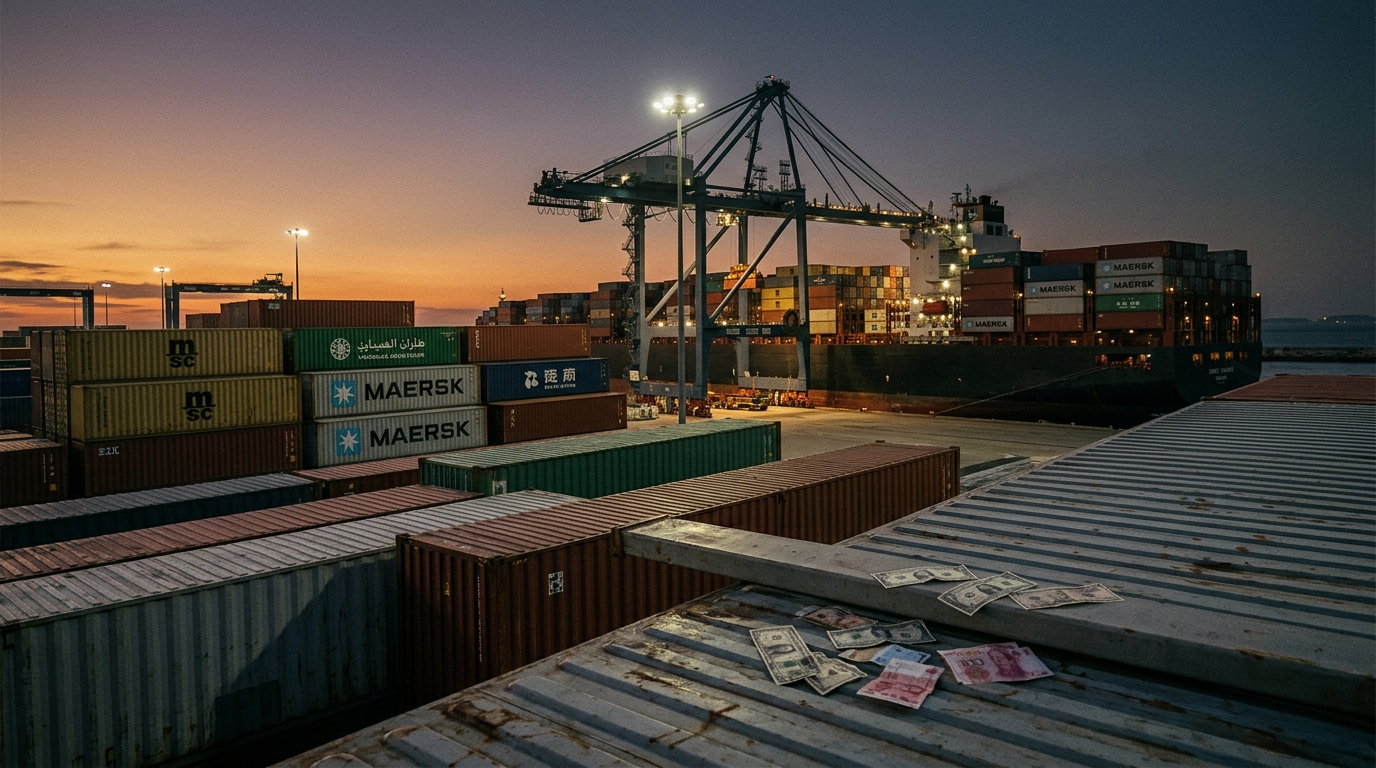
De-dollarization is accelerating faster than the calendar suggests.
The dollar’s reserve share has fallen to about 57%. A May 2021 IMF analysis found the dollar’s share of disclosed reserves fell by roughly 12 percentage points from 1999 through 2020. That shift did not happen slowly. In the IMF’s COFER update for Q1 2026, the dollar’s share actually rose to 57.13% from 56.42% in Q4 2025, with the IMF attributing about half of that increase to exchange-rate valuation effects. Sanctions weaponization is the catalyst. The 2022 freezing of Russian central bank assets rewired how reserve managers think about counterparty risk, permanently.
Three companies sit at very different coordinates on this map. One carries most of the downside. Two carry most of the upside. The spread between them is where the opportunity lives.
Pfizer: The Currency Ledger Problem
Pfizer generates roughly half its revenue outside the United States. In Q1 2026, foreign exchange added $431 million to reported revenue growth while operational growth came in at just 2%. In Q2, FX contributed another $217 million to what was otherwise a 1% operational quarter. That flatters the headline numbers when the dollar weakens. When the dollar strengthens or becomes volatile in sanctioned-economy corridors, the same mechanism punishes them.
What is “The Presidio Initiative”?
A single $20 million check delivered to a former military base may have launched the biggest megaproject in American history.
The real risk is not a single bad quarter. It is that Pfizer carries no structural hedge against a world where dollar volatility is a feature rather than an anomaly. With about $1.5 billion in patent-expiry headwinds expected in 2026 and no buybacks planned for the year, the balance sheet has limited capacity to absorb persistent FX drag on top of the existing transition pressure.
Newmont: The Hard Asset Correlation
Central banks bought over 1,000 tonnes of gold in 2024, the third consecutive year above that threshold. Newmont sits directly in the path of that demand signal, not as a speculator but as the industry’s largest gold producer by reserve base, with 118.2 million attributable ounces declared at end-2025.
In Q1 2026, Newmont reported an all-time record $3.1 billion in quarterly free cash flow, with the average realized gold price reaching $4,414 per ounce by Q2. All-in sustaining costs of $1,621 per ounce in Q2 imply a margin structure that turns every dollar of gold price appreciation into material cash. The spread between spot and cost is historically wide. Full-year 2026 production guidance stands at 5.3 million attributable ounces. At current realized prices, that guidance implies a cash-generation engine that few equity structures anywhere can match.
The Overlooked SpaceX Play
The opportunity right now is NOT to buy SpaceX – it’s to own the small, overlooked stocks that could rip triple digits as Elon expands his empire. That’s according to Tim Bohen, self-made millionaire who called Tesla at $37.
Visa: The Currency-Agnostic Toll Road
Visa’s business model does not require the dollar to win. It requires transactions to move. In Q3 FY2026, cross-border volume rose 13% on a constant-dollar basis. The company’s international transaction revenue line collects currency-conversion and cross-border fees on top of standard processing, making it structurally more profitable per dollar of volume than domestic flows.
Cross-border growth outpaced overall payments volume growth in each of the last three quarters. A multipolar currency world, where the euro, yuan, and dollar all settle meaningful trade flows, simply means more conversion events. More conversion events means more revenue for the network in the middle. Visa does not care which currency wins. It charges a toll on the exchange.
The Positioning Logic
De-dollarization is not a binary event. It is a slow redistribution of monetary risk that rewards assets with no counterparty dollar dependency and penalizes those whose reported earnings are hostage to FX translation. Newmont owns the physical metal central banks are buying. Visa owns the rails those central banks cannot displace. Pfizer owns a revenue base that can look better or worse than it actually is, depending entirely on which way the dollar moves next quarter.
A 96% win rate using this strange trading approach
There’s a way to profit from the AI boom that has nothing to do with picking stocks.
Wall Street legend Larry Benedict calls it “AI Profit Loops.”
This pattern hits the market every 90 days. Over the last five years, it has come around 23 times.
In 22 of them, Larry handed his members multiple winning trades. That’s a 96% win rate, and the next “Loop” is due to hit on September 16.
Watch this presentation to learn how to get positioned today.
That asymmetry is worth watching carefully.
This editorial is for informational purposes only and does not constitute investment advice. Past performance does not guarantee future results. Always conduct your own research and consult a qualified financial advisor before making any investment decisions.
 Rising Star Stocks