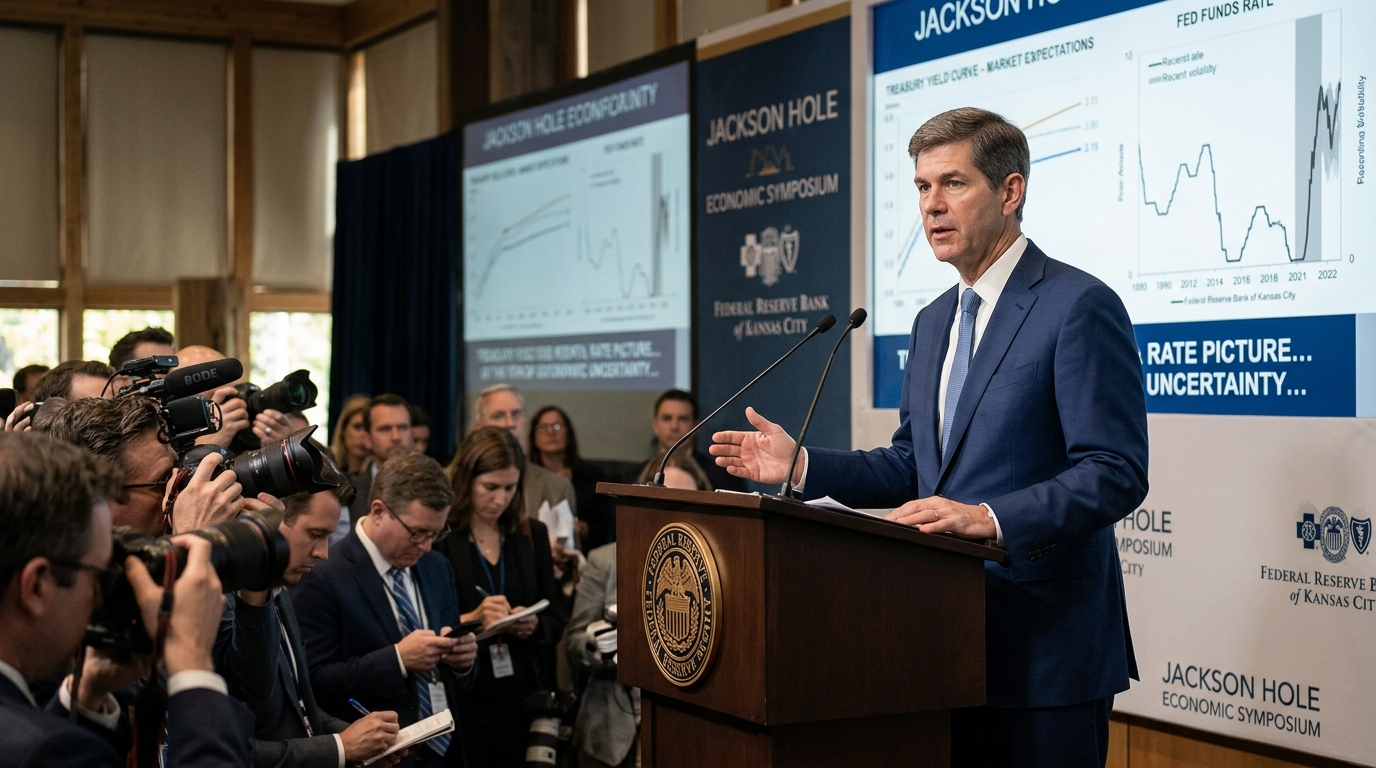
Federal Reserve Chairman Kevin Warsh speaks at Jackson Hole Friday morning for the first time since taking office in May. Every trading desk is watching. The reason has less to do with Jackson Hole tradition and more to do with the specific position investors are in right now: genuinely uncertain about whether the Fed’s next move is a hold, a hike, or something that takes years to resolve.
At the July FOMC meeting, the Fed voted 9-3 to hold its benchmark rate at 3.5% to 3.75%. Three regional presidents, Cleveland’s Beth Hammack, Minneapolis’s Neel Kashkari, and Dallas’s Lorie Logan, dissented in favor of an immediate 25-basis-point increase, the first time since September 2016 that three policymakers dissented with a unified view on which direction rates should move. The June dot plot median penciled in one quarter-point increase by year-end. Markets had been pricing roughly a one-in-three chance of a surprise hike at the July meeting.
The Warsh Complication
Under Warsh, the Fed no longer telegraphs its intentions between meetings. He told reporters on July 29 that he would not characterize the July hold as a “pause,” describing it instead as a “rigorous review of the economic situation.” That deliberate ambiguity is by design. But it means Friday’s speech carries more information value than a typical Jackson Hole keynote, precisely because investors have so little else to anchor on.
The challenge Warsh faces is significant. He must address persistent inflation without capitulating on his stated preference to avoid spoon-feeding investors with policy clues. Inflation expectations among consumers ticked up to 5.8% for the coming year in August, according to The Conference Board. The Expectations Index from that same survey fell to 68.2, well below the 80 level the Conference Board associates with elevated recession risk over the next twelve months.
What This Means for Your Portfolio
The rate path matters differently across asset classes. For equity investors, a signal that rates could move higher pushes the discount rate on long-duration growth stocks up, which is particularly relevant for technology companies whose valuation embeds years of future cash flow. The 10-year Treasury yield has been hovering near 4.66%. Those levels are already compressing valuations for rate-sensitive sectors including real estate and utilities.
For income-oriented investors, the current environment offers a genuine opportunity that did not exist three years ago. Short-to-intermediate duration investment-grade bonds, preferred shares, and dividend-growth stocks in sectors with pricing power, healthcare, energy infrastructure, and consumer staples, can generate income while preserving capital if rates hold or rise modestly. Locking in yield at current levels, rather than waiting for rate clarity that may not arrive in 2026, is a defensible strategy.
Warsh’s speech does not come with a vote attached. Jackson Hole keynotes almost never move markets dramatically on the day. The 2020 speech, when Powell rewrote the inflation-targeting framework, moved the S&P 500 by 0.17%. What Friday’s remarks will shift is the longer-term probability distribution for the September and November meetings, and by extension, where the 10-year yield settles through the end of the year.
Daily Wealth Takeaway
Central bank uncertainty is not a reason to freeze. It is a reason to own a portfolio that does not require a correct rate forecast to compound. Companies with pricing power, balance sheet strength, and growing dividends perform across rate regimes. Build around those, and let Friday’s speech inform the margin, not the foundation.
 Rising Star Stocks