August 28, 2026
SpaceX pulled its Starmind timeline forward. The suppliers that get paid first are worth watching now.
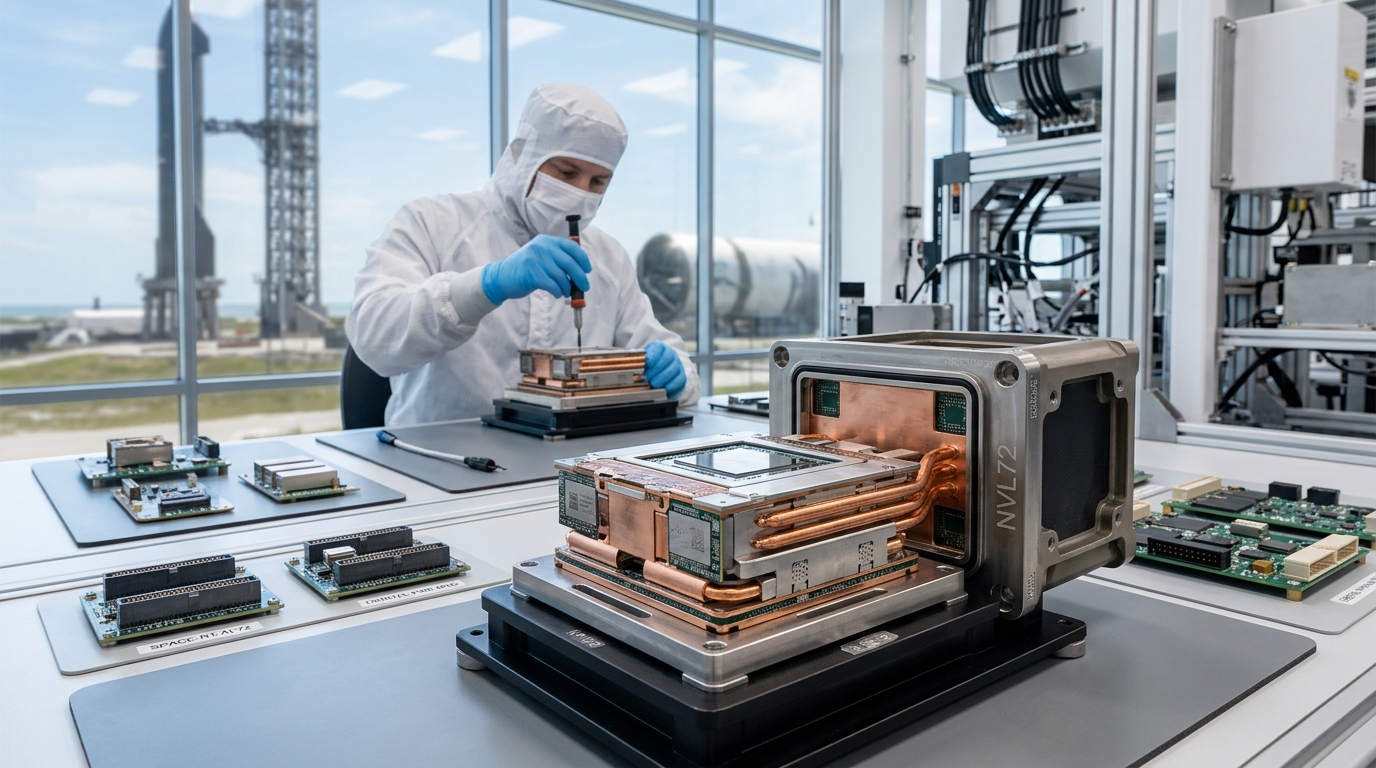
Elon Musk put a quarter on it last Monday. SpaceX, in partnership with Nvidia, has designed a space-optimized Vera Rubin NVL72 system for launch to orbit in Q4 2027, with significant scale following in 2028. That is roughly a year ahead of the “as early as 2028” window the company had previously suggested publicly. Wall Street spent most of the week debating whether the timeline is real. The more actionable question is which companies in the orbital supply chain collect revenue before Starmind ever proves itself in orbit.
The physical demands of the Starmind AI1 satellite are extreme. Each unit is designed to stand 20 meters tall with a 70-meter wingspan, carry a compute payload drawing 120 kilowatts on average and 150 kilowatts at peak, and reject all of that waste heat through 110 square meters of deployable liquid radiators, redundant pumped cooling loops, and micrometeoroid shielding. There is no ambient air. No cooling tower. Every thermal engineering decision has to be solved before the first prototype launches.
That engineering reality is a revenue event for suppliers. And the most interesting publicly traded name sitting at the intersection of those requirements is Rocket Lab (RKLB).
Anthropic’s Project Glasswing: The AI “Too Dangerous” for the Public
Anthropic’s Project Glasswing gives a select group of companies early access to an advanced form of AI that has been deemed “too dangerous” for the public. With this in their arsenal, these companies could become the most powerful businesses in the world this year.
What Rocket Lab Actually Sells
The company is often described as a launch provider, which undersells it. Rocket Lab supplies star trackers, reaction wheels, solar arrays, electric propulsion systems, composite structures, separation systems, and optical payloads. It builds satellite buses and complete spacecraft. Its Space Systems segment, the component and manufacturing side of the business, generated $189.5 million in Q2 2026 revenue, up 94% year over year. Total company revenue hit a record $234 million for the quarter, with a backlog that reached about $2.36 billion as of June 30, 2026.
Those numbers are not hypothetical future earnings tied to Starmind. They are shipping today, to government and commercial customers who need hardware in orbit on a schedule. The Starmind cycle is additive.
The Laser Link That Connects Everything
Starmind satellites pass results between each other via inter-satellite laser links before handing data off to Starlink for the trip down to ground stations. That architecture requires optical communications terminals at scale. In April 2026, Rocket Lab completed its acquisition of Mynaric AG, a Munich-based provider of laser optical communications terminals, for $155.3 million. Rocket Lab now plans to scale Mynaric’s production capacity to meet demand from commercial and government constellation operators that have long faced a supply chain bottleneck in this exact component.
Huge AI Announcement Coming on September 3
The last time this firm did this, it skyrocketed overnight. Now – backed by a $51 billion backlog, a SpaceX partnership, and President Trump’s ringing endorsement – the gains could be even bigger.
The Mynaric fit matters beyond Starmind. The same terminals serve government and commercial programs that are building constellations with optical crosslinks. Orbital AI is one buyer. Defense is another. The terminal runs in both markets.
Launch Adjacency Is a Real Tailwind
SpaceX has reportedly started turning away satellite operators seeking dedicated rides to orbit aboard Falcon 9 beyond 2028, underscoring the bet the company is making on Starship and its own internal manifest. That squeeze can route external satellite operators toward alternatives. Rocket Lab’s Electron has become one of the most frequently launched U.S. rockets, and its Neutron medium-lift vehicle is designed precisely for the constellation deployment market Falcon 9 currently dominates. Neutron already has dedicated missions under contract, including a Kepler Communications flight booked for no earlier than 2028.
The Falcon capacity tightening is not purely a headwind for the space sector. For a vertically integrated company that builds both the launch vehicle and the satellite components riding inside it, a tighter market for rival launch slots means more demand at every layer of the stack.
19 of the Top 20 Biopharma Companies Already Use This AI Platform
Nineteen of the world’s top 20 biopharma companies already use this platform.
Now customers are being moved onto its new AI-powered system as the legacy product shuts down.
Chief Investment Strategist Alexander Green with The Oxford Club, believes that makes this one of AI’s most overlooked opportunities.
Risks
Musk timelines carry well-documented risk. SpaceX’s orbital data center initiative is early-stage and not yet proven at commercial scale, and the FCC has not yet authorized SpaceX’s Orbital Data Center NGSO system. The FCC accepted the application for filing and public comment on February 4, 2026, and it remains pending. Neutron’s first launch window is also narrowing, with Rocket Lab acknowledging that the 2026 debut could slip into 2027. Execution on multiple simultaneous acquisitions, including Mynaric and Motiv Space Systems, introduces integration risk. None of those are trivial.
Still, the supply chain position is the point. Rocket Lab’s revenue grew 62% year over year in Q2 2026, its backlog stood at about $2.36 billion as of June 30, 2026, and it supplies components the orbital compute industry cannot do without, independent of whether any one constellation hits its stated schedule. That combination of in-hand demand and positioned upside is the specific situation worth having on the radar as the Starmind cycle begins to move from announcement to metal.
 Rising Star Stocks