Hi Trader,
Most “gurus” who teach beginners how to trade options start in the wrong place…
Because they immediately launch into complicated concepts like Greeks, spreads, and implied volatility.
And before long, most new traders are completely lost… and move on.
The free guide I want to share with you today takes a different approach.
Instead of overwhelming you with technical details…
It starts with the basics and shows you exactly how options work, why traders use them, and how they can fit into a simple trading plan.
If you’ve ever wanted to understand options but didn’t know where to start…
This is your chance.
Click here and get your free copy now.
To your trading success,
Dave Aquino
Lead Options Trader, Base Camp Trading
TSMC’s Texas Expansion Has a Clear First Winner
TSMC does not build quietly. The company is reportedly weighing a new campus in Texas that could add tens of billions of dollars to its U.S. footprint, driven by unrelenting demand for AI hardware from customers including Nvidia and Apple. TSMC has already committed $265 billion to an expansive site in Arizona, and the envisioned Texas investment would also involve multiple fabs.
The question most investors ask is whether to buy TSMC itself. That is the wrong question. The better one: who gets paid before a single wafer ships?
The Economics of “Move-In”
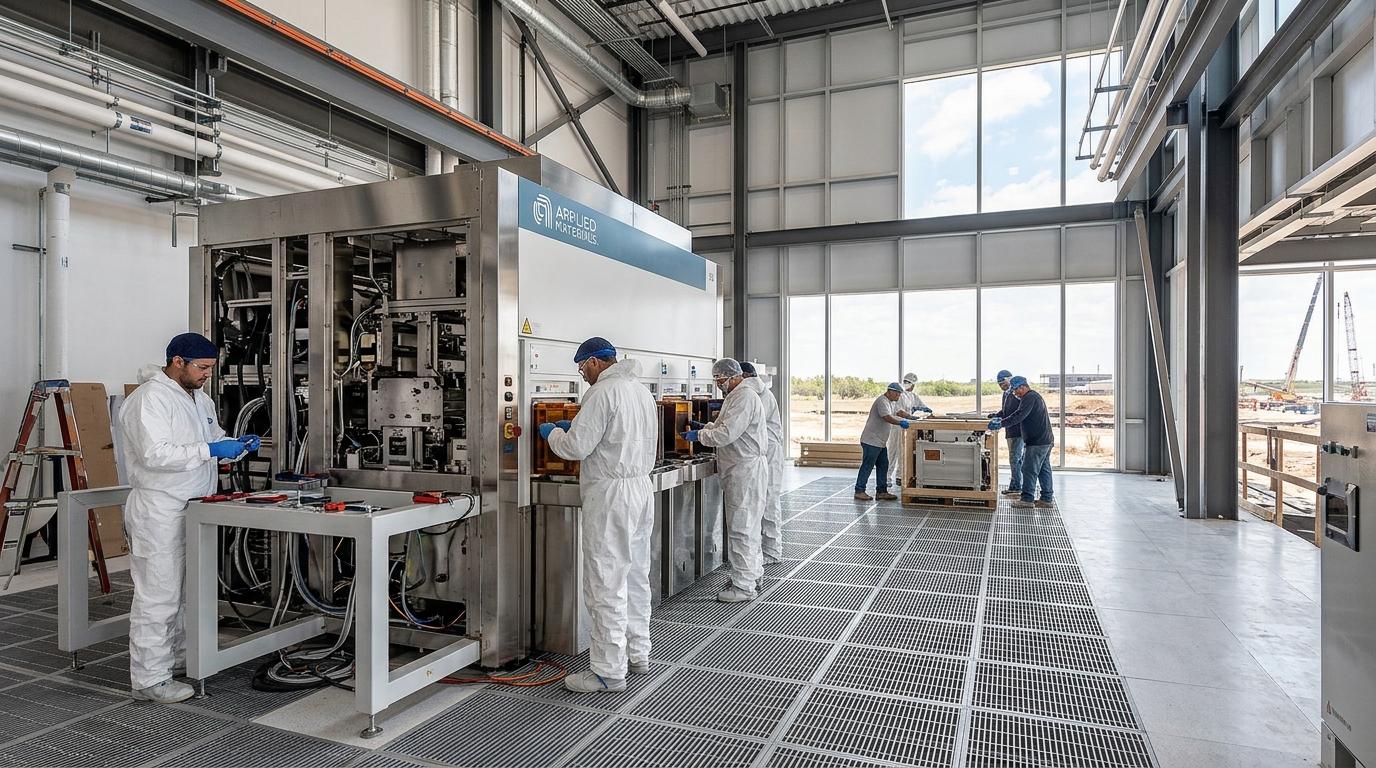
Every fab starts with equipment. Long before process engineers arrive, tool vendors spend 12 to 18 months doing what the industry calls equipment move-in, loading hundreds of deposition, etch, metrology, and implant systems into a shell building. That is when suppliers book revenue. Each fabrication plant at a proposed Texas campus would carry a price tag of at least $20 billion, and equipment typically accounts for roughly 70 to 80 percent of that figure.
The supplier positioned to capture the largest non-lithography share of that spend is Applied Materials (NASDAQ: AMAT). Applied Materials has repeatedly characterized itself as the leader in materials engineering, and it is widely regarded as the largest wafer fab equipment supplier outside lithography. Its two largest customers represented approximately 19 percent and 15 percent of revenue, respectively, in fiscal 2025.
Already Running Hot
The Texas story lands on top of an equipment cycle that is already accelerating hard. Applied Materials reported record revenue of $9.12 billion in its fiscal third quarter, up 25 percent year over year, with record non-GAAP EPS of $3.50, up 41 percent. The trailing twelve-month revenue figure now stands at roughly $30.8 billion.
CEO Gary Dickerson described it as “the highest sequential revenue growth in the company’s history,” adding that rapid AI adoption is driving unprecedented demand for materials engineering solutions. Management has also said it expects leading-edge foundry/logic, DRAM and advanced packaging to represent about 80 percent of wafer fab equipment market growth in 2026 and 2027.
The demand signal from TSMC’s own procurement desk confirms the direction. Reporting in late 2026 described an internal TSMC equipment-requirement index that was set to 1.0 at the end of 2025, rose to about 1.25 in the first quarter of 2026, and reached roughly 1.9 by July. When TSMC’s equipment demand nearly doubles, the effect ripples to Applied Materials, Lam Research, KLA, and thousands of subcomponent manufacturers.
What Texas Adds to the Calculus
Reports indicate the Texas campus could include as many as six advanced wafer fabrication facilities. A Texas campus would likely feature more advanced nodes from the start, built closer to where Nvidia, AMD, and cloud companies building custom AI chips want their most cutting-edge silicon made. More advanced nodes require more Applied Materials tool types per fab, not fewer.
Whether Congress extends or expands semiconductor incentives is among the factors that could determine whether the Texas project proceeds. That is a real risk, and the project remains in early stages. Nothing is final yet. The plans have reportedly not been approved by TSMC’s board, and the company’s suppliers have reportedly not been told.
Risks Worth Watching
Applied Materials carries its own risk profile. China represented about 30 percent of fiscal 2025 revenue, and any tightening of export controls could compress results faster than a Texas fab ramp can offset them. The company is also not immune to TSMC pricing leverage: TSMC cannot re-qualify a full process flow at another vendor, but that does not grant immunity on equipment pricing.
Valuation has moved. The stock trades at a significant premium to where it sat twelve months ago. Investors paying up are effectively paying for the Arizona ramp plus Texas optionality.
The Bigger Picture
The Arizona build and the proposed Texas campus together represent one of the largest sustained equipment procurement cycles the industry has ever seen. Applied Materials is strategically positioned in leading-edge foundry logic, DRAM, and advanced packaging, segments the company has said are expected to constitute about 80 percent of wafer fab equipment market growth in both calendar years 2026 and 2027.
TSMC’s Texas deliberations are still early. But the company that gets paid on day one of move-in, regardless of which node runs first or which customer fills the order book, is already known. That is worth keeping on the radar.
 Rising Star Stocks