
Below is an important message from one of our highly valued sponsors. Please read it carefully as they have some special information to share with you.
Did you see this?

At 12:34 in the morning, the President of the United States shared a video on Truth Social.
Along with just three words:
“The Midterm Meltdown”
By sunrise, the national press had picked it up – and they were not happy about it.
Because if this video proves correct?
They along with the most corrupt politicians in DC could soon be in serious trouble.
I can’t say how much longer this video will be online…
But I can tell you, if its creator is even half right…
This summer could mark the most serious turn in American history since the Civil War.
And for investors who aren’t prepared, it will be a bloodbath.
For the full story, click here.
Regards,
Aaron Gentzler
VP of Research, Paradigm Press
Trip.com Is Winning the China Consumer Shift
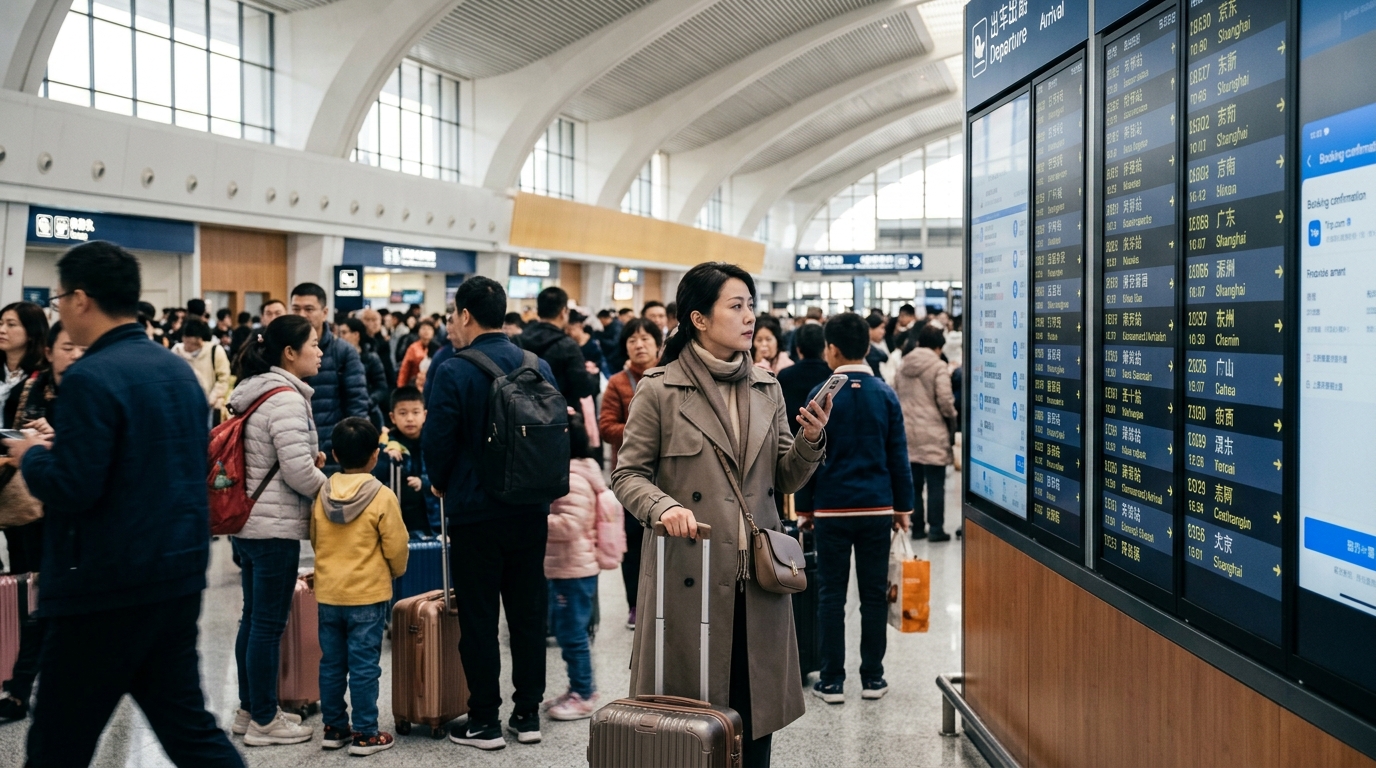
China just logged its busiest National Day holiday on record. 2.14 billion cross-regional trips across October 1–7. The transport ministry data hit markets as mainland exchanges reopened, and it looked, at first glance, like a demand vindication.
Look closer and the picture splits in two.
Average spending per trip came in at 893.92 yuan, a four-year low, down from 911.04 yuan in the same period last year, according to Reuters calculations on government data. Hainan duty-free revenue fell 3.6%. The box office dropped roughly 30% against last year. Traditional retail barely moved. The headline volume number flatters a consumer who is traveling farther, staying longer, and spending less per stop.
That is the part of the story most commentators are writing. Here is the part worth trading around.
Where the Money Actually Went
China’s State Taxation Administration reported that service industry sales rose 19.5% year on year over the National Day holiday, with tourism and entertainment leading at 23.6% and sports activity up 29.4%. Inside that surge, Caixin Global noted that health management tools, smart wearables, and AI-driven appliances were among the fastest-growing categories, precisely the experience-led, tech-adjacent spending that duty-free perfume counters and cinema chains cannot capture.
The consumer is not retrenching wholesale. They are reallocating: fewer big-ticket luxury purchases, more experiential bookings, more itinerary complexity. Multi-city trips on Trip.com’s platform rose 84% year on year for the holiday period. Hotel stays of seven nights or more jumped 123%.
That is the rotation in its clearest form.
Why Trip.com (TCOM) Is the Named Beneficiary
Trip.com Group is not a consumer goods company. It does not sell perfume in Hainan or movie tickets in Beijing. What it sells is itinerary complexity, and Chinese consumers are buying exactly that.
The Q2 2026 earnings report, released September 15, showed total net revenue of RMB 15.7 billion, up 6% year on year. International OTA platform revenue surged over 50%. Inbound travel revenue grew at a high double-digit rate. Entertainment gross bookings, cultural events, attractions, experiences, rose over 80% in Q2 alone.
The company’s AI assistant TripGenie processed roughly 400% more orders year on year, with nearly 60% of those interactions being booking-related. More than 70% of total bookings now arrive through mobile, a platform high.
Inbound tourism is a separate and growing tailwind. During Golden Week, 682,000 foreign nationals entered China, with 505,000 of them arriving visa-free, up 9.2% year on year. Trip.com has said it aims to serve 200 million inbound travelers over the next five years.
The Discount Is Real
TCOM closed Friday at around $38.90, up 2.48% on the day but down roughly 47% over the past 12 months. The 52-week high sits near $79. At current prices, the stock trades at a normalized price-to-earnings ratio of approximately 10x, while Wall Street’s 14-analyst consensus carries price targets averaging near $60.
The gap between price and analyst target exists partly because Q2 results included a one-time RMB 5.2 billion antitrust penalty from China’s State Administration for Market Regulation. Without the effect of that charge, Q2 net income attributable to shareholders would have been approximately RMB 2.7 billion. The operational business held up. The stock did not.
Risks Worth Naming
The regulatory environment is the most immediate concern. The SAMR penalty was a one-time charge, but it signals ongoing scrutiny of platform businesses. Geopolitical friction between the U.S. and China adds volatility to both the stock’s listing and to outbound travel flows. Per-capita domestic spending remains under structural pressure from property sector weakness and cautious household sentiment. Any China macro deterioration ahead of China’s October CPI release could reset near-term expectations sharply.
Transportation ticketing revenue actually fell 1% in Q2, a reminder that not every segment of the travel business benefits equally when consumers trade up in experience but down in per-trip spend.
The Bigger Picture
Golden Week 2026 confirmed a structural rotation in Chinese consumer behavior. Volume is not the constraint; spend concentration is. The winners will be platforms that capture longer, more complex, more personalized trips, not those selling commodity volume at thin margins.
Trip.com’s positioning, global OTA, inbound travel, AI-assisted booking, entertainment-led itinerary building, maps almost precisely onto where Chinese and inbound traveler spending is going. The stock’s current price may not reflect that alignment. Watch whether deflationary pressure softens or firms in the next CPI report. That will shape the macro backdrop for any re-rating.
TCOM appears worth monitoring closely as the next leg of this consumer rotation becomes clearer.
 Rising Star Stocks