Dear Subscriber,
During and after the Great Financial Crisis of 2008, 485 U.S. banks went under.
We warned about 484 – an accuracy rate of 99.8%
Now, I have a new warning.
But this time, it’s not just about a few hundred banks.
It’s about nearly every single bank in America, whether large or small.
A veritable banking nightmare!
Good luck and God bless!

Martin D. Weiss, PhD
Weiss Ratings Founder
Symbotic Has $22.5 Billion in Orders. Private AI Investors Are Paying 10x for Less.
When private money is sprinting toward physical AI and public markets are rejecting data-center listings, the question worth asking is which listed companies already do what the hot private ones are promising.
Business Insider reported in early October that FieldAI, a three-year-old Irvine startup backed by Nvidia’s venture arm and Intel Capital, has signed a term sheet to raise roughly $700 million at a $10 billion valuation. That is up from August 2025, when it closed a $405 million round at a $2 billion post-money valuation. The report said revenue plus signed customer contracts has crossed $135 million across more than 30 customers in construction, data centers, and defense.
The timing is pointed. On October 9, 2026, Nvidia-backed Australian data center operator Firmus pulled its IPO after investor demand failed to materialize. Public markets balked at a valuation that had surged in a short window, with much of the planned capacity still under development. Capital that walked away from Firmus is moving toward software that runs robots in physical environments, backed by real paying customers.
That rotation points at Symbotic (SYM).
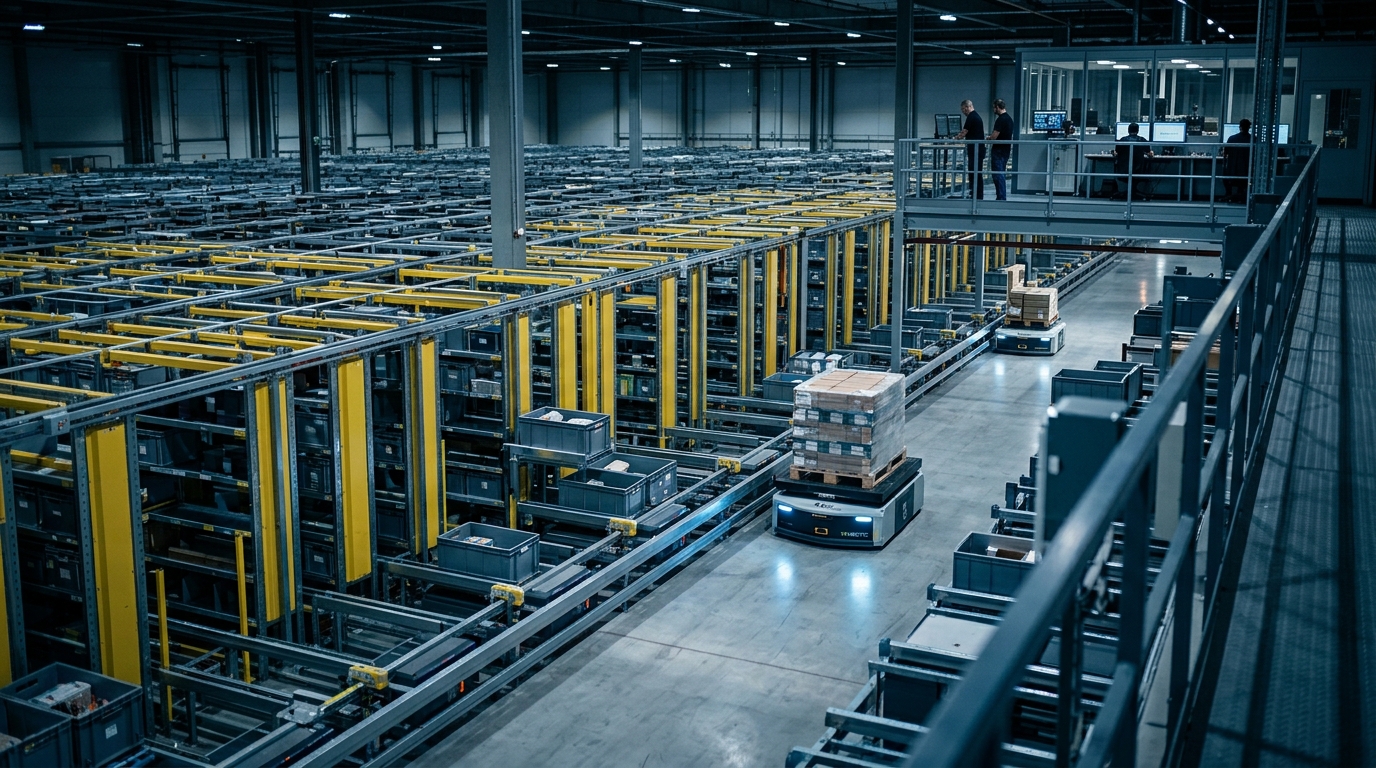
Symbotic builds AI-driven systems that automate the full movement of goods inside distribution centers. Its software orchestrates hundreds of autonomous bots, handling everything from case digitization to mixed-pallet sequencing. Both Symbotic and FieldAI sell intelligence for robots they do not manufacture. The difference: Symbotic is public, increasingly profitable, and compounding at scale.
The Numbers
Q3 fiscal 2026 revenue reached $721 million, up 22% year over year. Adjusted EBITDA more than doubled to $95 million. Net income turned positive at $55 million, compared to a $21 million loss a year earlier. Q4 guidance calls for $760 million to $780 million in revenue and $100 million to $105 million in adjusted EBITDA.
The backlog is where the case gets compelling. As of Symbotic’s fiscal year-end September 27, 2025, the company reported $22.5 billion of backlog. That underpins years of revenue regardless of what any single quarter’s bookings look like.
The Risk Nobody Ignores
Walmart is the central risk. In Symbotic’s fiscal year 2025, Walmart accounted for about 85% of revenue. Symbotic is working to reduce that concentration through GreenBox Systems, a warehouse-as-a-service joint venture with SoftBank that opens its systems to smaller businesses on usage-based terms. New wins with grocers and wholesale distributors show the diversification is moving.
The Valuation Gap
FieldAI, with $135 million in revenue and contracts, is seeking a $10 billion private valuation. Symbotic, with $2.25 billion in fiscal 2025 revenue and turning genuinely profitable in fiscal 2026, trades at a market cap near $25 billion, roughly 11x fiscal 2025 sales. Seventeen analysts rate SYM a Buy, with an average price target of $62.86, about 47% above the October 9, 2026 close.
The risks are real. SYM has fallen more than 50% from its November 26, 2025 intraday high of $87.88. Customer concentration remains the loudest bear case. A slowdown in retail capital spending could delay deployments and stretch backlog conversion.
But FieldAI commanding a $10 billion private valuation on $135 million in revenue is a clear signal of what the market believes physical AI software is worth. Symbotic has a far larger revenue base, a $22.5 billion backlog, and a decade of live systems. Private markets are paying full multiples for the category. At roughly 11x sales on its last full fiscal year, the public version may still be catching up.
 Rising Star Stocks