October 20, 2026
Bonus Content: The Indiana Utility Powering Microsoft’s Next Data Center
Jeff Brown is the former tech executive who called the rise of Bitcoin, Tesla, and Nvidia years in advance. He’s now predicting Elon Musk is about to open a new wealth window by October 30. Click here to see the details or read more below because the last three times this window opened, those who acted had a chance to walk away with generational wealth.
Dear Reader,
By the end of this month…
Elon Musk is about to shock the world again.
He’s predicting this NEW opportunity will be 180 times bigger than the SpaceX IPO…
And will unleash enough wealth to make every household in America $2.38 million.
Will you be one of them?
Click here to see the details and decide for yourself.
We have so much to look forward to,
Jeff Brown
Founder & CEO, Brownstone Research
The Indiana Utility Powering Microsoft’s Next Data Center
Nobody writes feature stories about regional utilities. That is exactly the point.
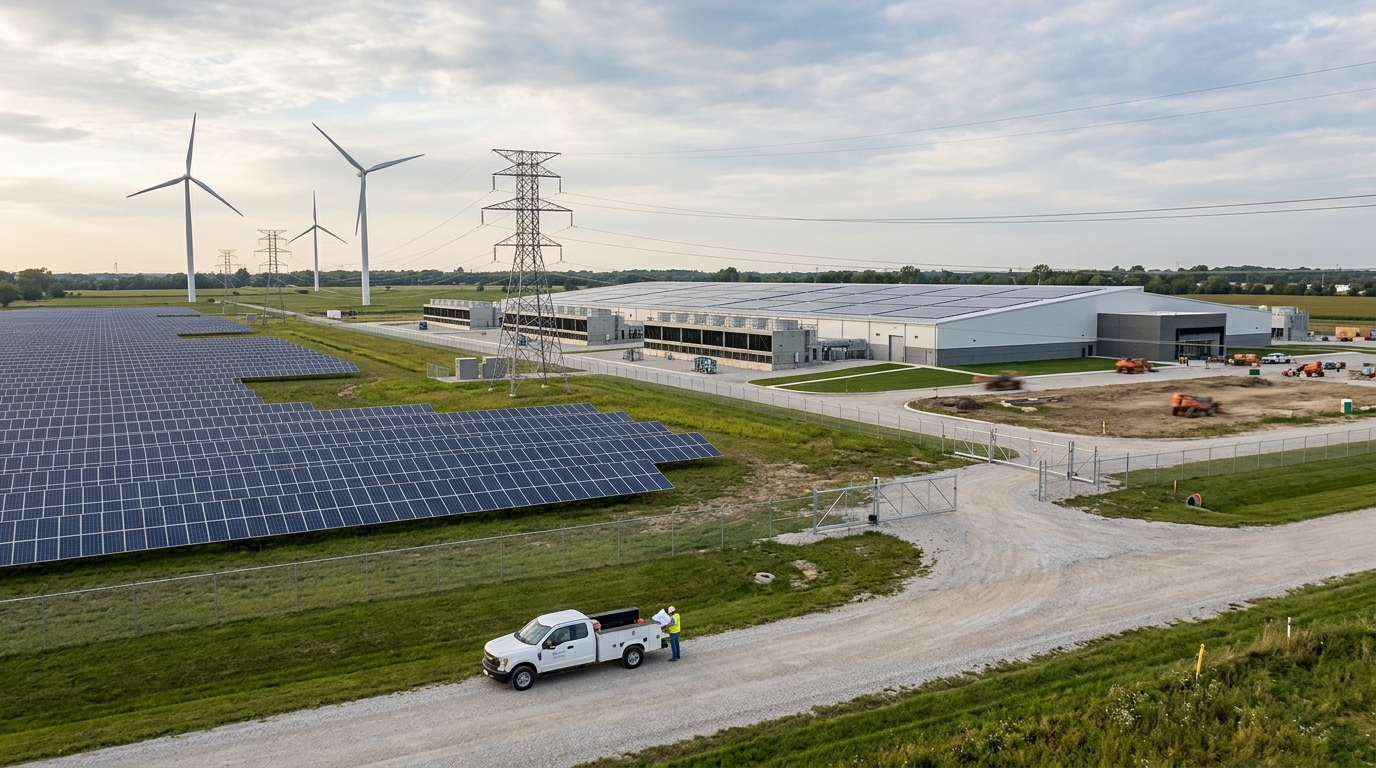
While Digital Realty’s plans for a gigawatt-scale campus on 476 acres in Kokomo, Indiana grabbed the headlines this week, the more consequential development for investors may sit two tickers away: NiSource (NYSE: NI), the Merrillville, Indiana utility that just signed a 20-year power agreement with Microsoft to fuel a data center campus in northwest Indiana.
What the Deal Actually Says
The contract runs for 20 years and commences in 2028, when Microsoft is expected to begin drawing power for its northwest Indiana campus. NiSource’s portfolio serving large-load customers is expected to increase by approximately 1.1 gigawatts as a result. That is not a rounding error. For context, NiSource serves approximately 3.3 million natural gas customers and 500,000 electric customers across six states. One hyperscaler deal just added capacity equivalent to a material fraction of its entire electric base.
Microsoft will fund all generation and transmission required to serve its load, with the structure designed to protect existing NIPSCO electric customers from incremental costs. NiSource will also upgrade transmission and, in connection with the agreement, GenCo has contracted 600 megawatts of battery storage under a long-term tolling agreement. That structure matters. The utility gets a long-duration revenue stream with large-load customers funding the infrastructure, and existing residential customers are positioned to be shielded from cost increases tied to serving the data center.
NiSource also raised its projected customer savings associated with its data center agreements to approximately $1.75 billion over the life of the contracts, up from a previously disclosed estimate of $1.4 billion.
Why Indiana, Why Now
The answer is power. U.S. purchases of land for future data centers reached about $6 billion in the first half of 2026, up 79% from a year earlier, according to Avison Young. That capital is not chasing cheap acreage. It is chasing electrons. “The biggest thing right now is speed to power,” said John Andril, a manager of market intelligence at Avison Young. In Northern Virginia, entitled land without power can sell for around $4 million per acre, while powered land can fetch at least $6 million per acre.
Indiana offers something Northern Virginia increasingly cannot: available capacity paired with a utility willing to structure large-load agreements that protect retail customers. The Drax episode in the UK illustrates the alternative. The UK’s rejection of the Drax AI Growth Zone bid cited a failure to meet criteria including “credible plans for energy delivery, environmental considerations, and local economic benefit.” Capital that cannot get a grid connection in one geography does not disappear. It relocates.
The Financials Behind the Story
NiSource is not a growth stock in the traditional sense. Over the twelve months to June 30, 2026, the company reported revenue of $6.9 billion. In its most recently reported full year (2025), NiSource reported non-GAAP adjusted net income available to common shareholders of about $905 million. Steady. Regulated. Not exciting.
What changes the calculus is the capital plan. The company expects to invest approximately $28 billion from 2026 through 2030 under its consolidated plan, which includes nearly $7 billion in strategic data center infrastructure investments. That plan is expected to support a compound annual EPS growth rate of 8% to 9% and rate base growth of 9% to 11% through 2033. For a regulated utility, those are aggressive targets.
The Microsoft deal follows other data center agreements. Reuters previously reported that NiSource had signed a long-term supply agreement with an Alphabet unit for a northern Indiana data center and had expanded an Amazon agreement to accelerate power delivery. Microsoft is not the first hyperscaler to choose this utility. It is the third.
Risks Worth Noting
NiSource is guiding for 2026 non-GAAP consolidated adjusted EPS of $2.02 to $2.07. The Microsoft revenue does not arrive until 2028, meaning the near-term financials reflect capital outlay before contracted income. Execution risk on the transmission upgrades is real, and regulatory approvals tied to these agreements still matter. A utility scaling this fast is also carrying meaningful debt.
The Bigger Picture
Simultaneously, Digital Realty plans to develop a gigawatt-scale data center campus on 476 acres in Kokomo, Indiana, comprising three one-story buildings. Kokomo is the county seat of Howard County, about 50 miles north of Indianapolis. That campus could be fully built out by 2033. Indiana is becoming a genuine data center corridor, and NiSource sits at its power backbone.
The companies generating the most investor attention in this buildout, the hyperscalers and the REITs, need a NiSource to function. That kind of structural necessity, locked into 20-year contracts, is worth keeping on the radar.
 Rising Star Stocks