
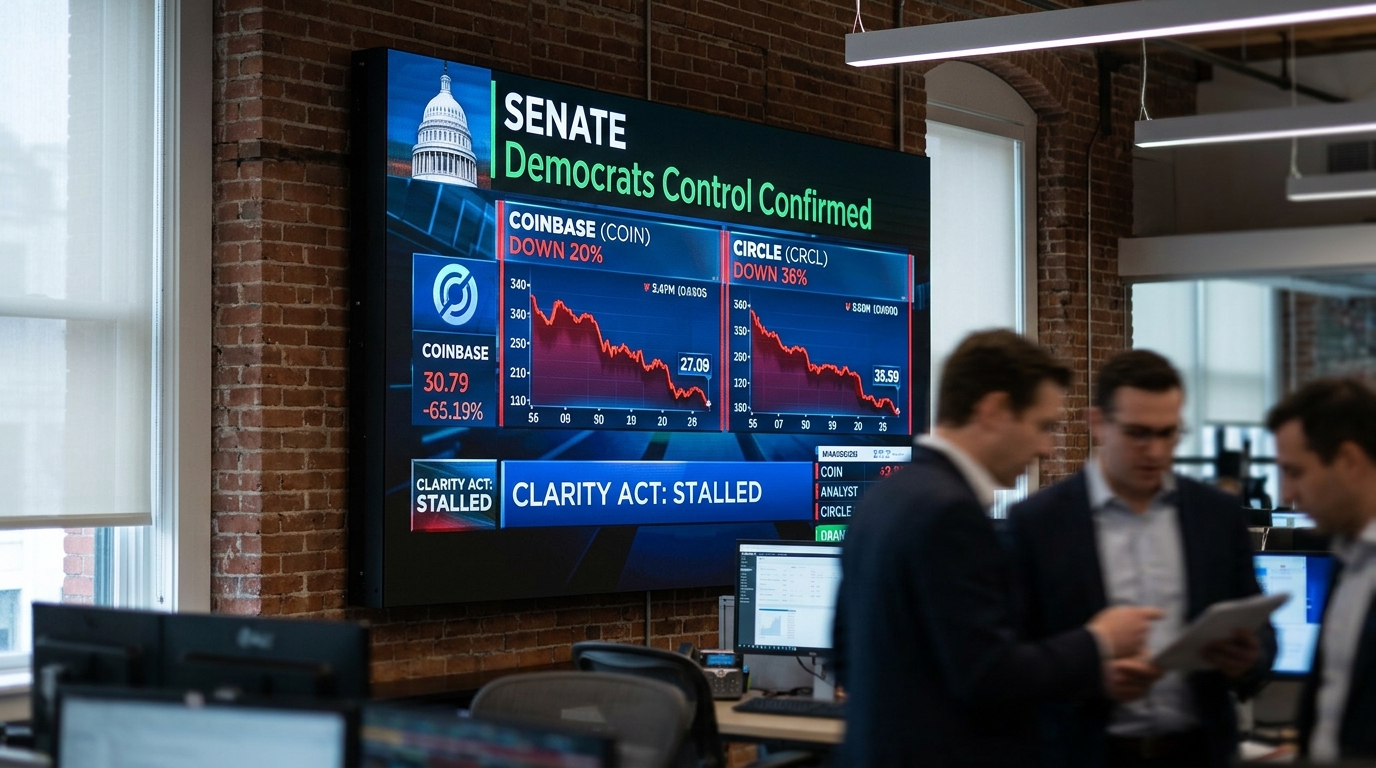
Bitcoin touched a seven-week low near $75,600 overnight before recovering above $78,000 Wednesday morning. The bounce was fast enough that some traders read it as resilience. It was not. TD Cowen’s Washington analyst Jaret Seiberg had already delivered the sharper verdict in an election-day note: a Democratic sweep of Congress ends the CLARITY Act’s chances for the next two years. That is now the base case, and institutional investors are not debating the bill anymore. They are debating something harder: how to price Coinbase and Circle without it.
The Legislative Premium, Priced and Unpriced
Democrats won control of the Senate after flipping Republican-held seats in Texas, Ohio, North Carolina, South Carolina, Kansas and Iowa.
Elizabeth Warren is the top Democrat on the Senate Banking Committee, which positions her to take over the chair when Democrats assume control. She voted against the CLARITY Act’s September procedural vote and demanded stronger restrictions on presidential crypto conflicts of interest.
The market-structure bill passed the House 294-134 in July 2025 and failed a Senate cloture vote 49-50 on September 15. If it does not pass by the end of the current Congress, the next Congress will have to start over. Nobody serious expects it to pass in the lame-duck window.
The question for portfolio managers is what, exactly, they were paying for when they bought COIN, CRCL, or HOOD. The stocks have been punishing. Coinbase trades around $145, down about 20% over the past twelve months. Circle’s market value sits near $18 billion. Circle is down about 36% in a year.
That decline predates this morning. The legislative premium unwound in stages. When the Senate first failed to advance the CLARITY Act on September 15, Coinbase closed 10.10% lower at $172.11 and Circle settled 11.41% down at $86.30, one of the sharpest single-session drops for either name in 2026. Today’s move simply confirms what September started.
The Bull Case Rests on the Business, Not the Bill
Here is where the professional debate actually sits. One camp argues Circle’s vote is on rates, not on crypto. Its stablecoin regulatory framework is bipartisan and already law. The election matters to Circle mainly through the Fed: a Democratic Senate makes rate cuts harder, which supports its interest income. That is a genuinely different thesis from the legislative one, and it held up through the September sell-off.
Coinbase’s case is more complicated. In the third quarter reported October 29, Coinbase generated $1.2 billion of net revenue, with transaction revenue of $590 million and stablecoin revenue of $307 million, roughly a quarter of net revenue. The election risk for Coinbase is a bank fight, not a party fight. The trading bill already stalled under Republicans, and a friendlier SEC does not need Congress. Trading volumes drive the stock more than any single piece of legislation.
A Democratic majority could block Trump’s nominees and use that power to shape leadership across the FDIC, SEC and CFTC, the three agencies at the center of crypto policy. That is the overlooked lever. Warren does not need the CLARITY Act to reshape the regulatory environment. Committee chairmanship gives her subpoena power, hearing agendas, and the ability to slow-walk any nominee whose views on digital assets she finds insufficient.
Stocks to Watch
Coinbase (COIN): Trading near recent lows with the legislative tailwind gone, the stock now lives or dies on Bitcoin price and institutional custody volumes. At roughly $42 billion market cap against $590 million in quarterly transaction revenue, the valuation still embeds a recovery that requires higher volumes, not a law.
Circle (CRCL): The more interesting case. USDC in circulation was about $73.5 billion as of early July 2026. Circle is a U.S.-regulated issuer with fully backed reserves, the kind of company the stablecoin law was written to favor. Its problem is the reserve rate, not Warren.
Robinhood (HOOD) and Strategy (MSTR): Strategy tracks Bitcoin more than the bill itself. Robinhood carries retail trading exposure that is entirely independent of market-structure legislation. Both rebounded Wednesday, which tells you more about Bitcoin’s recovery than about Congress.
The CLARITY Act was never the whole thesis for any of these companies. That was always the more honest framing. Warren’s chairmanship makes it easier to test.
 Rising Star Stocks