
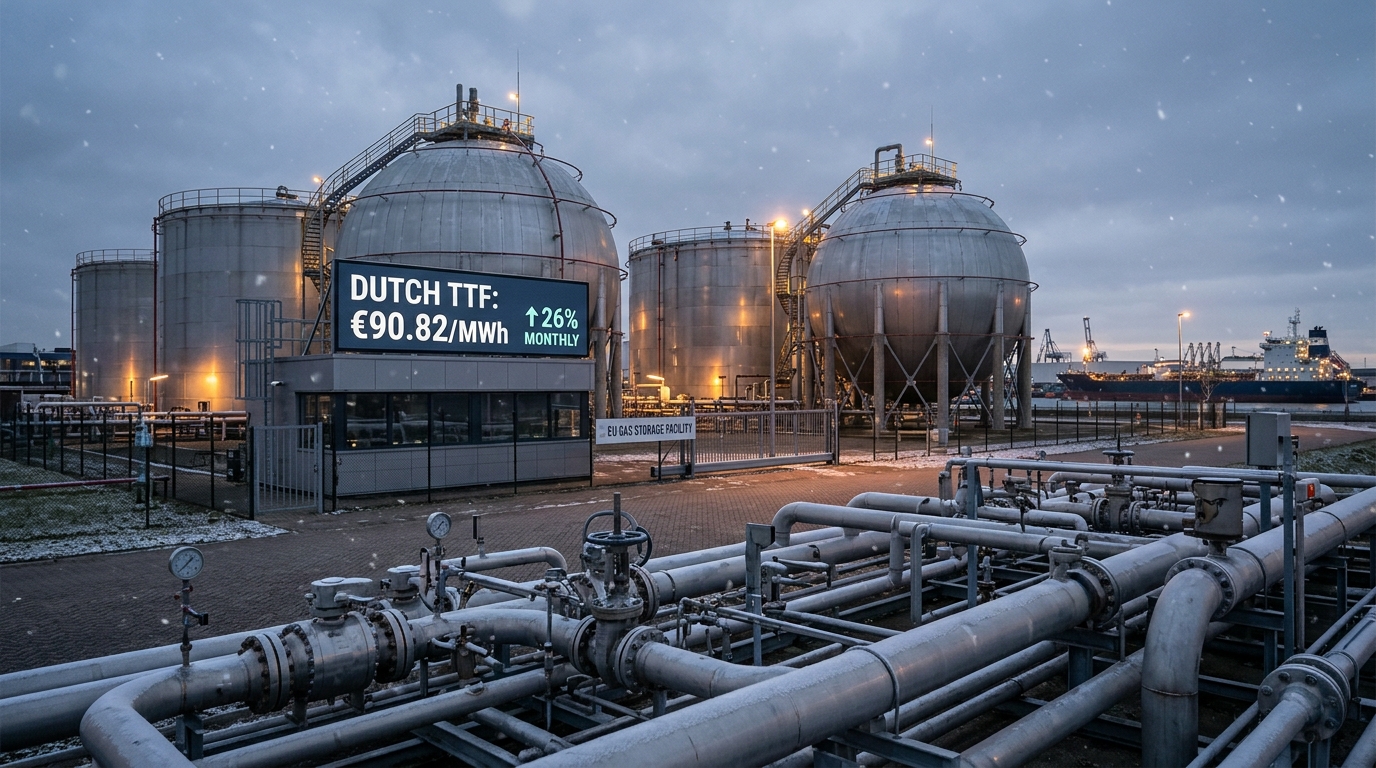
The move that deserves the most attention this week is not in equities. Dutch TTF settled at €90.82 per megawatt-hour on October 22, up about 4% on the day. As of this morning, front-month TTF is still trading around that level and has been testing above €90. A commodity back near multi-year highs tends to get noticed. European gas has not.
What Actually Moved
On October 20, Dutch TTF gas traded above €90 per megawatt-hour for the first time since December 2022, and it has hovered around that level since. European gas prices remain far above pre-2022 norms amid Middle East-related LNG disruption risk and unusually low inventories. As of October 20, European storage facilities were 74.62% full, with Germany at about 61%.
EU gas storage stood about 74% full in mid-October, well below the level recorded a year earlier and materially under the five-year average for the same date. The EU has not quietly relaxed its mandatory storage target from 90% to 80% for this winter. Instead, the rule still targets 90% filling, but it now allows a wider compliance window, with the 90% level to be reached any time between October 1 and December 1 rather than by November 1. That flexibility helps on paper, but it does not change the physical reality that Europe is entering winter with less cushion than usual.
Why It Happened
The supply side of this equation was broken in March. QatarEnergy said missile strikes damaged two LNG trains at Ras Laffan, curtailing 12.8 million tons per year of production, about 17% of Qatar’s exports. QatarEnergy also said the damage could cost about $20 billion a year in lost revenue and take up to five years to repair.
Force majeure extends for years on some contracts. Shipping risk through the Strait of Hormuz has also been a major swing factor for LNG flows since the outbreak of the Iran war, and it remains the fastest route to either relief or another leg higher in TTF. A midweek dip tied to ceasefire chatter did not last.
Qatar’s export volumes have been sharply constrained relative to pre-war norms. That is not a routine disruption. It is the market trying to clear without one of the world’s largest sources of LNG flexibility.
What the Market May Be Missing
The consensus view is that a mild winter saves Europe. The Copernicus Climate Change Service October forecast does lean toward above-normal temperatures across much of the continent. But mild weather is the scenario the market is already pricing. What it is not pricing cleanly is the tail.
ENTSOG has warned that colder, tighter scenarios can imply meaningful uncovered demand without additional flexibility, depending on assumptions around LNG availability and flows. Goldman Sachs commodities analyst Samantha Dart said in late summer that prices could need to rise to around €100 per megawatt-hour to discourage Asia LNG demand and free incremental cargoes for Europe. TTF is nearly there without a cold snap. Add one, and the math changes quickly.
The deeper issue runs beyond this winter. The EU’s full ban on imports of Russian LNG is set to take effect on January 1, 2027, tightening the 2026-27 winter balance further if replacement supply does not materialize. That pressure lands on top of storage that is already running well below its seasonal norm.
Where It Shows Up
The bond market is the clearest transmission channel. Bloomberg reported in late August that natural gas had overtaken oil as the biggest concern for European bond traders as depleted supplies threatened a resurgence in inflation. UK 10-year gilts have been trading at their highest levels since 2007, while German bund yields are back around levels last seen in the early 2010s. Rate expectations have firmed accordingly. Gas is a big part of that story.
Among individual names, Uniper is one of Europe’s largest gas and LNG merchants. The company says it supplies roughly 190 TWh of gas annually in Germany, holds 57 TWh of LNG regasification bookings, and has 7.2 billion cubic meters of underground gas storage capacity across Germany, Austria and Britain. Reuters reported this month that Apollo submitted a non-binding bid for Uniper, with other bidders including Equinor and a consortium of KKR with rival German utility RWE.
For industrial Europe, the pain is not new, but it is compounding. European gas prices averaged about 3.6 times US levels in January through July 2026, and Europe’s chemical production was down about 2.0% between January and July 2026 versus the prior year, according to Cefic. Named producers including SKW Piesteritz and LAT Nitrogen have been running reduced rates or curtailing capacity. At around €90/MWh, those calculations do not improve.
Risks and Counterpoints
The bear case on gas prices is real. Citi analyst Maggie Xueting Lin has maintained a Q4 TTF base case around €56 per megawatt-hour, pointing to industrial demand destruction as a release valve even amid continued Middle East-related LNG disruption risk. She is not wrong that demand has fallen. EU gas demand is still well below pre-crisis norms, and that weakness is the safety valve.
A mild start to winter would also give Europe room to build inventories before the coldest months. QatarEnergy has said repairs at Ras Laffan will take years, meaning any meaningful recovery in production is a 2027 story, not a 2026-27 winter one.
What to Watch Next
Three things resolve the near-term picture. First, the weather: a sustained cold spell rather than a brief snap is the event that changes the calculus. Second, any credible progress on Qatar-Iran diplomatic talks and any de-escalation that lowers shipping risk through the Strait of Hormuz would be the fastest route to supply relief. Third, watch eurozone inflation data due in the coming weeks: with bund yields at multi-year highs and the ECB priced for further tightening, a gas-driven inflation surprise could accelerate bond selling faster than the underlying commodity move suggests.
 Rising Star Stocks