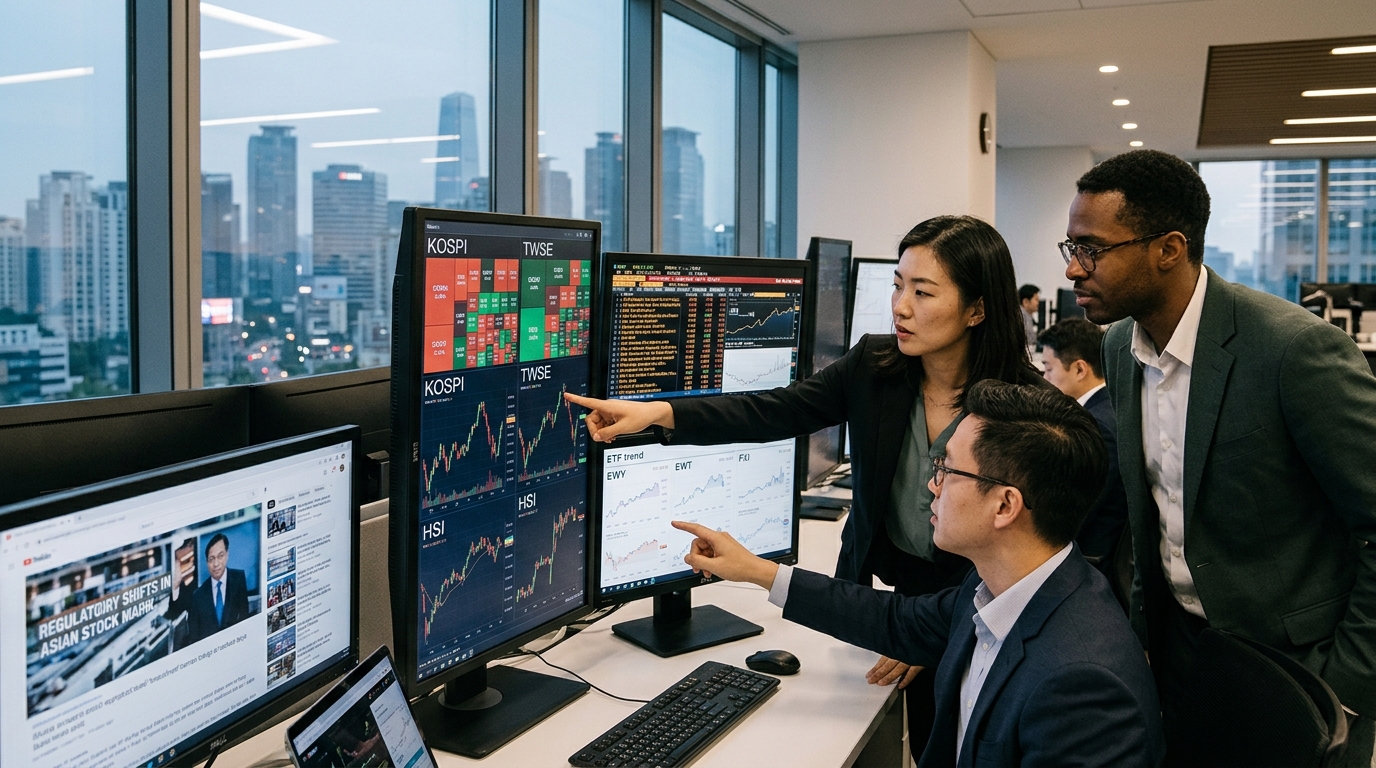
Three separate governments moved on the same weekend to put a floor under their stock markets. The question for traders this week is not whether the interventions are sufficient; it is whether the signal they send together is enough to change positioning across Asian indexes and the US-listed names tied to them.
What Each Government Did
China made the most dramatic move in raw dollar terms. State-backed funds poured a record 90 billion yuan ($13.5 billion) into nine ETFs on Friday alone, surpassing the previous single-day high of 87 billion yuan set during the April 2025 tariff rout, Bloomberg reported. The Harvest CSI 300 ETF drew a record 23 billion yuan; the ChinaAMC SSE 50 ETF attracted an all-time high of 21.7 billion yuan. That buying landed against a deteriorating backdrop: the CSI 300 has remained under pressure, with state-backed purchases yet to reverse the broader market downturn.
Taiwan moved on rules rather than cash. Taiwan’s Financial Supervisory Commission announced five measures, including a ban on short-selling below the previous trading day’s closing price and a rise in the minimum margin requirement from 130% to 150%. The intervention followed what Bloomberg described as the Taiex’s steepest weekly decline since August 1990. On Monday, the Taiex closed up 2.16% at 36,811.89, the first session under the tighter regime.
South Korea signaled the heaviest commitment by name, though it has yet to pull the trigger. Finance Minister Lee Hyoung-il said the government is preparing to activate its 10.76 trillion won (about $8 billion) market stabilization fund as the KOSPI’s selloff deepens. The fund was established in 2020 but has never been deployed; activation was considered in 2022 but not carried out. The fund’s size is already drawing skepticism: daily KOSPI turnover can run far above the fund’s headline size, which raises the risk that any deployment could be overwhelmed by sustained foreign institutional selling.
What the Market Did With It
The interventions produced divergent outcomes on Monday, which matters for trade sizing. The KOSPI closed down 3.31% at 4,708.54, triggering a sell-side sidecar mechanism amid steep intraday losses, with Samsung Electronics and SK Hynix declining 3.06% and 2.52%, respectively. Taiwan’s response was the clearest win for intervention: the short-sell curbs produced an immediate bounce and the Taiex closed higher. China’s CSI 300 edged up fractionally.
The divergence tells traders something. When the mechanism is structural, as Taiwan’s floor-price rule is, it cuts off the mechanical pressure of short sales below the close and delivers an immediate technical reprieve. When the mechanism is a fund that has not yet deployed capital, as Korea’s is, the market treats the announcement as a promise rather than a bid.
Where to Focus Exposure
EWT, the iShares MSCI Taiwan ETF, is the most direct expression of the short-sell rule trade. With the FSC ban in place, the technical floor on individual names tightens, and TSMC’s weighting in EWT means the ETF captures any further stabilization in the benchmark directly. EWT is the highest-conviction rebalancing candidate from this weekend’s actions.
FXI and KWEB reflect Beijing’s bid. Alongside the ETF purchases, China’s exchanges have flagged additional steps aimed at supporting market liquidity, and the record buying underscores Beijing’s efforts to prop up investor confidence amid persistent selling pressure. State buying at this scale has historically produced brief relief rallies in FXI rather than sustained reversals, so the trade here is tactical and short-dated.
EWY is the hardest call. Samsung Electronics and SK Hynix sit at the center of South Korea’s exposure. The fund is ready but undeployed, and Seoul’s measures’ market impact remains to be seen. Until the fund actually buys, EWY trades on sentiment rather than a confirmed bid, which makes position sizing the primary risk management tool here.
Three governments intervening in the same weekend is not noise. It is a signal that the political cost of further declines has reached a threshold. That changes the risk backdrop, even if it does not change the fundamental outlook on AI spending. Shorter time horizons, defined risk levels, and preference for the markets where intervention has already arrived in the form of active rules rather than pledged funds is the framework that fits this week.
 Rising Star Stocks