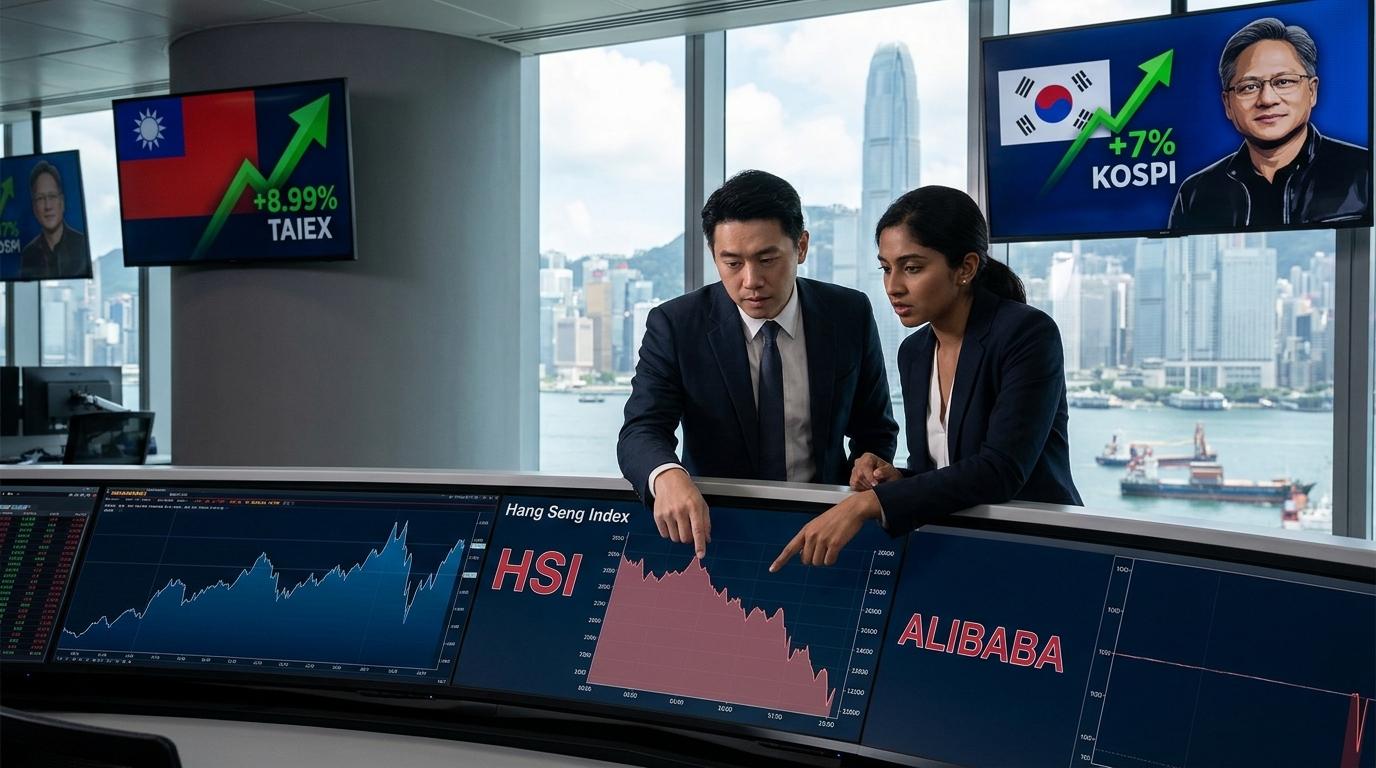
Every market in Asia had a reason to rally today. Taiwan’s benchmark Taiex rose 8.99%, reclaiming the 40,000 mark, and South Korea’s Kospi climbed about 7%, both powered by the relief that Jensen Huang was back at Nvidia’s helm. Hong Kong opened on the same script. The Hang Seng climbed 243 points at the open to 22,627, with Alibaba advancing more than 4% and Lenovo jumping about 10%. By midday, the picture had flipped entirely.
The Hang Seng fell as Hong Kong stocks failed to sustain their opening momentum and turned downward, ending the session lower while Seoul and Taipei held their gains. The divergence was not random. The Hong Kong benchmark wiped out the entirety of its opening gains amid weakness in Chinese tech stocks, while the US added Apex Enterprise Solutions (Singapore) and Megaspeed-linked firms to its trade blacklist.
What the Filing Actually Said
In a filing dated November 23, the Commerce Department moved to add seven firms to its Entity List, a designation that restricts US exports, reexports, and transfers of items subject to US export rules without a license. Also named were Apex Enterprise Solutions (Singapore) Private Limited, along with Megaspeed International Pte. Ltd. and Swiftdata Pte. Ltd. in Singapore, MSFusion Sdn. Bhd., PT Megaspeed International, and Speedmatrix Sdn Bhd in Malaysia, and Megaspeed (Thailand) Co., Ltd. in Thailand.
The Bureau of Industry and Security said the companies posed a “significant risk” of diverting advanced computing commodities to unauthorized end users. Alibaba rejected that reasoning immediately. The company said adding Apex Enterprise Solutions to the Entity List was erroneous and said Apex had not diverted advanced computing chips subject to US export restrictions. Alibaba also said it would pursue legal options to protect its Singapore unit.
The connection between Apex and Megaspeed is financial. Reporting in Singapore has described a financial arrangement between Apex and a Megaspeed-linked firm. Megaspeed, a cloud and data center company tied to Nvidia hardware, has been under investigation since 2024 over possible chip diversion to China.
What the Market May Be Missing
The Hong Kong reaction tells you something the index headline obscures. Alibaba’s core cloud and e-commerce operations in China are not on the Entity List. Apex is a Singapore-based intermediary. Yet Alibaba fell in Hong Kong as heavyweight technology stocks retreated, pulling the market lower into the afternoon session. The selling reflects not what Alibaba loses operationally from this designation, but what the market is pricing: that Washington is now willing to reach directly into Chinese technology companies’ overseas subsidiaries.
This Entity List action arrives within days of a broader tightening. On November 19, BIS put an interim final rule titled “Addressing Remote Access to Advanced Semiconductors” into effect, targeting what the government calls a gap in existing chip controls: companies in China can rent US-designed computing power from data centers in third countries rather than import the chips themselves. The rule adds new license requirements for Indonesia, Malaysia, Singapore, Thailand, and Brazil, countries BIS described as presenting a higher-than-normal risk of diversion. The Entity List action against Apex is enforcement; the remote-access rule is architecture. Together, they signal that the third-country workaround Washington tolerated for years is being dismantled systematically.
Where It Shows Up
“Jensen’s return is particularly welcome for Asian technology stocks, many of which suffered collateral damage from Nvidia’s leadership crisis,” said Charu Chanana, chief investment strategist at Saxo. That collateral damage is now distributed unevenly. Taiwan and Korea hold the supply-chain upside from Huang’s return. Hong Kong holds the enforcement risk. Any Chinese technology company with Southeast Asian subsidiaries touching Nvidia infrastructure now faces a credible question about whether its own entity structure survives the next BIS filing.
Risks and Counterpoints
Alibaba’s legal challenge has real grounds. The company’s argument that Apex never physically diverted chips is factually distinct from the question of whether Apex’s financial ties to firms under investigation constituted unacceptable risk. In the November 23 rule adding the seven entities, BIS applied a presumption of denial for licenses for all items subject to US export rules for each listed entity, including Apex, which shapes the starting point for any appeal.
What to Watch Next
Three things will determine whether today’s Hong Kong divergence is a one-session anomaly or the start of a wider re-rating of Chinese tech’s overseas exposure. First, the outcome of Alibaba’s legal fight: an administrative appeal that succeeds would signal the BIS designation was overreached; failure would validate the template for future actions. Second, Singapore’s own investigation into Megaspeed, which Prime Minister Lawrence Wong said will continue. Third, whether any other Chinese technology company discloses material contracts with entities now on the Entity List. The filing is dated November 23. The Federal Register publication is scheduled for November 25. The legal clock is now running.
 Rising Star Stocks