June 12, 2026
Dimon Say Banks Should Be “Scared S**tless”
Featured – Rising Star: EchoStar Corp ($SATS)
Editor’s Note: JP Morgan’s Jamie Dimon warned this day was coming. Now the investment expert who called Nvidia before it soared 1,000%, says it’s finally here. Full story…
Dear Reader,
JPMorgan CEO Jamie Dimon… the most powerful banker in America… told his peers something shocking not too long ago.
He said, “banks should be scared s**tless.”
Not about a recession or interest rates…
It’s the moment big tech finally comes for Wall Street.
And that moment just arrived.
At the center of everything is Elon Musk.
And Elon just launched the most direct assault on traditional banking America has ever seen.
He’s secured money-transfer licenses in all 50 states. He’s signed a deal with Visa. And he’s already mailing physical banking cards to Americans across the country.
Most surprisingly, he’s offering yields on cash that are 10 times what your bank is paying you right now.
Dimon saw it all coming. As did The Federal Reserve, IMF, Goldman Sachs, and BlackRock.
In fact, they’ve all been warning about this for years.
And while the banks figure out how to respond, there’s a narrow window for regular investors to get in early, before this becomes front page news.
My name is Luke Lango. I was voted America’s #1 stock picker in 2020. My readers have had the chance to see gains as high as AMD +13,500%… Nvidia +5,000%… Palantir +1,200%.
And I’ve put together a full briefing on exactly what to do with your money right now because of this.
You can find everything on this page here.
Best,
Luke Lango
Senior Investment Analyst, InvestorPlace
P.S. Your bank has been skimming off every transaction, every deposit, every paycheck for your entire life. Elon just decided to end that. The investors who move first on this story could make incredible profits. In fact, my readers have had the chance at gains as high as 13,500% or more when I’ve spotted stories like this early. Get the full briefing here.
Rising Star: EchoStar Corp ($SATS)
Most Investors Are Watching SpaceX. A Few Are Watching This.
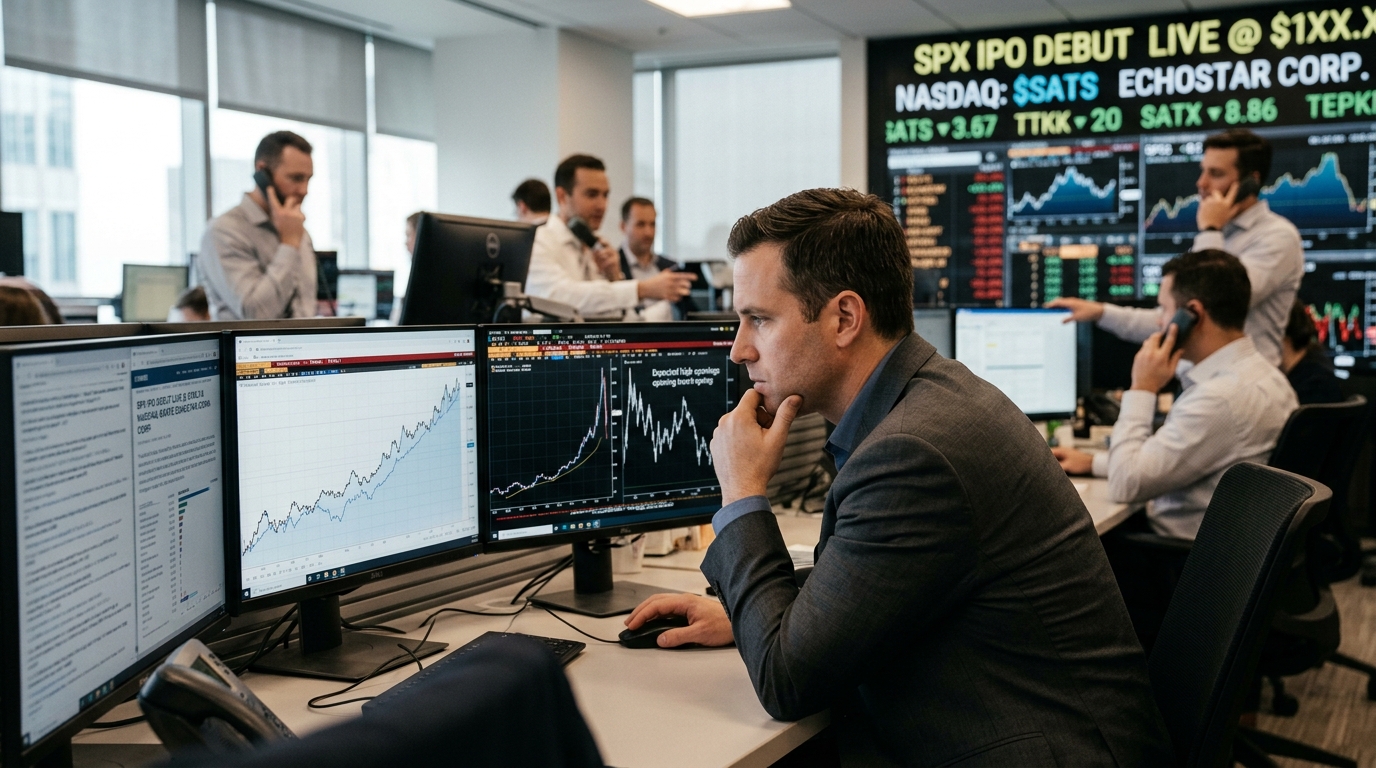
Today is the day. SpaceX priced its IPO at $135 per share, raising $75 billion and landing a valuation of roughly $1.77 trillion before its Nasdaq debut. Every financial desk in the country is staring at the ticker. Retail order books reportedly topped $70 billion in demand. It is the kind of moment that rewires how people think about an entire sector.
But here is what most people are missing while the rocket gets all the attention.
EchoStar Corporation ($SATS) closed Thursday at $128.13, up 11.19%, and climbed another 5.48% in Friday pre-market trading to around $135. Today’s intraday range has already stretched from $115.52 to $135.45, with volume running at nearly double its daily average of 8.44 million shares. The market cap has pushed past $37 billion. And the reason has very little to do with satellite television.
Missed Tesla? PayPal? SpaceX? You Might Regret Missing This One Too…
Many are calling him The Next Elon Musk…
His first company made investors 6,566% before the age of 25…
Now, he’s building one of the most-anticipated companies in the world… with $26 billion in government contracts already in place.
And one rare 4-letter ticker gives you early access – before the IPO.
What EchoStar Actually Is Right Now
This is where it gets interesting. EchoStar is no longer simply a legacy pay-TV and broadband company. Analysts at MoffettNathanson have described the company as trading more like a “space-themed hedge fund” than a traditional telecom operator. That framing is blunt, but it is not wrong.
In September 2025, EchoStar agreed to sell its AWS-4 and H-block spectrum licenses to SpaceX for approximately $17 billion, structured as up to $8.5 billion in cash and up to $8.5 billion in SpaceX stock. SpaceX also agreed to cover roughly $2 billion of EchoStar’s debt interest payments through November 2027, removing a major financial overhang from the balance sheet. The deal later expanded in November, when EchoStar agreed to sell its unpaired AWS-3 licenses to SpaceX for an additional $2.6 billion in SpaceX equity. That second tranche pushed total SpaceX equity consideration past $11 billion at deal marks.
SEC filings confirmed EchoStar could receive up to $11 billion in SpaceX Class A shares valued at $212 per share at the time of signing. At SpaceX’s IPO valuation of $1.77 trillion, that stake has grown considerably in implied value. New Street Research rated EchoStar a Buy, specifically calling it a “proxy play” on SpaceX due to this equity exposure. TD Cowen analyst Greg Williams put fair value at $155 per share. Oppenheimer started SpaceX itself with an outperform rating and a $190 price target.
Slight tangent, but it matters: EchoStar was added to the S&P 500 in March 2026 as part of the index’s quarterly reshuffle, landing in the communication services category. That index inclusion alone redirected passive fund flows into a stock that had been largely ignored outside of telecom desks for years.
The Spectrum Angle
The core asset being transferred is licensed wireless airwaves. EchoStar’s spectrum portfolio, accumulated over years of government auctions and merger activity, is precisely what SpaceX needs to expand Starlink’s direct-to-cell satellite network globally. These are not generic assets. They are scarce, regulated, and irreplaceable by definition.
The FCC approved the full roughly $40 billion spectrum transaction, covering $17 billion to SpaceX and $23 billion to AT&T, in May 2026. That regulatory clearance resolved one of the biggest overhangs on the stock and opened the path toward a November 2027 closing timeline. As part of the commercial relationship, EchoStar’s Boost Mobile customers will also gain access to Starlink’s direct-to-cell service through EchoStar’s cloud-native 5G core. That commercial layer adds a recurring revenue dimension beyond the one-time spectrum sale proceeds.
As Costs Rise, More Americans Are Looking for “Fast Cash” Ideas
With rising expenses squeezing household budgets, many Americans are searching for new ways to grow their money.
Discover a strategy designed to identify “Fast Cash” trade opportunities after earnings announcements.
The Part People Skip
The risks here are real and worth stating plainly. EchoStar’s core operating business is under measurable pressure. First-quarter 2026 revenue came in at $3.67 billion, down from $3.87 billion a year earlier, and the company reported a net loss of $146.89 million. On June 1, EchoStar disclosed it elected not to make approximately $183 million in cash interest payments on DISH DBS notes, a signal that the legacy business still requires careful balance-sheet management. The FCC also required EchoStar to fund a $2.4 billion escrow account as part of the spectrum deal approval.
And the SpaceX shares are not in hand yet. The deal is expected to close in late 2027, meaning any lockup periods or post-closing restrictions could delay EchoStar’s ability to monetize or use those shares for debt reduction. GuruFocus has flagged the stock as significantly overvalued on traditional intrinsic value metrics. Insider selling of $7.6 million over the last three months, with no reported buying, adds a layer of caution to the picture.
The 52-week range tells its own story: $16.73 to $147.25. That is not a stock for the faint-hearted.
Why It Still Demands Attention
What makes EchoStar unusual is that most of its current market value is no longer tied to satellite TV subscriptions or wireless ARPU metrics. It is tied to the outcome of the most-watched private technology company in the world going public on the Nasdaq today. If SpaceX’s debut holds and the valuation stays elevated, the implied value of EchoStar’s SpaceX equity consideration moves with it. That is a structural dynamic that has very few comparisons in the current market.
This is not a traditional value stock. It is not a dividend play. It is not a defensive hold for a volatile week. What it may be is a liquid, publicly traded vehicle for investors who want economic exposure to the SpaceX listing without paying the IPO price directly. The question investors are sitting with right now is whether that exposure is worth the balance-sheet complexity underneath it.
That is the kind of question that does not resolve cleanly by the closing bell.
 Rising Star Stocks