July 27, 2026
The $20 Billion Tunnel Bet
The Boring Company is chasing a valuation that would reshape underground transit investing.
First a note from Base Camp Trading
Hi Reader,
There’s a reason the most profitable trading desks in the world don’t care whether the market goes up or down.
They figured out a long time ago that betting on direction is a losing game, and they quietly moved to the other side of it.
While retail traders bet on calls and puts… hoping they guessed right, the “smart money” collects cash from those exact same trades… every trade… every time.
Win, lose, or draw on the direction call… they get paid regardless.
See how to turn their “smart money” secret into your new income strategy – FREE.
Bull markets. Bear markets. The sideways chop that drives every trader crazy.
Doesn’t matter. The income keeps coming.
I spent 25 years at Merrill Lynch and Vanguard watching this play run, week after week, in every market condition imaginable.
Now that I’m on the outside, I’ve put together a free guide that breaks down exactly how this works, in plain English, no jargon, no finance degree required.
It’s so simple to use, you could put it to work in your own account as early as today.
It’s called the Rapid Retirement Guide, and it covers the simple weekly options technique that institutional desks have used for decades to generate consistent income from the market.
What you’ll discover inside:
- Why most investors looking for retirement income are actually trading on the wrong side of the market… and the simple shift that puts you on equal footing with the “smart money”
- The four principles that guide every trade I make. You’re getting the exact framework I refined over 25 years at Merrill Lynch and Vanguard, in plain English. If you’re playing catch-up, this could shave YEARS off your retirement date!
- The incredible win rate behind this approach. You’ll see why it works more often than not, in up, down, and even sideways markets. And discover how using it could change what you consider a comfortable retirement, for good.
- How weekly options work, along with the pro trading technique quietly used for decades to generate income in every market condition.
All laid out so simply, it could be put in action as early as tomorrow.
Click here to get your free copy of the Rapid Retirement Guide.
Good Trading,
Dave Aquino
Base Camp Trading
The $20 Billion Tunnel Bet
There’s a number floating around Wall Street right now that deserves a closer look. Twenty billion dollars. That’s the reported target valuation for The Boring Company, Elon Musk’s tunneling venture, as it pursues what would be one of the larger private-market technology raises in recent memory.
To be clear about what we actually know: The Boring Company is in talks to raise roughly $4 billion at a $20 billion valuation, according to The Wall Street Journal. The round has not closed. Terms could still change. Boring Company President Steve Davis has not commented publicly. So this is reported, not confirmed. That distinction matters.
But even as a working figure, the number is striking.
The Valuation Jump Is Real
The Boring Company’s last formal funding round was in April 2022, when it raised $675 million and was valued at roughly $5.7 billion. Investors in that Series C included Sequoia Capital, Vy Capital, Founders Fund, and Valor Equity Partners. The company has raised approximately $908 million in total lifetime funding to date.
A $20 billion valuation would represent more than a 3x jump from that 2022 figure. Secondary market trading throughout 2025 told a more cautious story, with some estimates placing the company closer to $5.7 billion. A confirmed round at $20 billion would require convincing investors the company is worth significantly more than where private markets have recently priced it.
That’s a big ask. But Musk-affiliated companies have consistently commanded premiums in private markets, even when the underlying businesses are pre-scale. That dynamic is almost certainly part of what’s driving interest here.
What The Boring Company Actually Does Right Now
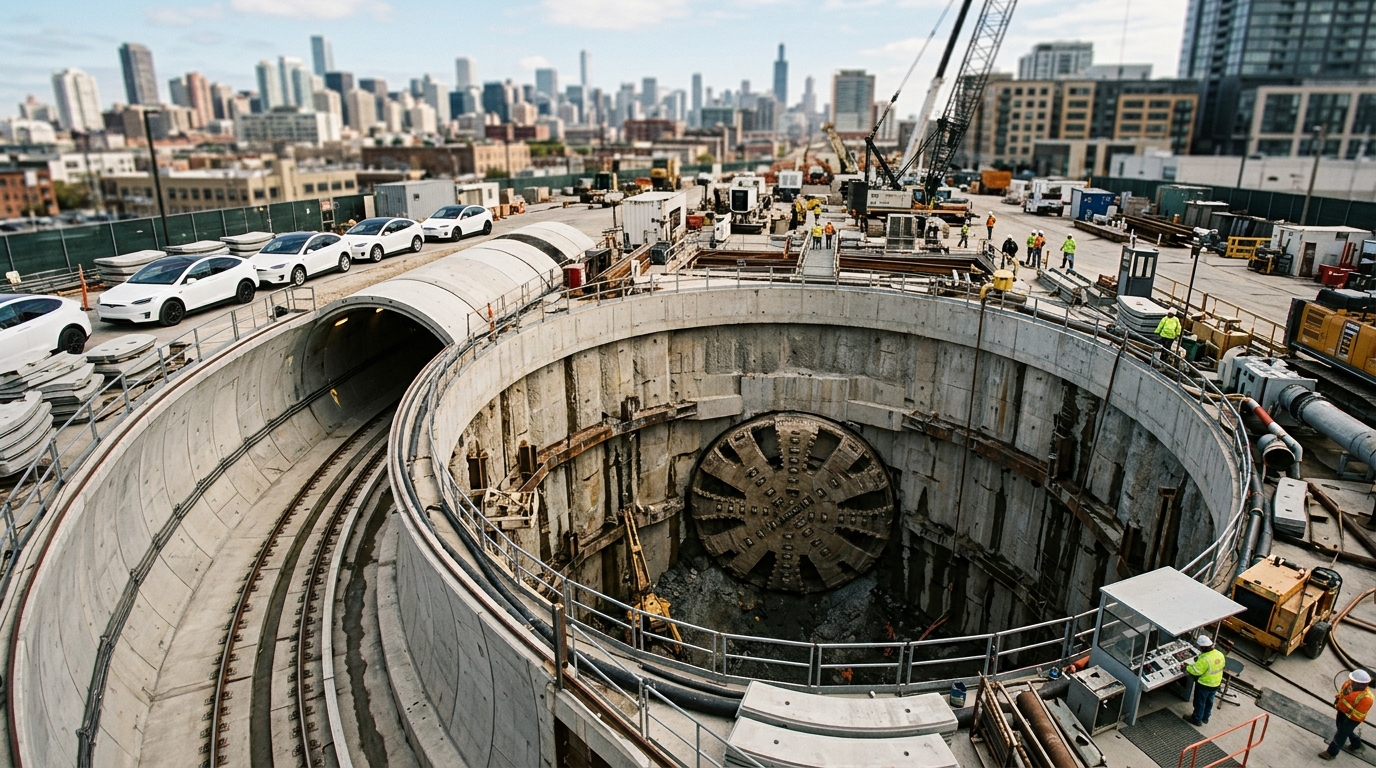
The company’s only fully operational system is the Vegas Loop, a network of tunnels beneath the Las Vegas Convention Center that uses Tesla vehicles to shuttle passengers between stations. The system has transported over 3 million passengers since opening, demonstrated peak throughput above 4,500 passengers per hour, and most recently moved roughly 82,000 riders during the CONEXPO trade show in March 2026 alone.
In November 2025, the Vegas Loop added the Encore station, connecting the convention center to the resort strip. The Nevada Transportation Authority approved airport rides in the same month, a move that could push annual ridership from around 1 million toward 5 to 10 million once the airport connector is fully operational. As of mid-2026, total tunnel construction in Las Vegas stands at roughly 11 miles, of which approximately 3.5 miles are currently active. When fully built out, the company says the Vegas Loop could handle around 90,000 people per hour.
Slight tangent, but it matters: the company also built the Cybertunnel at Tesla’s Gigafactory in Austin, a purpose-built underground passage that moves finished Cybertrucks from the production line to the outbound lot in about 60 seconds, cutting what was a 12-minute surface trip. That project used the Prufrock-3 boring machine and showcased the company’s ability to deliver narrow-use industrial infrastructure quickly.
The Pipeline Is Growing Fast
This is where the $20 billion figure starts to feel less absurd, even if it still needs proof points to fully justify it.
- Nashville (Music City Loop): The Boring Company has partnered with the State of Tennessee to build a privately funded underground system connecting downtown Nashville, Music City Center, and Lower Broadway to the Nashville International Airport. As of early 2026, tunneling had not yet begun and permitting was still incomplete, but the project is under active construction. The Tennessee Legislature passed special legislation in 2026 to give the state, rather than Nashville’s city council, regulatory oversight of the project.
- Dubai Loop: In February 2026, the company signed a construction contract with Dubai’s Roads and Transport Authority. The pilot phase covers 6.4 kilometers of tunnel and four stations, connecting the Dubai International Financial Centre to Dubai Mall. The full network would expand to 22.5 kilometers and 19 stations. Phase one is estimated at $154 million; the full build at roughly $545 million. Tunneling is targeted to begin in the second half of 2026. The pilot route is projected to serve around 13,000 passengers per day at launch.
- Tunnel Vision Challenge: In March 2026, the company announced it would fully self-fund three additional underground Loop tunnels through a city selection process, choosing New Orleans, Baltimore, and Dallas as recipients. The move signals a shift toward the company bearing construction costs directly, lowering the barrier for cities skeptical of committing public money to new infrastructure.
- Additional pitches: The WSJ also reports the company has pitched projects in Baltimore, Chicago, and Los Angeles, though none of those have resulted in signed contracts.
The Technology Argument
The company’s core claim is that it can build tunnels far cheaper and faster than traditional contractors. Its Prufrock boring machines are designed to launch from the surface without large excavation pits, tilt down and begin cutting within 24 hours, and resurface at the destination. In March 2026, the Prufrock-2 completed a record 2.28-mile continuous tunnel drive near the Westgate station in Las Vegas, excavating roughly 68,000 cubic yards of material in a single run.
The original Las Vegas Convention Center Loop was built in about one year for $47 million, covering 1.7 miles and three stations. If that cost structure scales, the economics could get interesting. The part people usually skip is that most infrastructure competitors aren’t even trying to hit those figures. The Boring Company’s cost advantage, if real and repeatable, is the actual thesis here.
The Risks Are Real Too
This isn’t a clean story. Tunnel workers have suffered serious injuries on Boring Company projects. Nevada regulators found the company violated environmental regulations nearly 800 times, according to a report cited by TechCrunch. Nashville’s Metro Council voted 20 to 15 to formally oppose the Music City Loop, and engineers have raised concerns about the sinkhole-prone limestone bedrock beneath middle Tennessee. To serve even 1,000 travelers per hour in Nashville, one estimate suggests a vehicle would need to depart roughly every 3.6 seconds.
Prior pitches to Baltimore, Chicago, and Los Angeles mostly failed to launch. The company is now tunneling in three U.S. states simultaneously, which is progress, but executing multiple projects across different regulatory environments and geologies is a different challenge than a single Convention Center build in a business-friendly desert city.
And the valuation ask itself is not small. The gap between seeking funding at $20 billion and actually closing at $20 billion is a significant one. Investors willing to pay that premium are largely betting on the Musk brand and the long-term vision, not on a company with a large completed project base or visible public revenue.
What to Watch
The near-term proof points are Nashville and Dubai. If the Music City Loop delivers an airport connection on time and near its projected budget, and if Dubai tunneling begins on schedule in late 2026, the credibility of a $20 billion valuation gets a lot stronger. If either project slips badly, that number faces real pressure.
The airport connector expansion in Las Vegas is also worth watching closely. A jump from roughly 1 million annual riders to 5 to 10 million would shift the operating economics of the Vegas Loop considerably and give investors a clearer revenue picture ahead of any potential deal close.
Whether the $4 billion round closes at $20 billion, at a lower figure, or at all remains to be seen. But the direction of travel is clear. The Boring Company is moving from a single-city proof of concept toward something that could look, eventually, like a real infrastructure business. The open question is whether the valuation is getting ahead of the tunnels, or whether the tunnels are finally catching up.
This content is for informational purposes only and does not constitute investment advice. All figures are sourced from publicly available reporting and may not reflect confirmed or final terms.
 Rising Star Stocks