
July 2, 2026
The $40 Trillion Labor Market
Featured: The $40 Trillion Labor Market
Below is an important message from one of our highly valued sponsors. Please read it carefully as they have some special information to share with you.
Dear reader,
If you have any money in the markets…
Public Law 63-43 (see it below) could have a huge impact on your wealth in 2026.
You see, three simple words buried deep in Section 10 of this 112-year old little-known law…
Grants President Trump the power to make this critical move on June 17th.
President Trump himself has confirmed the plan is already in motion.
As a former advisor to the CIA, the Pentagon and the White House…
I know for a fact there are meetings taking place right now behind closed doors in the White House.
His entire administration is preparing for it.
I recommend you prepare as well.
That “gift” will make a lot of patriots rich on America’s 250th anniversary.

Regards,
Jim Rickards
Former advisor to the CIA, the Pentagon and the White House
The $40 Trillion Labor Market
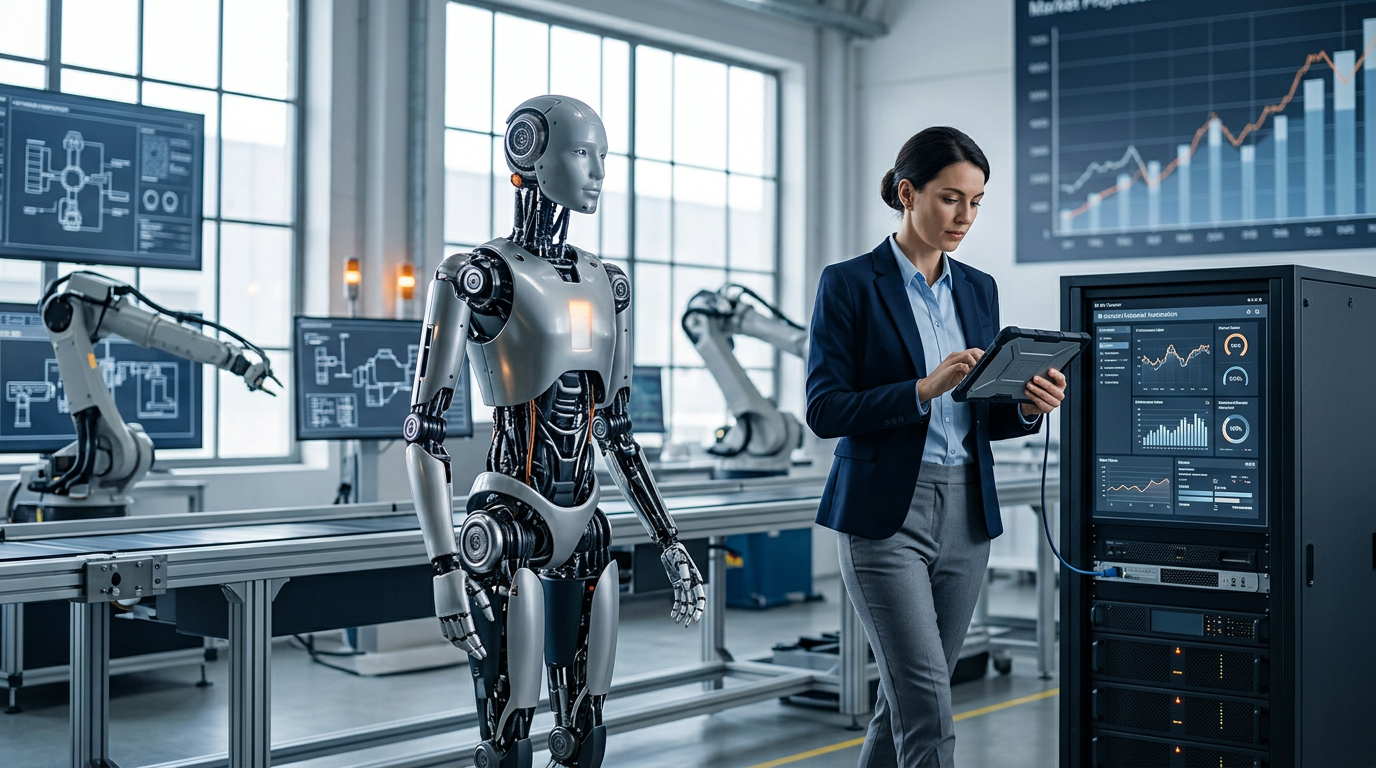
Jensen Huang said it plainly: humanoid robots represent a $40 trillion total addressable market for labor automation. He’s said it more than once now. And Wall Street is starting to catch up.
Here’s what’s interesting. The consensus trade is Tesla’s Optimus. The smarter money may be somewhere else entirely.
The problem with the headline play is timeline risk. Tesla ended production of the Model S and Model X in early May 2026 to convert its Fremont factory into an Optimus production line – a real capital commitment with real opportunity cost. On the Q4 2025 earnings call, Musk acknowledged that the several hundred Optimus units deployed in Tesla factories were “primarily for learning, not productive tasks – still very much in the R&D phase.” Gen 3 full production is now targeted for late July or August 2026, with Musk himself warning initial output will be “quite slow.” At roughly 195x forward earnings, that gap between ambition and output has to close fast.
Meanwhile, the infrastructure layer is already generating revenue.
Nvidia’s Isaac GR00T – now on its N1.7 iteration – is the world’s first open, fully customizable foundation model for generalized humanoid reasoning and skills. The platform has expanded well beyond its original partner list, with companies including ABB Robotics, AGIBOT, Agility, Figure, KUKA, and Universal Robots now building on Nvidia technology to develop and deploy physical AI at scale. The model is straightforward: if Huang’s $40 trillion figure is even directionally right, Nvidia collects rent on every humanoid trained, simulated, and deployed. Q1 FY2027 revenue hit $81.6 billion, up 85% year over year, beating Wall Street’s consensus of roughly $78.8 billion. Q2 guidance came in at $91 billion – above the $86.84 billion consensus – even after excluding all data center compute revenue from China. The robotics story adds a second, longer-duration growth arc on top of an already-dominant data center business.
“A Dangerous Financial Plan Unfolding in D.C. Could Cost You 40% of Your Wealth”
Former Goldman Sachs executive who traded through Black Monday warns this plan is all written down in black and white, spearheaded by a financial insider who infiltrated the Federal Reserve… It’s gone “viral” in the hedge fund circles… and yet practically nobody on Main Street understands this financial shock playing out across America. He lays out all the evidence… plus a detailed roadmap for exactly what to do. (And it doesn’t require shorting… options… or perfectly “timing the market.”)
The first wave of humanoid deployment is already happening. Not in living rooms. In factories. Boston Dynamics unveiled the production version of its Atlas robot at CES 2026, with all 2026 deployments committed to Hyundai’s Robotics Metaplant Application Center and Google DeepMind. Full deployment at Hyundai Motor Group Metaplant America in Georgia is targeted for 2028, with a planned production capacity of 30,000 robots per year from that facility. By 2030, applications extend to component assembly and heavier industrial tasks. That is not science fiction – that is a procurement pipeline with a specific address.
The component suppliers may be the most overlooked angle here. At this early stage, no publicly traded company appears to be generating significant revenue from selling humanoid robots directly. But the brains, actuators, vision systems, and edge AI processors that go inside each unit are shipping today. These are the picks-and-shovels of the humanoid cycle – businesses with existing revenue, existing margins, and growing exposure to a market that is just beginning to scale.
Morgan Stanley puts the total opportunity at roughly $5 trillion by 2050, with global adoption reaching around one billion units. The bank’s own analysis points to the component and supplier layer – not the robot brands themselves – as the more durable entry point. Those numbers could be wrong in either direction. But the direction itself is not really in dispute anymore.
What investors may be missing is how early the second wave actually starts. The labor shortage problem in developed economies is not going away. It may be accelerating. Companies that solve it – even partially – will be structurally advantaged for a long time.
The risk is concentration. Many of the sector’s most advanced humanoid companies remain private. The publicly available plays are either expensive, speculative, or both. The component layer offers a better entry point than the robot manufacturers themselves at this stage. The question is not whether humanoid robots will matter. It is who gets paid along the way.
Worth a closer look before the next wave of headlines makes this obvious.
 Rising Star Stocks