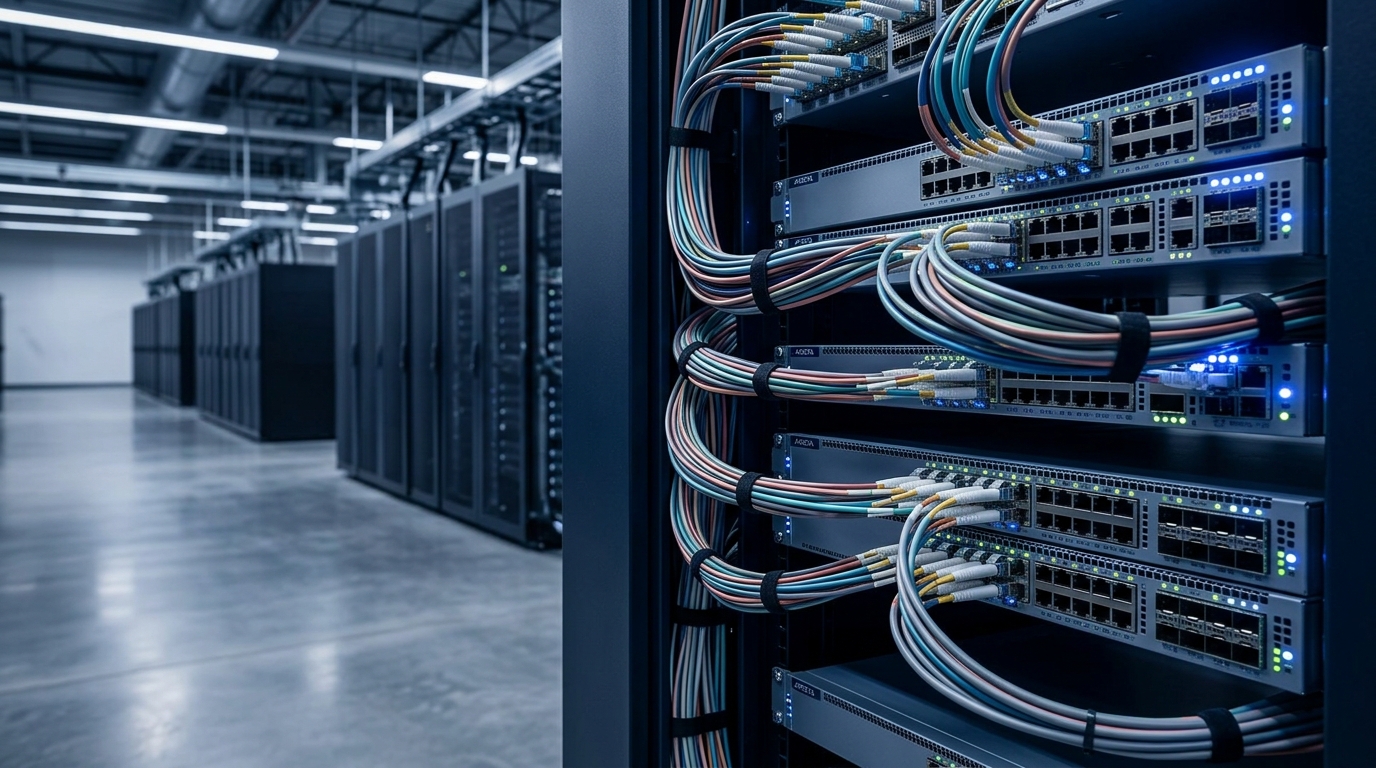
Every GPU cluster needs a nervous system. That is Arista Networks’ business, and right now the hyperscalers cannot wire their data centers fast enough to keep pace with AI demand.
Arista said it delivered about 40% year-over-year growth in non-GAAP earnings per share as the company achieved its first $3+ billion revenue quarter in Q2 2026. That milestone matters beyond the headline: it confirms that demand is accelerating, not plateauing, as the buildout enters its most capital-intensive phase.
At the Goldman Sachs Communacopia and Technology Conference this week, CFO Chantelle Breithaupt reiterated Arista is now targeting about $12.6 billion in full-year 2026 revenue, implying roughly 40% growth. That figure has been revised upward more than once this year. The company has also raised its 2026 AI fabrics revenue goal to at least $3.5 billion as production-scale deployments accelerate.
The angle most investors miss is what drives the next leg of that growth: the shift from 800G to 1.6 terabit switching, with both generations expected to coexist for a time. Arista is positioned directly in the path of that transition. In June 2026, the company announced its next-generation 1.6T portfolio for AI fabrics, including platforms designed for air, liquid and hybrid-cooled environments, aimed at scale-up and scale-out AI networking.
The moat here is software, not just silicon. CTO Ken Duda has argued that Arista’s Extensible Operating System, EOS, is a major differentiator, and that open-source alternatives can require substantial engineering work to assemble, validate, and deploy cleanly across specific hardware platforms. Deep EOS integration creates switching costs that entrench Arista with Microsoft and Meta, both executing multi-year gigawatt-scale AI buildouts that translate near-linearly into sustained switch demand.
The risks are real. Nvidia’s Spectrum-X is positioned as an Ethernet platform built for AI networking, and for customers who want Ethernet but prefer Nvidia’s tightly integrated ecosystem, it is a real alternative. White-box hardware at Meta and custom silicon at Google remain structural long-horizon threats. Arista has also repeatedly highlighted that supply chain constraints can linger, which can translate into longer lead times, heavier purchase commitments, and elevated inventory.
Arista maintained its 2026 gross-margin outlook of 62% to 64%, respectable for a hardware business in a component-inflation environment. That combination of scale, margin discipline, and a decade-long head start in high-speed switching is what disciplined long-term investors are actually buying. The 1.6T cycle does not begin in earnest until 2027. Arista already owns the room.
 Rising Star Stocks