
The signal is not in the stock market. It’s in oil.
As of July 30, the CBOE Crude Oil Volatility Index — the OVX, essentially the VIX for crude — sits near 67, down from its peak of roughly 126 in early April but still trading at more than double its calm-market range. The OVX has ranged from 23.59 to 125.99 over the past 52 weeks. That spread tells you almost everything about the year that just happened. And the fact that it hasn’t normalized — even after a ceasefire was signed, broken, renegotiated, and broken again — tells you something more important about what the options market thinks comes next.
OVX up 18% against a VIX still at 16 says the options market is pricing the Strait of Hormuz risk through oil volatility, while equity front-end premium stays cheap and the S&P curve holds contango. The geopolitical premium is in crude, not stocks. That divergence is the trade. And it is a trade that has been reshaping sector positioning all summer.
The Signal
Here is the simplest version of what the options market is communicating right now: sophisticated participants are not selling their energy upside exposure, even with Brent pulling back from its highs. On Tuesday, July 28, Brent crude hovered close to $86.65, slipping 1.9%, while West Texas Intermediate dropped 1.5% to reach $81.36. Two days of oil weakness. Shares of ExxonMobil increased 0.4% at the start of trading. Chevron advanced 0.8%. The Energy Select Sector SPDR Fund XLE was up 0.3%.
Energy stocks barely flinched. That gap between oil falling and energy equities holding is not noise. It is the market saying the risk premium is not fully gone.
Notably, the options market developed a call skew in crude — upside options bid over downside — the opposite of the typical crisis pattern, signaling that traders feared a further price spike more than a crash. That call skew has compressed as Brent pulled back from its April highs, but the underlying positioning hasn’t fully reversed. In the 2026 spike, front-month oil implied volatility traded far above longer-dated levels, a backwardated curve signaling the market expected the crisis to resolve within months. It hasn’t fully resolved. Which is why the curve is still elevated.
Why It Matters
To understand why the options market keeps treating this situation as unfinished business, you need to understand what actually happened here — and why a ceasefire on paper hasn’t meant a ceasefire in practice.
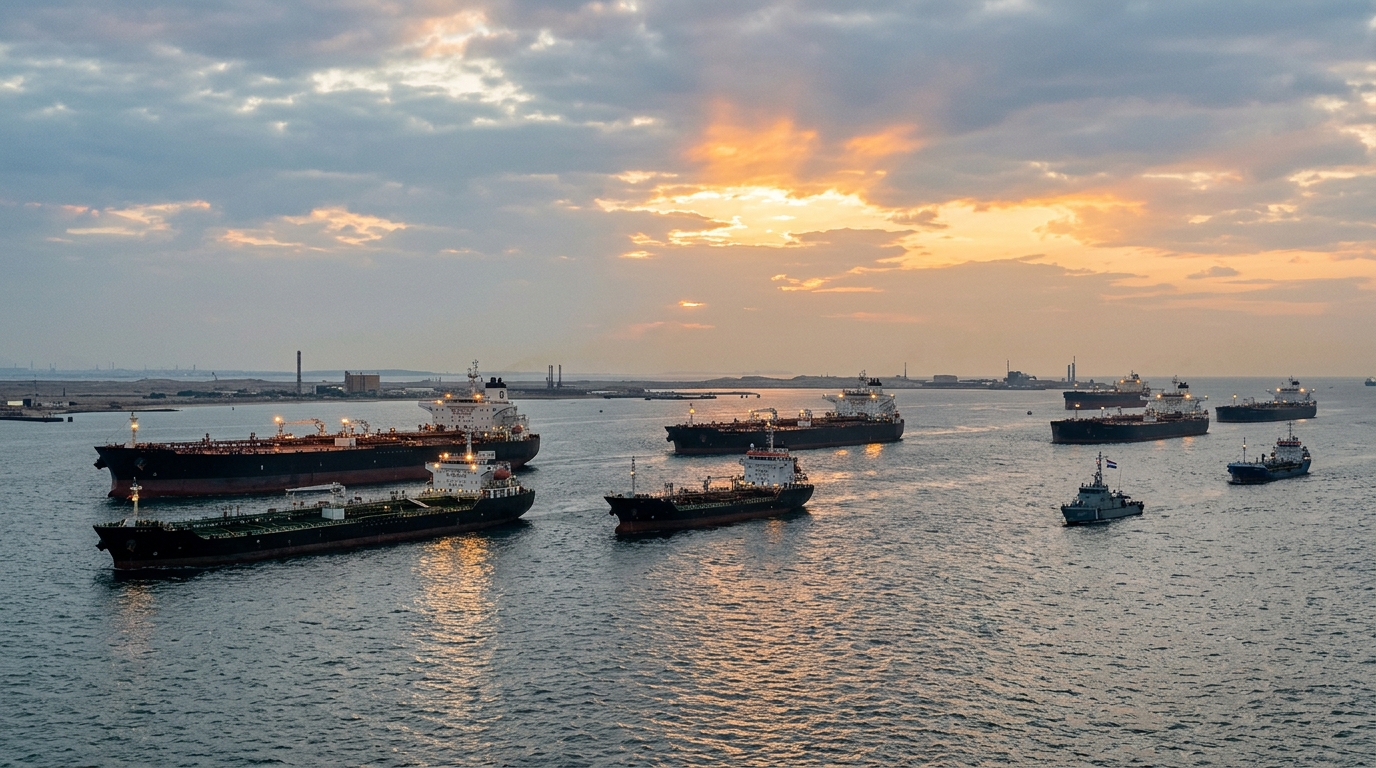
U.S. and Israeli military operations against Iran since February 2026 and subsequent Iranian military action throughout the Persian Gulf raised concern about oil and natural gas markets in relation to the Strait of Hormuz. Starting on March 4, 2026, Iranian forces declared the Strait “closed,” threatening and carrying out attacks on ships attempting to transit.
Stretching barely 33 kilometers at its narrowest navigable point between Iran and Oman, this sliver of water handles approximately 20% of the world’s daily oil supply — a concentration of energy flow with no comparable alternative route capable of absorbing equivalent volume at comparable cost or speed. That geography has never changed. Iran’s leverage over the chokepoint has never changed. The only thing that changes is how much the market is willing to pay to price that leverage in.
At the peak of the crisis, WTI ran from roughly $70 to over $111 by early April, and the OVX surged to about 126, its highest level since the 2020 collapse. Brent went even higher. By the end of March, the Brent price had increased by about 65% to record its highest monthly rise ever, amid pronounced volatility. That is not a normal supply disruption. That is a structural shock.
Then a ceasefire came through in mid-June, prices collapsed back toward $70, and the market started pricing in resolution. Then the ceasefire broke. Maritime traffic in the Strait of Hormuz declined sharply amid renewed fighting. Just six vessels were tracked crossing the strait between 18:00 GMT on Thursday and 06:00 GMT on Friday, compared with 18 to 22 daily crossings earlier in the month. For context, roughly 130 vessels transited the strait each day before the start of the war.
Six vessels versus 130. That math does not resolve in a week.
Now, as of July 30, Brent climbed above $92 per barrel after the U.S. carried out a fresh wave of air strikes against Iran. The two sides remained unable to reach a potential agreement as Tehran insisted on maintaining control of the Strait of Hormuz. The conflict has also expanded. The conflict expanded beyond Hormuz into the Red Sea, where Iran-backed Houthi rebels in Yemen threatened to blockade Saudi Arabia, prompting Riyadh to join U.S. forces in launching strikes on targets in Iraq linked to Tehran-backed militants.
This is not a single-chokepoint problem anymore. It is a corridor problem.
The Company Behind the Signal
The options market is not telling one story here. It is telling three simultaneously, each through a different sector lens.
Energy producers are the clearest read. Upstream oil producers and integrated energy majors occupy the clearest beneficiary position when crude prices rise. Their production cost bases are largely fixed in the short term, meaning price increases flow disproportionately through to operating margins. U.S. domestic producers carry an additional dimension of advantage: their supply chains are geographically insulated from Hormuz physical risk, making them perceived as comparatively safe beneficiaries of Middle East supply anxiety.
That distinction matters more than it usually does. ConocoPhillips, Pioneer-model producers, Permian Basin independents. These names benefit from the price without bearing the transit risk. The market has been pricing this. Energy was the shelter: WTI crude held near $74 and Brent near $79, lifting XLE 1.8%, with Valero and Marathon Petroleum hitting records as refiners rode a diesel squeeze. Refiners, not just producers. That is a more nuanced signal — it suggests the market is also pricing in a tight refined-products environment, not just raw crude.
Defense is the second leg. The Hormuz conflict has not just been about oil. RTX is a direct beneficiary. The Raytheon segment makes the Standard Missile family used by Arleigh Burke destroyers, the Tomahawk land-attack cruise missile, the Evolved SeaSparrow, and the Patriot system. The Raytheon segment’s products are being expended in real time, and defense backlog already sits at $109 billion with Q1 2026 free cash flow of $1.309 billion, up 65% year over year.
Options traders have noticed. Options traders need to watch for increased implied volatility across defense names, especially near-term expiries. This creates opportunities for bullish vertical spreads, or even outright call purchases if conviction is high. The sector momentum has been extraordinary. Lockheed Martin just posted a record backlog near $230 billion. The Department of War signed multi-year framework agreements to scale Patriot, THAAD, and PrSM production by three to four times current rates, and Lockheed landed a $4.8 billion PAC-3 missile production contract. These contracts don’t reverse when a ceasefire gets signed. The munitions inventory has been drawn down and needs rebuilding regardless of how this ends.
Airlines are the counterweight. The damage here is not subtle. United Airlines said it expects nearly $6 billion in added fuel expense for full-year 2026 compared to expectations at the start of the year. In the second quarter, fuel expense jumped by $2.3 billion, or 84% year-over-year. That kind of cost shock does not disappear with a diplomatic handshake.
Jet fuel prices are back on the rise after leveling off in June. The global average jet fuel price jumped to $149.40 per barrel — an increase of nearly 18% — for the week ending July 17, on the heels of a 7% increase the previous week. The re-escalation of July did real damage to Q3 guidance that carriers were just starting to feel comfortable about. The fresh spike in jet fuel prices in July upended profit guidance of U.S. airlines, whose management teams had to readjust earnings estimates for the year just days ahead of reporting second-quarter results. The re-escalation in the Middle East resulted in a 20% spike in jet fuel prices during the two weeks in which air carriers were reporting their April-June earnings.
Southwest, American, Alaska. All revised guidance lower. Alaska Airlines reported fuel expenses of $1.3 billion in the second quarter — up 85% from a year ago — and lost almost $500 million in the first half of the year. That is not a valuation debate. That is a fundamental shift in the P&L while demand stays robust and pricing power is capped by consumer behavior.
Market Expectations
Here is what is actually priced in right now, as best as the options market can tell us.
Brent near $90, OVX near 67. That combination says the market is not pricing a full reopening of Hormuz but also not pricing a return to crisis-level disruption. It is pricing a muddle. As Ole Hansen, Head of Commodity Strategy at Saxo Bank, wrote: “The ceasefire has reduced the immediate risk of further escalation, but it has not resolved the underlying supply disruptions. As long as traffic through the Strait of Hormuz remains restricted, and as long as infrastructure, storage and shipping constraints persist, the oil market is likely to remain tight — especially in the prompt segment.”
The physical reality supports that view. Physical supply has lagged behind in its recovery. Persian Gulf oil exports stayed at 41% of levels seen before the war. Red Sea deliveries dropped by over 3 million barrels per day last week. These are not numbers that normalize in a month.
Commercial crude inventories posted their largest draw since mid-June, reinforcing signs of a tightening physical market. The nation’s strategic petroleum reserves also declined for an 18th straight week, falling to their lowest level since 1983. The SPR buffer that cushioned the initial shock is largely spent. If this escalates again with any severity, the price response will be faster and bigger than in March — because the shock absorbers are depleted.
Goldman projects Brent falling to around $80 by year-end assuming full Hormuz reopening in Q4. Goldman projects the price will fall to $80 by the end of the year, assuming full reopening of Hormuz takes place in the fourth quarter. That is a reasonable base case. It is also a case that requires a durable diplomatic settlement between two parties who have broken every previous agreement. The options market is not fully believing that story. Neither should you.
Strategic Considerations
The options signal here is asymmetric, and it cuts differently across sectors.
On the energy side, the call skew in crude has partially compressed as Brent pulled back from its peak. That means upside calls on XLE or individual E&P names are cheaper today than they were in May. If you believe the muddle-through scenario gets disrupted again — one more ceasefire break, one more tanker attack, Houthis actually closing the Bab el-Mandeb — the cost of owning that upside is lower now than it was during the crisis peak. A straightforward call spread on XLE or USO captures a re-escalation scenario without requiring you to hold outright long crude futures.
Slight tangent, but it matters: the refiner trade may actually be more interesting here than upstream. Refiners capture the margin between crude input cost and refined product prices. When crude supply is constrained but domestic production is running hard, refiners with access to U.S. crude can see margins expand even as global benchmarks move around. The closure of the Strait of Hormuz has sent shockwaves through Wall Street. While the broader S&P 500 has faced intense downward pressure, the energy sector has emerged as a powerhouse, decoupling from the general market to reach multi-year highs. That decoupling is still partially intact. Valero and Marathon have been the clearest expressions of it.
On defense, the options opportunity is different. The sector is no longer cheap. The primes trade at 22 to 25 times forward earnings, a clear premium to history. Backlog supports the multiple, but the margin of safety is thinner than in prior defense cycles. Buying outright calls on LMT or NOC here means paying elevated IV for a catalyst that may already be well-priced. The more interesting approach is a defined-risk structure: a debit call spread that benefits from continued strength without paying full price for the possibility of a ceasefire-driven pullback.
On airlines, the put-side opportunity has largely already been realized. Implied volatility on the carriers is elevated after months of bad news. Owning puts from here means paying for a move that has mostly already happened. The more interesting question is whether the sector becomes a contrarian call option on peace. If Hormuz actually normalizes — a real normalization, not a 48-hour ceasefire — airline stocks could see a violent short-covering rally. A low-cost call spread on the U.S. Global Jets ETF captures that scenario with defined risk.
The key variable nobody can model cleanly is the SPR. The Trump administration deployed the Strategic Petroleum Reserve at an aggressive pace, committing to release 172 million barrels as part of a coordinated advanced-economy response. That buffer is now largely exhausted. The next supply shock — if it comes — hits a market with less cushion, which means the price response will be faster. That dynamic favors owning near-term oil upside structures rather than longer-dated ones.
What to Watch
Three things will decide whether this thesis confirms or collapses over the next four to six weeks.
Hormuz transit counts. According to Raymond James analyst Pavel Molchanov, a meaningful recovery in Hormuz transit would require a sustained weekly average of at least 20 ships per day, a threshold he described as unrealistic without a durable diplomatic settlement between the United States and Iran. Watch the Windward data. Right now we are well below that threshold. If the count moves toward 20 and holds, the oil risk premium compresses further and energy upside becomes harder to own. If the count stalls or drops again, Brent could re-test $95 to $100 quickly.
The Houthi escalation in the Red Sea. Iran’s Houthi allies in Yemen declared a maritime embargo against Saudi Arabia. The embargo could exacerbate the oil supply disruption triggered by Iran’s tanker attacks in Hormuz. The Houthis have repeatedly threatened to close the Bab el-Mandeb Strait, which connects the Red Sea to global markets. Saudi Arabia’s pipeline bypass has been the market’s primary relief valve. The Saudis have diverted millions of barrels of oil per day through a pipeline to an export terminal on the Red Sea. Those exports have acted as a crucial relief valve for the global crude market. If the Houthis actually interdict that route, the supply math changes dramatically. This is the tail risk the OVX is still partially pricing.
The diplomatic calendar. President Trump pledged a strong response after an attack on U.S. forces in Jordan. Both sides continued to struggle to reach a potential deal as Tehran insisted on maintaining control over the Strait of Hormuz. Any credible framework for Hormuz control — not just a ceasefire but an actual agreed transit protocol — collapses the oil risk premium and triggers the airline contrarian trade. The absence of one keeps the energy and defense positioning intact. The OVX at 67 is the market’s best guess that we stay in the middle. It is probably right. But it is not certain — and that uncertainty is exactly what the options market is there to price.
 Rising Star Stocks