
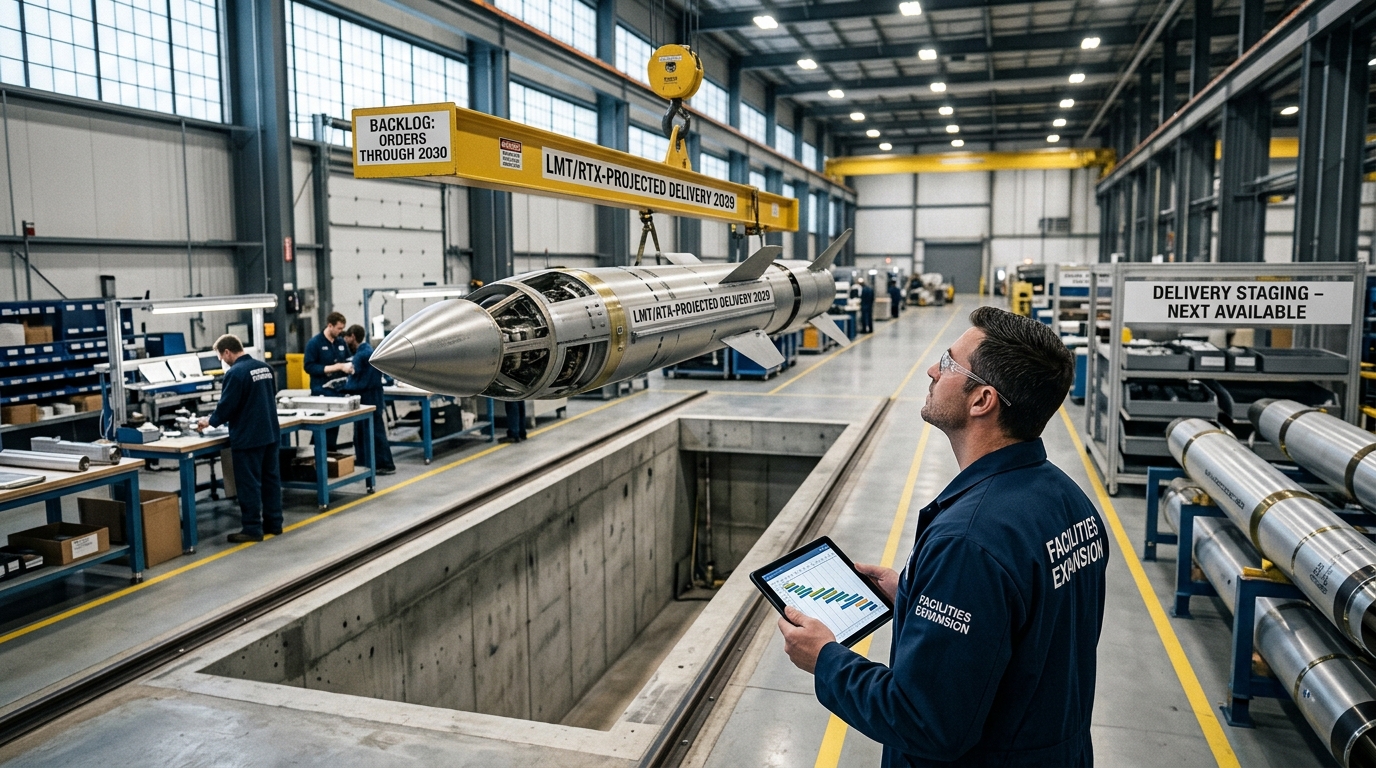
The Wall Street Journal dropped a blunt assessment over the weekend: defense contractors are spending billions building factories to restock America’s precision-missile cupboard, but those efforts have not yet produced real gains. Most new missiles will arrive too late for any conflict in the next couple of years. That finding lands directly on the investment case that has driven RTX and LMT to record backlogs.
Why Institutional Investors Are Focused Here
The order-book-equals-earnings equation has been the load-bearing assumption for defense bulls since early 2026. RTX’s backlog surged to a record $289 billion in Q2, including $119 billion in defense contracts. Lockheed’s hit a new all-time high of $230 billion. Both companies have been rewarded accordingly. The question the WSJ raises is whether those numbers reflect durable earnings power or a pipeline that clears too late to matter for the war actually being fought.
The Bull Case
Start with what is genuinely happening. The Navy contract signed in August targets annual Tomahawk production above 1,000 missiles, against a pre-war baseline of roughly 60 per year. Lockheed was first in the industry to announce a framework agreement for munitions acceleration, tripling PAC-3 MSE capacity and signing a separate deal to quadruple THAAD interceptors, and has also added a further agreement to expand PrSM production. Lockheed intends to spend between $8 billion and $9 billion through 2030 on new or modernized facilities. For bulls, this is secular demand that compounds well beyond any single conflict.
The Bear Case
The problem is arithmetic. Independent estimates indicate the U.S. fired more than 1,000 Tomahawk missiles during the Iran war, roughly one-third of its pre-war inventory. Tomahawk procurement averaged 86 missiles annually over the past decade, and the recent annual production rate remains below 200 because of historically small orders. The Navy has requested 785 Tomahawks in the FY2027 budget, but delivery timelines for rebuilding inventories extend into the end of the decade. THAAD follows a similar arc: the Army has requested 857 THAAD interceptors in FY2027, with replenishment taking multiple years. Meanwhile, officials identify solid rocket motors, high-grade explosives, and skilled manufacturing labor among the most persistent constraints, meaning additional funding alone cannot immediately restore depleted inventories.
The Evidence
CSIS estimates the Iran war depleted more than 1,000 Tomahawks and indicates U.S. inventories will take years to recover to pre-war levels. The Congressional Budget Office estimates that replacing munitions used through August 1 would cost $21.7 billion, including $13.1 billion for Patriot, THAAD, SM-3, and SM-6 interceptors. An industry analysis published after the August Tomahawk award estimated 2030 to 2031 as the most credible window for achieving a sustainable production rate of approximately 1,000 Tomahawks per year. The gap between what the stock market is pricing and what the production schedule delivers is somewhere between two and four years.
What Investors Are Missing
The more consequential risk is what a prolonged production gap does to allied relationships. A Bloomberg investigation published on September 18 reported that several allies had been warned of delays of up to five years for certain missile and air-defense deliveries. Analysts also warn the U.S. could face a dangerous replenishment window in the next several years in any major-power contingency, when the gap between offensive arsenals and U.S. interceptor stocks could be at its widest. That framing redefines the replenishment cycle from a growth story into a strategic liability, one that Washington will spend heavily to close but that investors are not yet discounting properly. Backlog size and delivery schedule are two entirely different things.
Stocks to Watch
RTX carries the most direct exposure to this debate through the Tomahawk program. RTX raised its 2026 adjusted EPS outlook and increased free cash flow guidance to $8.50 to $8.75 billion. The commercial aerospace buffer at Collins and Pratt provides a hedge that pure-play primes lack, making it the more defensible position if the missile ramp timeline slips.
LMT faces the sharper version of the problem. Execution risk and a near-term capital expenditure cycle that compresses free cash flow before munitions ramp revenue materializes are live concerns, even as the order outlook has never looked stronger. CEO Jim Taiclet has said the company is preparing to accelerate PAC-3 MSE output, quadruple THAAD production, and expand PrSM production. Doing all three at once, inside a constrained labor market, is the real execution question.
NOC and LHX are less directly exposed to the missile timeline squeeze but benefit from the broader industrial buildout as integrators and subsystem suppliers. BAESY sits in an overlooked position: Raytheon is partnering with Northrop Grumman, Anduril, Avio USA, and Nammo to expand solid rocket motor supply chains, the historic chokepoint in U.S. cruise missile production. The companies solving that bottleneck may matter more to the replenishment timeline than the primes do.
 Rising Star Stocks