
There is one number in Adidas’s preliminary third-quarter results that matters more than the record revenue or the guidance raise: 54.3%.
Gross margin improved 2.5 percentage points to 54.3% in the quarter. That is not the kind of margin you achieve by running promotions or flooding outlet channels with old inventory. It is the margin of a brand that consumers are actively seeking out, at prices they are willing to pay without being nudged by a discount code.
Preliminary third-quarter revenue rose 9% to a record €7.252 billion, and operating profit climbed 37% to €1.008 billion, the highest quarterly level on record. CEO Bjørn Gulden credited marketing and innovation, with strong, profitable growth in football, running, and training.
Critics will note, correctly, that a one-time item inflated the result. During the quarter, Adidas received the majority of its US tariff claims, recording a refund of around €200 million that contributed directly to the gross margin improvement. Strip that out and operating profit would have been about €800 million, still well ahead of the €736 million Adidas made in Q3 2025, but the gain is much smaller than the headline 37%. That caveat is real. It does not change what the underlying business is saying.
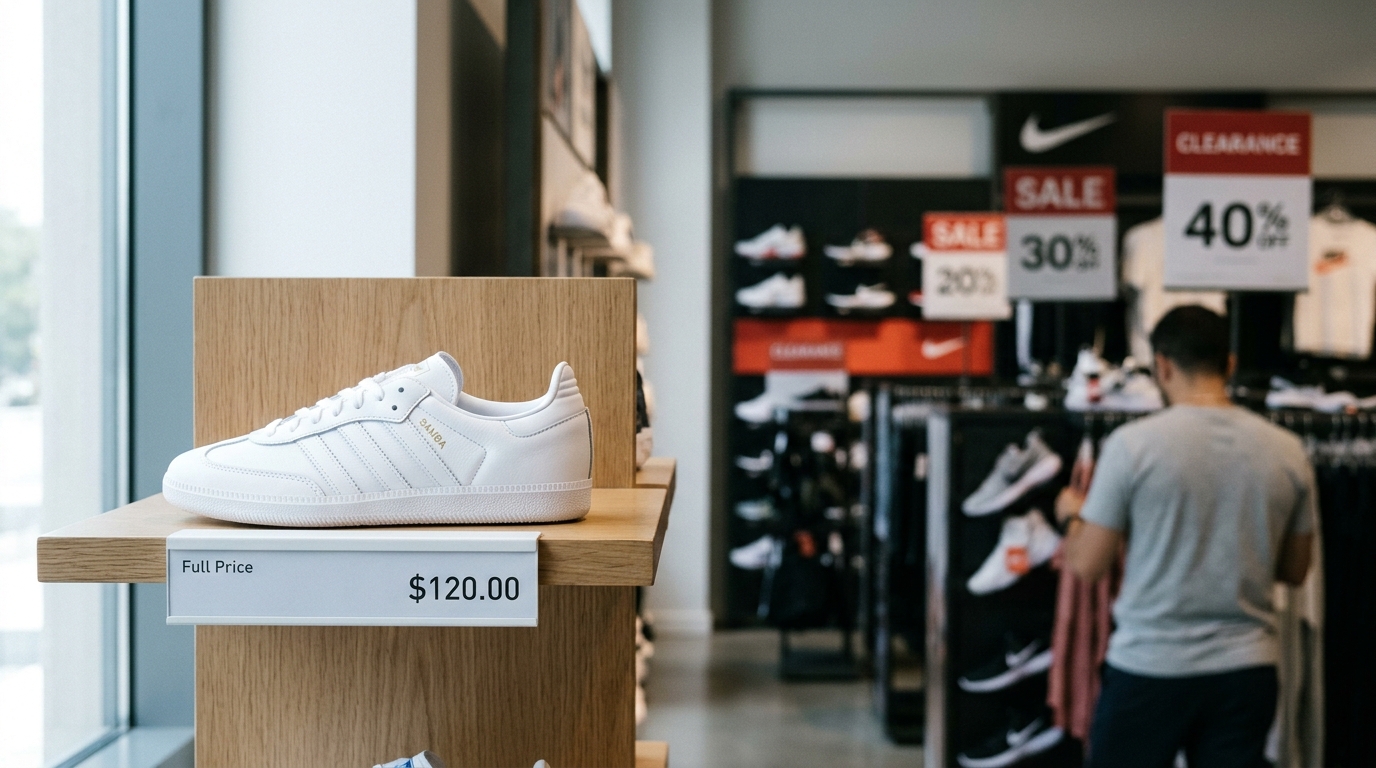
In addition to the tariff refund, the strong gross margin development was driven by healthy full-price sales, while unfavorable currency developments had a negative impact. Full-price selling, not accounting luck, is the structural signal here. Adidas has now strung together consecutive periods of disciplined pricing that confirm the brand recovery Gulden has been engineering since taking over in January 2023.
The contrast with Nike could not be sharper. Nike’s own leadership has said the company is not living up to its full potential, particularly in Nike Sportswear and Jordan Streetwear, where sell-through remains challenged, impacting both current discounting and future order books. Analysts have tied Nike’s worries in large part to a shortage of fresh, compelling product, which has contributed to heavier promotions and discounts. A brand that relies on discounting to move product is a brand whose customers are negotiating rather than choosing.
For long-term investors, the gross margin gap is where the compounding story lives. Higher full-price realization flows directly to operating leverage. Adidas intends to put roughly €100 million back into the business in the last three months of the year, directing it at measures that give it more room to grow profit as sales rise, consistent with its mid-term profitability targets. That is not a company scrambling. That is a company investing from a position of strength.
Adidas expects currency-neutral revenue growth of 9% to 10% for 2026. The company now projects full-year operating profit of about €2.5 billion, up from about €2.3 billion previously. Those numbers beat the average analyst estimate of €2.4 billion that Bloomberg had tracked heading into the release.
The risk is not trivial. Gulden acknowledged that the footwear lifestyle business is challenging, mainly because of too much inventory and discounting in the market, which he expects to normalize soon. Currency headwinds are persistent. The tariff refund will not recur. And Adidas still holds a single-digit share of the US athletic footwear market, well behind Nike’s dominant position in the one geography where brand premiums are most monetizable.
But those risks frame a business that is earning, not borrowing, its momentum. A 54.3% gross margin on full-price volume is what desirability looks like in a financial statement. Investors who are weighing which sportswear name deserves a seat in a long-term portfolio now have a concrete data point to anchor the comparison.
 Rising Star Stocks