
 By Rising Star Stocks
 April 30, 2026
SoFi Technologies Just Posted the Quarter That Silenced the Skeptics
Record revenue, doubled profits, 14.7 million members — the fintech that wasn’t supposed to work is working.
For years, the case against SoFi Technologies (NASDAQ: SOFI) was straightforward: too many product lines competing for attention, too much sensitivity to interest rate cycles, and no real evidence that the whole “everything app” concept would ever convert into durable, compounding earnings. The bears weren’t wrong to ask the question. They just held onto the answer too long.
April 29, 2026 made that position a lot harder to defend.
What the Numbers Actually Say
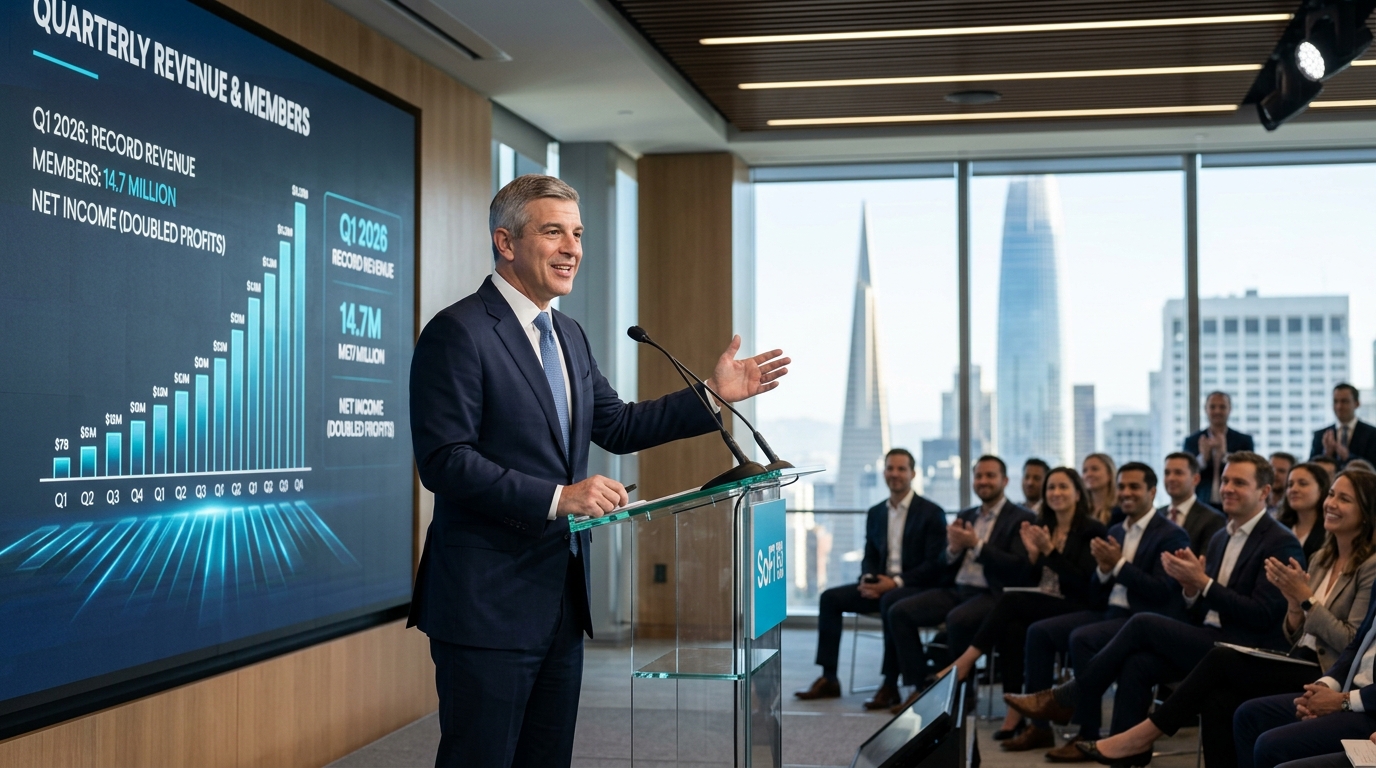
SoFi’s Q1 2026 results weren’t a marginal beat. They were a statement. Revenue hit a record $1.1 billion, up 43% year-over-year. Net income more than doubled to $166.7 million. Diluted EPS came in at $0.12 — exactly double the $0.06 from the same quarter last year. Adjusted EBITDA reached $340 million, up 62%, with a 31% margin.
The company also logged its 18th consecutive quarter of the Rule of 40 — a combined measure of revenue growth and profitability margin that most fintechs can only aspire to — landing a score of 72. That’s not a fluke. That’s a compounding machine showing up consistently.
What’s interesting is where the growth came from. This wasn’t one segment pulling the weight while others dragged. The lending segment posted GAAP net revenue of $642.4 million, up 55% year-over-year. Financial services brought in $428.5 million, up 41%. Even with the tech platform segment down 27% due to a major client departure in late 2025, the overall picture held firm — and then some.
‘Dark Energy’: Elon Musk’s Next Potential $10 Trillion Move
A highly secure site in West Texas now houses an emerging potential $10 trillion technology backed by Elon Musk and Sam Altman. This breakthrough could completely replace our need for foreign oil – and send one small group of stocks soaring in the process.
Click here to learn how you can invest in Elon’s next $10 trillion move.
Lending Is Breaking Records
Total loan originations hit $12.2 billion in the quarter — a 68% jump from the same period last year, and the highest single-quarter figure in the company’s history. Break that down and it gets more interesting.
- Personal loans: $8.3 billion, up 51%
- Student loans: $2.6 billion, up 119%
- Home loans: $1.2 billion, up 137%
That home loan number deserves a second look. Up 137% in a housing market that’s been locked up for two years — rising rates, low inventory, buyers waiting on the sidelines. Against that backdrop, SoFi managed to more than double its home lending volume. That’s not a tailwind play. That’s market share capture.
Of the $12.2 billion in originations, roughly $5.4 billion was placed on SoFi’s balance sheet and about $3 billion moved through the Loan Platform Business — a channel that generates fee income upfront and frees up capital simultaneously. It’s a capital-efficient structure that the market has been slow to fully credit.
The Platform Argument Is Getting Harder to Dismiss
Membership grew 35% to 14.7 million, with a record 1.055 million new members joining in a single quarter. Total products hit 22.2 million, up 39% year-over-year. But the metric that cuts through is this: 43% of new products were opened by existing members — up from 40% the prior quarter and 36% a year ago.
That’s not just growth. That’s the cross-sell engine accelerating. The bears insisted SoFi couldn’t build real product stickiness — that members would grab a loan and disappear. The data is moving in the opposite direction, and the trend is consistent enough now that it’s hard to dismiss as noise.
Slight tangent, but it matters: In the J.D. Power 2026 U.S. Investor Satisfaction Study for self-directed investing, SoFi ranked No. 1. Forbes also placed them at the top of its customer satisfaction rankings for U.S. banks — ahead of JPMorgan Chase and Bank of America. In a business where trust and long-term retention drive lifetime value, that kind of recognition isn’t decorative. It feeds directly into the member acquisition economics.
The SpaceX IPO makes me FURIOUS
Elon has reportedly filed to take SpaceX Public… in an IPO that’s expected to hit a $1.75 trillion valuation.
The biggest in Wall Street history…
And you know who’s going to make all the money? The banks brokering the deal. The hedge fund managers. The billionaire insiders. The same “already rich” 1%’ers.
After the IPO, everyone else will be left fighting over scraps.
That’s why I’m leveling the playing field.
New Moves Worth Watching
SoFi launched a fully digital HELOC product and introduced SoFiUSD — a stablecoin built on a public blockchain, developed in partnership with Mastercard for settlement capabilities. The aim, according to management, is to enable faster global money movement and expand business banking use cases.
The company also relaunched SoFi Plus in April as a pay-only subscription, with enhanced benefits including higher deposit yields and one-on-one financial planning access. Early uptake has been strong — and the majority of new subscribers are existing members coming back for an additional product. That’s the platform working the way it’s supposed to.
On the tech side, SoFi is preparing to rebrand its technology platform business under the unified name “SoFi Technology Solutions” — consolidating capabilities across processing, core banking, Payment Hub, and risk and fraud management. Thirteen new partners launched on the platform in Q1 2026. That’s a pipeline that hasn’t fully scaled into revenue yet.
The Risks Are Real
The technology platform segment posted revenue of $75 million — a 27% year-over-year decline, directly tied to a large client that exited before year-end 2025. Management says that on a like-for-like basis, the segment was up roughly 12%, but the headline number still stings and will be a point of scrutiny for the next several quarters.
In March, short-seller Muddy Waters published a critical report alleging accounting irregularities. SoFi disputed the claims vigorously. CEO Anthony Noto responded by purchasing nearly 29,000 shares on the open market following the release — a visible, if not conclusive, signal of conviction. Short interest still sits at 13.2% of the float, which means any sustained upward movement could trigger a significant covering wave.
Full-year 2026 guidance was reaffirmed: approximately $4.655 billion in adjusted net revenue, roughly $1.6 billion in adjusted EBITDA, and about $825 million in adjusted net income. Q2 guidance calls for revenue of approximately $1.115 billion and an EBITDA margin of around 30%. The company also noted it’s modeling for no Federal Reserve rate cuts in 2026 — a conservative assumption that gives the guidance some cushion if conditions shift.
What the Market Got Wrong
Despite beating revenue estimates by 3.5% and posting EBITDA roughly 10% above consensus, SoFi’s stock dropped nearly 10% in pre-market trading after the release. The market was apparently looking for something the results didn’t deliver — likely a more aggressive upward revision to full-year guidance, or a cleaner tech platform number.
What that reaction reveals is a market still anchored to a version of SoFi that hasn’t existed for several quarters. A rate-sensitive lender with execution risk and scattered product focus. That version is increasingly difficult to reconcile with a company generating $1.1 billion in quarterly revenue, maintaining a 31% EBITDA margin, and building a member base that’s engaging with more products over time — not fewer.
Net interest margin came in at 5.94%, up 22 basis points sequentially. Tangible book value reached $9.2 billion — up 83% year-over-year, or $7.21 per share. Total deposits hit $40.2 billion. The capital ratio stood at 21%. These aren’t the metrics of a fragile growth experiment. They’re the metrics of a financial institution that’s been quietly building real structural strength.
Millionaire warns: “Move your money now.”
Larry Benedict generated $274 million in profits for his clients by knowing where money flows when the Federal Reserve shifts.
He says Trump’s Fed Takeover is triggering the most significant shift in U.S. markets in nearly 20 years.
He’s already identified the one ticker he expects billions to flood into… and he’s giving away the name for free.
Click here to get the full details before the window closes.
The Bigger Picture
The fintech landscape in 2026 is doing something useful: it’s separating companies that talked about becoming full-stack financial platforms from companies that actually built them. The former group is getting repriced — not by hype, but by attrition. Products that don’t compound, members that don’t return, unit economics that don’t improve.
SoFi’s Q1 results suggest it may be on the right side of that divide. The cross-sell momentum is accelerating. The lending engine is outperforming in a constrained market. The stablecoin and platform initiatives hint at a next chapter that’s more infrastructure than consumer lending. And the management team — whatever one thinks of the short-seller debate — keeps buying stock.
Whether the market catches up to those fundamentals in the next quarter or the next year is anyone’s guess. What’s harder to argue is that the business isn’t delivering. The numbers are there. The question is how long the gap between performance and perception stays open.
This editorial is for informational purposes only and does not constitute financial advice. All data referenced is sourced from publicly available earnings reports and company filings. Past performance is not indicative of future results. Investing involves risk, including the possible loss of principal.