June 4, 2026
The One Bill Pet Owners Never Cut
How IDEXX Laboratories turned pet humanization into a recurring revenue machine
From the Desk of InvestorPlace: I don’t forward many outside notes to my readers. But this one from my colleague Luke Lango stopped me cold. If you’ve been following the OpenAI IPO story – and most of our readers have – what Luke is about to share could completely change how you approach it. Please read this carefully before IPO day arrives.
Dear Reader,
It’s no longer theoretical. It’s officially in motion.
CNBC just announced that OpenAI – the inventors of ChatGPT – are about to file the confidential paperwork to go public.
And it could be the largest IPO in American history.
We all knew it was coming. But here’s what almost everyone is about to get wrong.
They’ll rush to buy OpenAI the moment it hits the market.
And if history is any guide, most of them will regret it.
In nearly every blockbuster tech IPO of the last 15 years, the people who bought on day one underperformed.
While a small group of other folks made as much as 3,900% on a little known investment connected to the IPO.
I call it the Pre-IPO Backdoor.
In my view, it’s one of the best moneymaking opportunities out there.
It rarely comes around. You only see it when a huge tech company goes public.
And it’s about to open again, thanks to the OpenAI IPO.
There’s only one catch. You need to get in before OpenAI actually goes public.
And that could happen very, very soon.
For the full story – and a free ticker you can invest in TODAY – click here.
Sincerely,
Luke Lango
Senior Technology Analyst, InvestorPlace
P.S. There’s every chance the OpenAI IPO will be the biggest in American history. And that means the Pre-IPO Backdoor opportunities could be the biggest ever too. You may never see another opportunity like this in your lifetime. For your free ticker, click here now.
Think about the last time a recession changed how someone treated a sick pet.
Not delayed treatment. Not shopped around for a cheaper clinic. Actually skipped the blood panel entirely because things got tight financially. It almost never happens. And that behavioral reality, more than any valuation metric or analyst model, is why IDEXX Laboratories keeps compounding quietly while most of the market stresses about rate cycles and consumer confidence readings.
The broader context is worth sitting with for a moment. U.S. pet industry spending reached $152 billion in 2024. Veterinary care alone was $39.8 billion of that. Globally, the veterinary services market was valued at $145.65 billion last year and is projected to reach $281.93 billion by 2033 at a 7.66% CAGR. The U.S. companion animal health segment is growing even faster, estimated at $8.01 billion in 2024 and projected at a 9.87% CAGR through 2030. North American veterinary care broadly is expected to grow at 10.3% annually through 2033.
Those numbers are large. But here is what they do not show on their own.
The spending is not discretionary in the traditional sense. According to 2025 survey data from Grand View Research, 97% of pet owners now describe their animals as family members. One in three spends more on their pet monthly than on their own health and wellness. That is not a lifestyle trend. That is a generational value shift that is permanently embedded in household budgets across income brackets. It does not reverse when the economy softens. If anything, the emotional intensity deepens during stressful periods, which is the opposite of what happens to most consumer categories.
IDEXX Laboratories (NASDAQ: IDXX) is positioned at the most defensible layer of that shift.
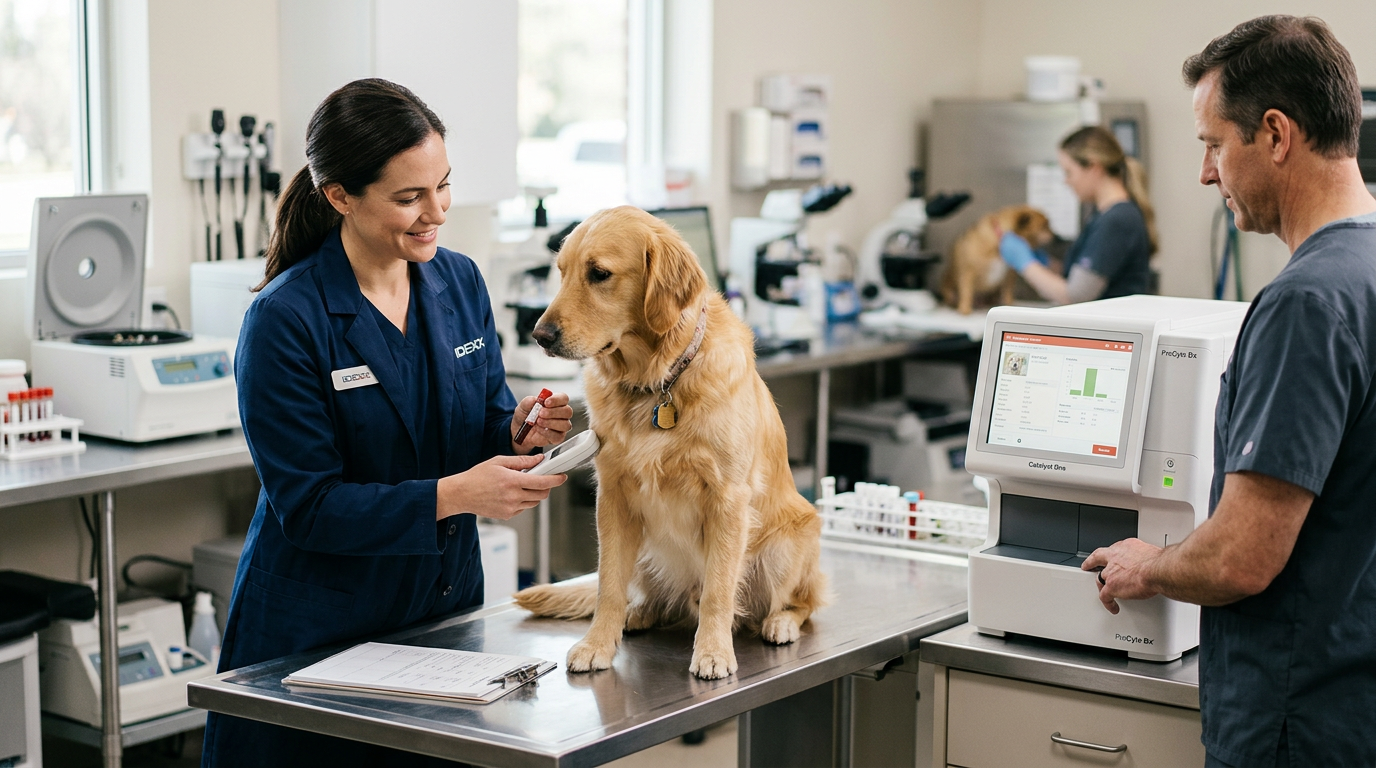
The company develops and manufactures diagnostic instruments, consumables, and practice management software used by veterinary clinics worldwide. The business model is a razor-and-blade structure: get premium instruments placed inside clinics, then generate recurring, high-margin revenue from the consumables those instruments require on an ongoing basis. Clinics do not migrate away from these platforms easily. The integration runs deep, the switching costs are meaningful, and the revenue base compounds without requiring constant new customer acquisition to sustain growth.
Slight tangent, but it actually illustrates the model well. In June 2025, IDEXX launched the Catalyst Cortisol Test, their third menu expansion for the Catalyst platform in under twelve months. It targets endocrine diagnostics specifically for Addison’s disease and Cushing’s syndrome in dogs. That kind of cadence matters because each new test added to an existing platform increases utilization per clinical visit without requiring a new instrument sale. More tests per visit means more consumable revenue from the same installed base. The moat gets wider without the capital outlay of acquiring new customers.
The financials reflect exactly that dynamic.
Full year 2025 revenue came in at $4.304 billion, up 10% on both a reported and organic basis. EPS reached $13.08, up 14% on a comparable basis and 23% reported. CAG Diagnostics recurring revenue grew 9% reported and 8% organically for the full year. IDEXX VetLab consumables specifically grew 17% reported and 15% organically, supported by a 12% expansion in the global premium instrument installed base. Q4 2025 on its own delivered $1.091 billion in revenue, up 14% reported and 12% organic, with EPS of $3.08 rising 18% year over year.
International was particularly interesting in 2025. Q1 international organic growth ran at 8.5%, helping absorb softer U.S. clinical visit volume early in the year. The geographic diversification is not just a hedge. It is an indicator that the pet humanization dynamic is not a U.S. phenomenon. It is playing out across developed and developing markets simultaneously, which extends the runway considerably.
For 2026, management has guided revenue of $4.632 billion to $4.720 billion, with EPS of $14.29 to $14.80 and 40 to 90 basis points of reported operating margin expansion. The guidance implies continued organic growth without a step-change in capital deployment, which is consistent with the recurring revenue model doing what it is supposed to do.
What is worth flagging for skeptics: IDXX does carry a premium valuation. The stock does not screen cheap on a price-to-earnings basis, and clinical visit volume in the U.S. was demonstrably softer in early 2025, which creates a real near-term risk to growth acceleration. If pet owners do pull back on routine wellness visits, not sick-pet diagnostics but elective check-ups, that could put pressure on consumable volumes in the short run. That is a legitimate concern, not a dismissible one.
But zoom out and the picture holds. A growing installed base, expanding menu, recurring consumable revenue, and a customer base that emotionally cannot say no to a vet’s recommendation is a durable combination. The structural driver here is not about pet spending being fashionable right now. It is about a decades-long shift in how humans relate to animals, and IDEXX is the infrastructure that processes that relationship at the point of care, visit after visit, test after test.
The vet bill does not get skipped. That is the whole thing.
- FY2025 revenue: $4.304B (+10% reported and organic)
- FY2025 EPS: $13.08 (+14% comparable basis)
- VetLab consumables: +17% reported, +15% organic
- Global premium instrument installed base: +12%
- 2026 revenue guidance: $4.632B to $4.720B
- 2026 EPS guidance: $14.29 to $14.80
- U.S. companion animal health CAGR through 2030: 9.87%
- Global veterinary services market CAGR through 2033: 7.66%
Whether IDXX is the right entry at current levels depends on your own framework. But the underlying business is doing what it was always designed to do, and the macro driver behind it is not going away. Worth a closer look.
 Rising Star Stocks