
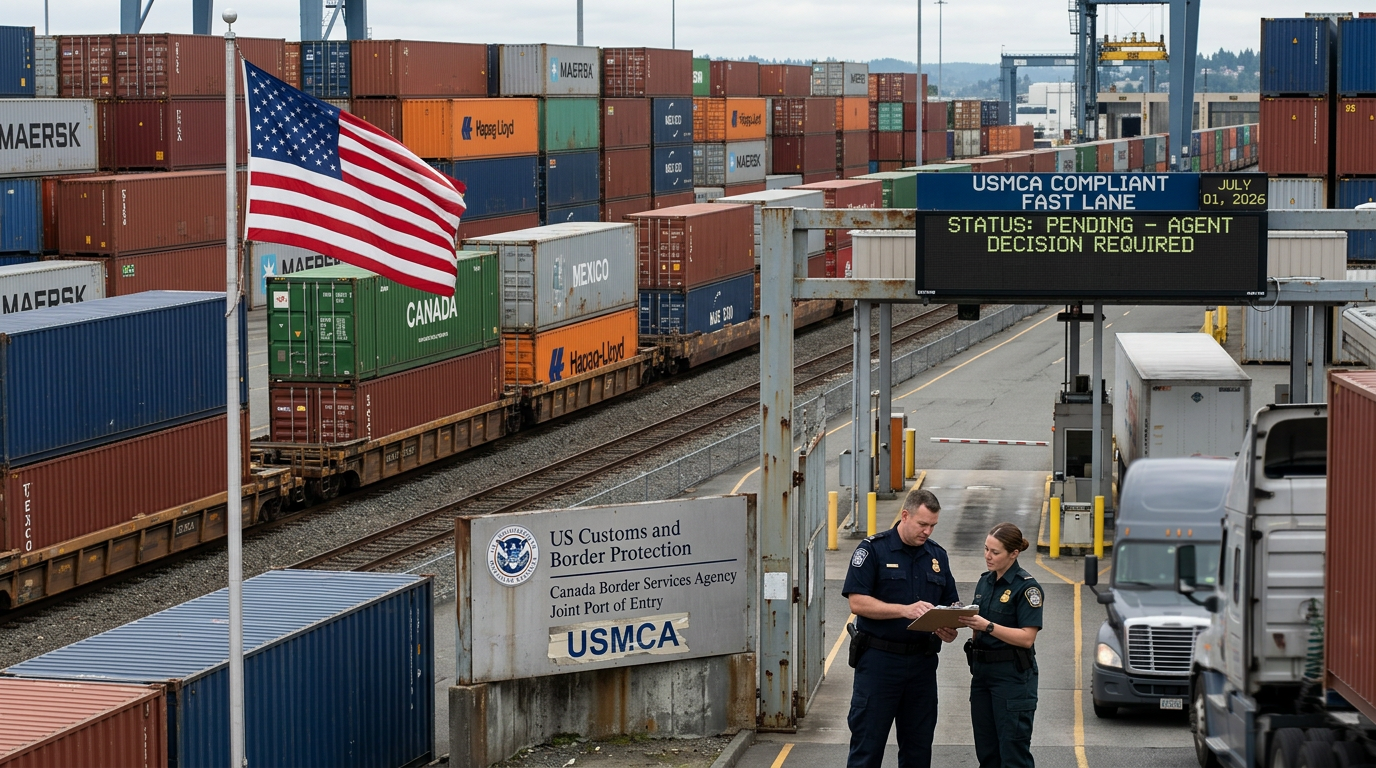
July 1, 2026
USMCA Just Hit Its Deadline. The U.S. Walked.
The $2 trillion trade framework covering North America is now in limbo.
Today is July 1, 2026. Six years to the day since the USMCA took effect. And the U.S. just confirmed it is not renewing.
Markets barely moved. That is probably a mistake.
This morning, the USMCA Free Trade Commission held its required virtual joint review. The United States, Mexico, and Canada met. And then USTR Jamieson Greer issued a statement that left no ambiguity: “The United States did not agree to renew the USMCA in its current form. As a result, the USMCA is not renewed.” The agreement stays in force for now, but the clock has started. What was supposed to be a procedural checkpoint has become something much messier.
Forget SpaceX. The Aftershock Is Where the REAL Fortunes Are.
SpaceX is about to mint a fortune, just not for the people buying it.
The trader whose research was sought out by legends like Stan Druckenmiller has seen this exact setup four times before. After Tesla. After Facebook. After Netscape. After the IPO that launched biotech.
And each time, the real money was made in what he calls the “Aftershock.”
What Is Actually at Stake
The USMCA governs roughly $2 trillion in annual trade and supports millions of U.S. jobs. This is not a symbolic agreement. Canada and Mexico accounted for more than $1.8 trillion in goods and services trade in 2024, largely supporting the manufacturing, agriculture, and energy sectors. In 2024, goods and services trade within North America totaled an estimated $1.93 trillion, with Mexico and Canada standing as the United States’ top two trading partners.
Here is the part people are skipping past. Under Article 34.7, today’s review gave the countries two choices. Option A: confirm a 16-year extension, keeping the deal in place until 2042. Option B: decline to extend, which triggers annual reviews stretching through 2036, with no guaranteed resolution in sight. The U.S. chose Option B. Effectively.
Slight tangent, but it matters: the auto sector is the nerve center of this entire negotiation. Auto trade within North America represents about 17-18% of total trilateral trade, and the sector already absorbed serious damage before today. US purchases of Mexican vehicles and auto parts fell 11.3% in the first quarter of 2026 compared to the same period in 2025, dropping from $42.92 billion to $38.05 billion. Passenger vehicle imports alone dropped 22%. Another round of uncertainty lands on an industry already absorbing serious body blows.
The Sector Breakdown
Automotive carries the highest operational risk going forward. Rules of origin, labor enforcement, and tariff pressure will likely drive more frequent compliance audits across manufacturers and suppliers. The Trump administration reportedly wants to raise the regional value content threshold for vehicles from the current 75% to 82%, with at least 50% of a vehicle’s value required to be sourced from the United States. Right now, roughly a dozen vehicles meet the existing 75% threshold. None are at 80%. That gap is the entire negotiation in miniature.
Electronics faces growing scrutiny as nearshoring has expanded Mexico-based manufacturing. Products with components of Chinese origin will attract heightened attention, a direct byproduct of U.S.-China trade policy intersecting with USMCA enforcement.
For Every $1 the Market Returned, This paid $25.
Retirement costs have doubled in the last six years.
The gap between what you need and what retirement requires keeps widening.
Most people won’t fully understand this until it’s too late.
Garrett Goggin has spent more than twenty years analyzing the mechanism behind this shift.
While retirement accounts struggled to keep pace with rising costs, his research returned over 1,100% in the last two years alone.
For every $1 the market returned, this returned more than $25.
That last point deserves more attention than it is getting. Roughly 20% of the value of Mexican exports to the United States consists of Chinese content. China has been routing components through Mexico to sidestep U.S. tariffs. USTR Greer has made stopping that a top priority. Any renegotiation that tightens rules of origin will directly disrupt electronics and EV supply chains that have spent the last three years building out Mexico-based capacity.
What the Talks Look Like Right Now
The U.S. and Mexico have already completed two formal bilateral rounds, covering automotive rules of origin, steel and aluminum trade, agricultural market access, and economic security. A third round is scheduled for the week of July 20 in Mexico City, where negotiators are expected to move into more detailed legal texts and regulatory provisions.
Canada is a different story. Formal bilateral talks between the U.S. and Canada have only recently begun preliminary discussions. Relations have soured significantly over the past year and a half, and the northern negotiating track is well behind where the U.S.-Mexico process stands today.
The political calendar complicates everything. The November 2026 midterm elections will add pressure. Lawmakers from key manufacturing and agricultural states may push the White House to use the renegotiation to extract concessions from Mexico and Canada. Campaign politics will run parallel to every negotiating round between now and then.
Three Scenarios From Here
Bull Case: A deal framework is announced before Labor Day. Trump packages it as a major win. Markets re-rate North American-exposed industrials, automakers, and agricultural stocks higher. One school of thought holds that a deal by Labor Day would be politically advantageous, giving the Republican Party something concrete to campaign on heading into the midterms.
Base Case: Talks drag into Q4 2026 and beyond. Uncertainty weighs on cross-border capital investment. Supply chain decisions get delayed. Manufacturing stocks and Mexico-exposed names trade at a discount that is not fully reflected in prices yet. The Tax Foundation estimates that removing USMCA exemptions entirely would raise taxes by $466 billion from 2027 through 2036, roughly $300 per U.S. household in 2027, and shrink U.S. output by 0.1% while eliminating the equivalent of 95,000 full-time jobs. That is the downside scenario the market is not pricing.
Bear Case: Talks collapse or grind into annual reviews through the decade. Supply chains are built with thirty-year visibility, not five. Years of bargaining carry their own costs even if additional tariff hikes never materialize. As CSIS noted, investment in Mexico is already down roughly 10% year over year. That is what sustained uncertainty does before anything formally breaks.
The automakers hit hardest in that scenario: GM, Ford, Stellantis. Mexico-domiciled manufacturers with Chinese component exposure face a double hit. Deere and Archer-Daniels-Midland carry meaningful agricultural exposure to any disruption in cross-border access.
What Markets Are Missing
The VIX is sitting at 16.45 today. That is not the behavior of a market that is worried about a protracted renegotiation over $2 trillion in commerce. Either the market believes this gets resolved quickly, or it is not paying close enough attention yet.
The stocks most directly exposed if this turns contentious: Ford (F), General Motors (GM), Stellantis (STLA), Aptiv (APTV), BorgWarner (BWA) on the auto side. Deere (DE) and Archer-Daniels-Midland (ADM) on agriculture. Any electronics assembler with Mexico-based operations using Chinese inputs faces potential rules-of-origin reclassification risk.
Your Complimentary Dividend Package
Today, you can claim the Ultimate Dividend Package… For FREE. (No credit card required!)
Inside, Marc Lichtenfeld – bestselling author of Get Rich with Dividends and world-renowned income expert – is giving away his top dividend picks for 2026.
You’ll get details on…
• Marc’s No. 1 dividend stock for 2026
• The safest 9% dividend in the world
• The top three “Extreme Dividend” stocks
• And much, much more!
Positioning and What to Watch
Watch IYT (iShares Transportation Average ETF) and XLI (Industrials SPDR) for early signals. Both are closely tied to cross-border goods flow. If USMCA uncertainty starts seeping into guidance language during Q2 earnings season beginning mid-July, those sectors will feel it first in the options market.
The options market is the most interesting place to look right now. Implied volatility on automakers is compressed heading into a period of acute trade policy risk. That kind of dislocation tends to correct when earnings calls start surfacing the language of uncertainty.
What happens next depends almost entirely on whether the Trump administration treats this as a campaign asset or a governing problem. History suggests it may try to be both simultaneously. And that means the timeline is genuinely unclear, which is itself the risk. Worth watching closely into July 20.
 Rising Star Stocks