The U.S.-China AI rivalry is almost always framed as a race for compute. Who has the most advanced chips. Who controls the most GPU clusters. Who can pour the most capital into frontier model training. Washington has spent years pulling levers on that exact dimension, restricting exports, blocking chip sales, and pressuring allies to limit China’s access to Nvidia hardware.
That framing misses the fight that China has already won.
The Open-Source Inversion
In the spring of 2026, Hugging Face published its annual platform data. The number that landed hardest: Chinese open-source models now account for 41% of global downloads on the platform, surpassing U.S. models for the first time. Hugging Face CEO Clément Delangue did not bury the finding. He told CNBC’s Squawk on the Street that China is "clearly dominating on open models right now" and that he would not be surprised if Chinese labs start dominating at the frontier as well, by year-end or in 2027.
That is not a marginal shift. Hugging Face hosts millions of public models, and the repository count has been growing fast. When the download rankings flip at that scale, something structural is moving.
On the AI routing platform OpenRouter, recent usage rankings have been heavily populated by Chinese-origin models, including Tencent, Xiaomi, DeepSeek, MiniMax, and Zhipu AI. The U.S. congressional advisory body the U.S.-China Economic and Security Review Commission flagged the dynamic bluntly in March 2026, warning that China’s open-source approach can create a self-reinforcing competitive advantage, allowing it to challenge U.S. rivals despite restricted access to advanced chips.
The mechanism is not complicated. Beijing has deployed AI throughout manufacturing, logistics, and robotics at scale. That real-world deployment generates proprietary data. That data feeds back into model improvement. Broader adoption produces better models, which produces broader adoption. Export controls can slow chip access. They cannot slow this loop.
Alibaba Is Where the Trade Lives
Within the Chinese AI ecosystem, one company is positioned across every layer that matters: model, cloud, and now consumer device. That company is Alibaba Group Holding (NYSE: BABA), and it reports earnings on August 28.
The stock trades near $128, down roughly 22% year-to-date despite cloud revenue growing 38% last quarter and AI-related product revenue posting triple-digit growth for the 11th consecutive quarter. AI-related revenue now accounts for 30% of the Cloud Intelligence Group’s external revenue. Management has guided for that figure to exceed 50% within the next year.
The market has been selling the income statement, not the business. And to be fair, the income statement deserves scrutiny. Alibaba’s fiscal year 2026 free cash flow swung from a RMB 73.9 billion inflow to a RMB 46.6 billion outflow, driven by aggressive spending on AI infrastructure and quick commerce. Non-GAAP net income declined 62%. These are real numbers.
But they are also the numbers you would expect from a company in the middle of a deliberate platform transformation, not a company losing its business.
The Apple Signal
The single most significant external validation of Alibaba’s AI strategy came on July 15. China’s Cyberspace Administration registered Apple Intelligence for deployment in the country, with Alibaba confirming that its Qwen model will power on-device features across iOS, iPadOS, macOS, and visionOS for users in China.
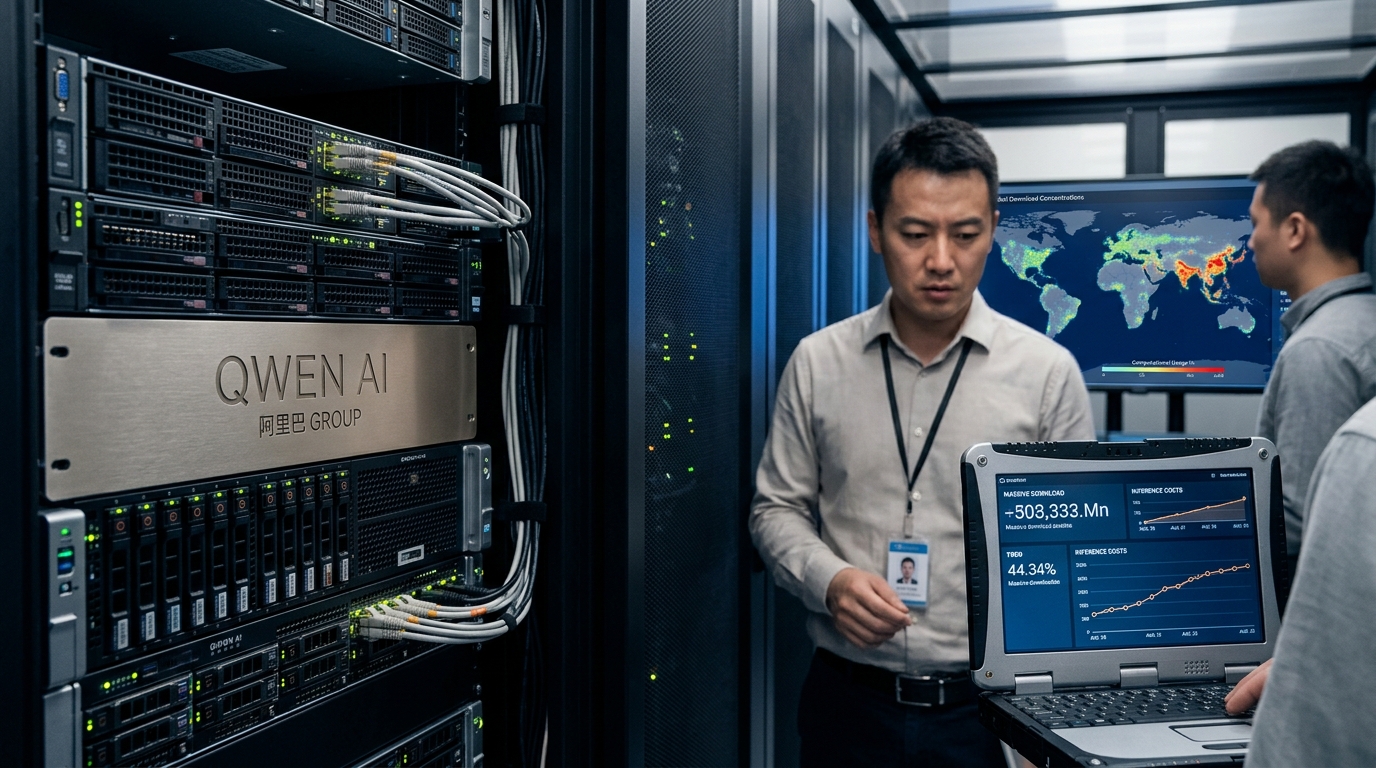
Alibaba beat out Baidu, ByteDance, and DeepSeek for the contract. The selection criteria, according to reporting, came down to model capability, computing capacity, and business complementarity. For a company that built the most widely adopted open-source model family in the world, with over 700 million downloads by January 2026, the win was not a surprise. For the stock, which jumped roughly 6% on the news, it was treated as confirmation.
The Apple deal does something strategic that pure cloud revenue cannot. Qwen running inside Apple Intelligence places Alibaba’s models on hundreds of millions of devices in a single regulatory clearance. Apple shipped approximately 12.4 million iPhones in mainland China in the second quarter alone. The distribution scale is instant. The monetization timeline is not.
Analysts covering the stock know this. Barclays rates BABA Overweight with a $195 price target, implying substantial upside from current levels. The bank forecasts cloud AI annualized recurring revenue hitting RMB 30 billion by year-end 2026, a target that Alibaba itself has guided toward, with token consumption from model services running at an annualized rate of RMB 36 billion as of the most recent quarter.
The Competitive Moat Most Investors Underestimate
Alibaba is not just a model company. It is the infrastructure layer underneath the Chinese AI ecosystem’s global expansion.
Alibaba Cloud has repositioned itself as, in its own framing, the operating system for other AI companies. The Cloud Model Studio is a one-stop platform for AI startups and enterprises. Its Platform for AI infrastructure lets outside developers run models on Alibaba’s GPU hardware. Over 180,000 derivative models had been built on top of Qwen by early 2026. Developers do not simply download Qwen and move on. They build on it, fine-tune it, and redeploy it, creating an adoption flywheel that deepens Alibaba’s position every time a new startup ships a product.
That is the loop the U.S. policy apparatus has struggled to address. Washington’s export controls target chips, the physical layer. China’s open-source strategy operates at the software and ecosystem layer, where the barriers are social and architectural rather than physical. There is no coordinated U.S. response to China’s open ecosystem dominance. The most prominent U.S. advocate for open AI development, Meta, has reportedly begun shifting its next-generation models toward a more hybrid approach, keeping some of its largest models proprietary.
Pulling back from open-source may protect Meta’s frontier models. It cedes the global developer community to Qwen and DeepSeek.
The August 28 Question
Consensus for the quarter expects total revenues of approximately RMB 268.9 billion, representing roughly 8.6% year-over-year growth. Adjusted EPS is expected near 10.46.
The earnings call is not about whether Alibaba is growing. It is about whether the spending cycle is showing any sign of inflecting. Two data points matter most: whether cloud AI revenue continued to accelerate beyond the 38% posted last quarter, and whether quick commerce losses show any sign of having troughed.
If cloud AI revenue growth holds or accelerates, and management provides any credible signal that the investment-heavy phase has a visible endpoint, the stock’s 22% year-to-date decline looks like a mispricing against a business that has landed a massive distribution deal, commands 41% of global open-source AI downloads through its model family, and is guiding for cloud AI ARR to cross RMB 30 billion before December.
Risks Worth Taking Seriously
The China discount is real. U.S.-listed Chinese stocks carry regulatory, delisting, and geopolitical risk that does not price away quietly. The free cash flow situation is under pressure, with AI and quick commerce spending consuming capital that would otherwise show up in buybacks or dividends. The company has said it plans to invest at least RMB 380 billion (about US$53 billion) in cloud and AI infrastructure over three years, and the payback on that spending is not guaranteed.
Geopolitics is also not resolved. Both governments are planning formal AI talks in September 2026 ahead of an expected visit by President Xi. That could ease tension or surface new fault lines. U.S. lawmakers have continued to push for restrictions on companies doing business with Chinese AI infrastructure providers.
And on the competitive side, Alibaba’s consumer-facing AI product still trails domestically. Monthly active users for Doubao, ByteDance’s consumer application, stood at 382 million in June 2026 versus 167 million for Qwen’s consumer app, according to QuestMobile data. Enterprise and cloud are winning. Consumer is not.
The Bigger Frame
The U.S.-China AI contest has spent two years focused on who has the best model. That benchmark race is effectively over. As a CNBC op-ed published August 2 put it, the defining question is no longer whether China can compete at the frontier. It is whether the U.S. can adapt quickly enough to compete against an ecosystem advancing on cost, deployment, customization, developer adoption, and global reach simultaneously.
Alibaba is the company at the center of that ecosystem. It has the cloud infrastructure, the most-downloaded open-source model family in the world, a regulatory-cleared deal with Apple, and a multiyear AI infrastructure spending commitment that signals it intends to hold its position. The stock is down 22% this year while the business underneath it is executing on one of the most significant AI distribution milestones in Chinese tech history.
August 28 is the next data point. It will not resolve the China discount or the geopolitical overhang. But it may resolve the question of whether the spending is producing the revenue acceleration that would make the current price look, in retrospect, like the year’s most interesting dislocation.
That is worth watching closely.
Subject Line: Alibaba Reports Aug. 28. The Data Is Already In.
Preheader: Qwen just cleared Apple’s China market. Earnings may show whether the spend is paying off.
Meta Description: Alibaba’s Qwen model dominates global open-source AI downloads and just won Apple’s China AI deal. With earnings due August 28, here is what investors should actually be watching.
Disclaimer: This editorial is for informational purposes only and does not constitute investment advice, a recommendation, or a solicitation to buy or sell any security. All data and financial figures referenced are sourced from public company filings, earnings calls, and third-party research available as of August 14, 2026. Past performance is not indicative of future results. Investing involves risk, including the possible loss of principal. Readers should conduct their own due diligence and consult a qualified financial advisor before making any investment decisions.
 Rising Star Stocks