September 18, 2026
A new licensing deal may be the growth engine Wall Street has not yet modelled
There is a problem that most hardware companies dream of having. Vicor has it. Demand for its power-conversion technology is running so far ahead of what its factory can ship that a roughly $380 million backlog has accumulated, and customers are still booking orders. This week, Vicor did something elegant with that constraint: it stopped trying to solve it entirely with concrete and started selling the intellectual property instead.
He Doesn’t Buy Gold. He “Skims” It.
A former hedge fund manager ranked in the top 1% by Barron’s has developed a three-step strategy to profit from gold – without buying a single ounce.
His followers have had the chance to collect $2,975… $3,781… and even $6,786 at a time. With a 73% win rate.
He calls it “Gold Skimming.” And he’s just revealed the full strategy for the first time.
The Deal and What It Changes
Vicor granted a non-exclusive license to a new OEM with the right to procure Vertical Power Delivery modules covered by Vicor patents from unlicensed suppliers. VPD enables high-performance AI compute and network processors fueled at high current density from a low-voltage source.
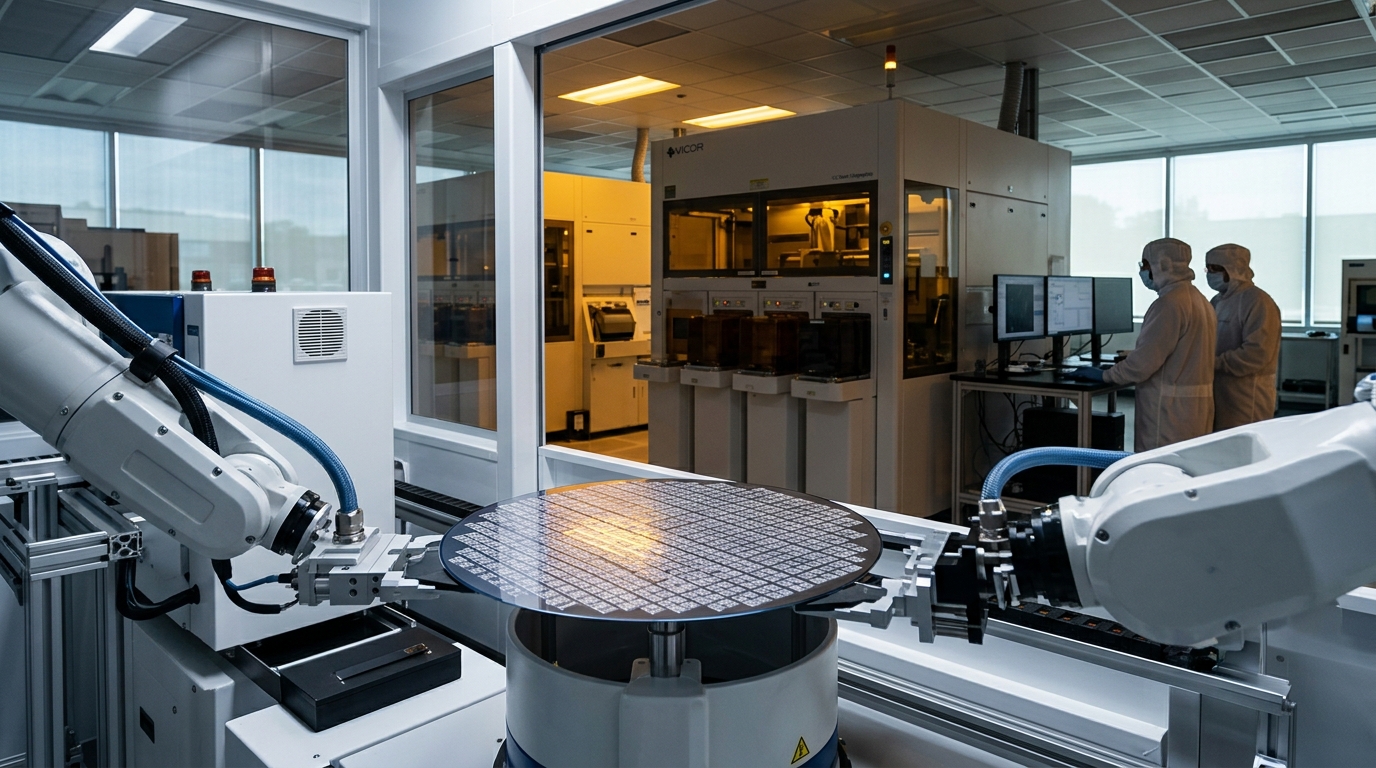
The OEM has not been named. The financial terms have not been disclosed. None of that stopped the market from reacting sharply. VICR stock surged about 15% to 18% on Thursday, September 17, 2026, as investors digested the combination of the licensing news and Vicor’s recent announcement that it is acquiring two large New Hampshire sites to build ChiP Fab-2 and Fab-3, expanding its manufacturing footprint as its Andover ChiP Fab-1 runs close to full utilization.
What the market is pricing in is the business model shift, not just the contract. The company granted a non-exclusive VPD license to a leading AI OEM, letting that customer buy modules from Vicor or third-party suppliers while still paying Vicor royalties. It is a hybrid model: sell modules where you can, get paid on competitors’ shipments where you cannot.
The Numbers Behind the Constraint
Backlog increased 26% sequentially and 145% year-over-year, reaching approximately $380 million. That figure is not a soft indicator. Backlog for product shipments scheduled within the following 12 months was approximately $379.7 million as of June 30, up 26% sequentially and 145% year over year. The fab in Andover physically cannot convert that queue into revenue fast enough.
Calls, Puts, and Why It’s Simpler Than It Sounds
Two basic building blocks. That’s really where it starts.
Once you see how calls and puts actually work — without the textbook fog — the whole thing clicks.
This free guide gets you there, with examples you can copy into your own account.
Normally $29.97. Free today.
Stripping out a one-time patent litigation settlement from the year-ago quarter, Vicor’s revenue grew 49.3% year-over-year to $143.352 million in Q2 2026. Gross margin for Q2 2026 was 58.0%, up from 55.2% in Q1 2026. The long-term target management has set is 70% gross margin on a path to $2.5 billion in revenue. That target requires more than one plant.
Vicor announced on September 11 that it is purchasing a 334,000-square-foot building on 66 acres in Merrimack, New Hampshire, and another 54 acres in Hooksett. The properties would support planned ChiP Fab-2 and Fab-3 power-component manufacturing facilities with a combined footprint of nearly one million square feet. Vicor has pointed to about a one-year lead time to initial Fab-2 deployment. That is roughly twelve months where the licensing model has to carry the growth story.
Why Licensing Is Not a Consolation Prize
The framing matters here. This is not Vicor licensing because it cannot win on product. A fresh non-exclusive license puts Vicor’s VPD technology inside a leading AI OEM’s roadmap, with royalties due even when third-party modules ship. The new VPD licensing framework encourages adoption by offering royalty discounts when customers still buy Vicor-made modules. Royalties become the floor; hardware pull-through is the upside.
Vicor’s proprietary VPD technology is positioned as a bottleneck-breaker for next-generation AI accelerators, driving the demand profile. That is the moat. Every major AI accelerator platform that adopts VPD architecture either buys Vicor modules or pays Vicor royalties. The licensing deal adds a second path to the same toll booth.
5 Nasdaq Stocks Under $5 That Aren’t What You Think
Most stocks under $5 come with a reputation. These don’t.
Each company on this list is tied to major trends like AI, cybersecurity, and next-gen infrastructure.
They may not have the spotlight yet, but they are building real businesses in real markets. That combination is not always easy to find at this price level.
Risks Worth Watching
The OEM’s identity is undisclosed, and so are the royalty rates and duration. The licensing model could generate ongoing royalty and product sales income, but the exact financial impact is unclear due to undisclosed terms. Fab-2 carries real execution risk; a one-year lead time assumes construction, equipment sourcing, and yield ramp all proceed on schedule. And VICR stock has already surged roughly 97% year-to-date through September 17, 2026, so much of the optimism is already reflected in the price.
The Bigger Picture
The expansion comes as power infrastructure emerges as a key constraint on AI data-center growth. Every rack of next-generation accelerators is an argument for more sophisticated power delivery. Vicor is not a commodity component supplier competing on price. It holds foundational patents on a delivery architecture that the industry is increasingly being forced to adopt.
The licensing deal announced this week is small on its own. What it signals is worth watching far more carefully: a company that has figured out how to monetize a capacity wall rather than simply suffer it. That is a different kind of growth story from the one Wall Street has been modelling.
 Rising Star Stocks