
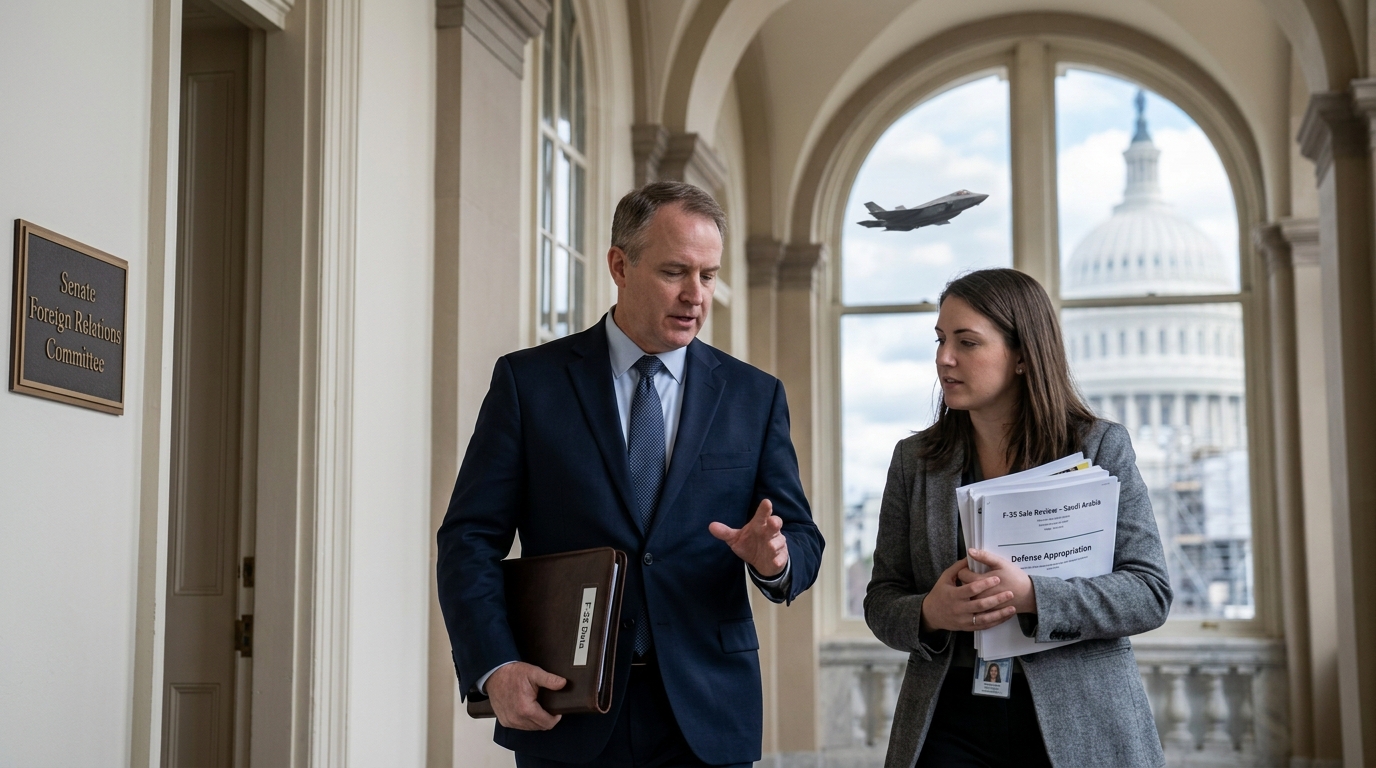
Defense portfolio managers spent Friday doing the math on a $24.3 billion number that, at the moment, is more ceiling than contract. The State Department approved a potential $24.3 billion sale of 48 F-35 fighter jets to Saudi Arabia. Congress has 30 days to scrutinize or attempt to block the deal, and some lawmakers have already raised concerns. That gap between approval and execution is where the real investment question lives.
Why Institutional Investors Are Focused on This
A sale would mark a significant policy shift from the U.S., potentially altering the balance of military power in the Middle East and testing Washington’s definition of maintaining its ally Israel’s qualitative military edge. For defense funds, the strategic framing matters less than the production math. The $24.3 billion ceiling equals roughly $506 million per requested aircraft, compared with an often-cited F-35A unit price near $82.5 million for recent production lots, leaving the remainder to finance engines, software, cryptography, electronic warfare support, spares, simulators, training and logistics. That spread is where both Lockheed Martin and RTX’s Pratt & Whitney collect most of their economics on foreign military sales.
The Bull Case
The announcement comes as the Houthis have recently ramped up attacks on targets in Saudi Arabia and made advances on the ground around the Bab el-Mandeb Strait, a strategically vital chokepoint. That pressure gives the administration real political cover to push the sale through. In May 2025, the United States announced an arms package worth nearly $142 billion for the kingdom, which the White House called the largest defense cooperation agreement Washington has ever done. The F-35 deal follows that commercial logic directly, and a Congress that let $142 billion stand faces a higher bar to block $24.3 billion on top of it.
For Lockheed, the production angles are meaningful. The company has said it expects to continue with a production rate of 156 aircraft per year. Forty-eight additional jets for Saudi Arabia, delivered over several years, would extend that run without requiring a factory expansion. On the F-35 side, contract awards tied to Lots 18 and 19 and related sustainment are already a multibillion-dollar river of work. Saudi Arabia lengthens the tail on all of it.
RTX’s position is equally durable. Pratt & Whitney was awarded a nearly $1.3 billion undefinitized contract for F135 engine spare parts as recently as July 31, 2026. Forty-nine engines for Riyadh, plus a decade-plus of sustainment, would layer on top of a franchise that has already delivered more than 1,500 F135 production engines to customers in 20 allied nations.
The Bear Case
The congressional risk is not theoretical. A Defense Intelligence Agency assessment raised concerns about potential Chinese access to Saudi air bases and Saudi Arabia’s use of Chinese technology in telecommunications infrastructure. Representative Raja Krishnamoorthi has argued the U.S. should not move ahead with the deal at a time when the intelligence community is warning it could put the crown jewels of American military technology within reach of the Chinese Communist Party.
The DIA report has circulated within the administration and in Congress. That the formal notification still triggered immediate opposition suggests the 30-day window will be contentious. A joint resolution of disapproval, while difficult to pass against an aligned White House, would freeze any contract action and introduce timeline uncertainty Lockheed’s production planners cannot absorb cleanly.
What Investors Are Missing
The debate has centered on whether the sale clears Congress. The less-discussed consequence is what happens to Pratt & Whitney’s Engine Core Upgrade program regardless of the vote. Pratt & Whitney completed the F135 Engine Core Upgrade Risk Reduction Design Review on September 15, 2026, a major milestone that validates the maturity of the upgrade design and advances the program toward production to support F-35 Block 4 and beyond capabilities. Saudi Arabia, if it eventually receives the jets, would require the upgraded engine standard. Even if Congress delays this specific sale, the ECU program’s momentum locks in RTX’s propulsion position for the next decade of F-35 exports. The engine contract endures longer than any single customer decision.
Even if the sale receives congressional approval, it could take years before the first jets are supplied to the Saudis. That delivery horizon actually reduces near-term revenue risk for Lockheed’s production schedule while adding a funded order to the backlog that supports long-range planning.
Stocks to Watch
Lockheed Martin (LMT): The primary contractor on the airframe. Forty-eight jets at stable production rates extend the program’s run without capital investment, and the sustainment contract that follows an operational Saudi fleet would run well past 2040.
RTX (RTX): Pratt & Whitney holds sole-source propulsion on every F-35 variant. Forty-nine F135 engines for Saudi Arabia, plus decades of spare parts and the ECU upgrade cycle, make this sale more durable for RTX than headline risk suggests.
Northrop Grumman (NOC): Builds the F-35’s center fuselage and provides mission systems integration. Any expansion of the production run touches Northrop’s workshare directly.
General Dynamics (GD): Less direct exposure to the airframe, but GD’s information technology and secure communications divisions are embedded in F-35 ground infrastructure, and the Saudi package explicitly includes secure communications equipment.
 Rising Star Stocks