October 1, 2026
Bonus Content: Jabil Just Posted $10.6 Billion. The AI Rack Builders Are Hiding in Plain Sight.
Two Metals. Two Megatrends. One Under-$1 Story.
Investors usually separate gold and silver into two very different trades.
Gold is the hard-asset trade. It gets attention when central banks are buying, currencies feel shaky, and investors start looking for something outside the paper system.
Silver is different. It has the precious metals DNA, but it also gets pulled into the real economy: AI infrastructure, electronics, defense, EVs, and grid demand.
One is about protection. The other is about pressure. That’s why this under $1 story is worth a double take.
It’s not asking investors to choose between the two. It has above-ground material tied to both gold and silver, with 2026 production timing and cash flow within sight.
So the setup is not just “gold is up” or “silver is tight.” It is a small company sitting between both metals at a moment when both are becoming harder to ignore.
Gold gives the monetary story. Silver gives the industrial squeeze.
And the cash flow potential gives this under $1 name something most junior explorers are still years away from.
Jabil Just Posted $10.6 Billion. The AI Rack Builders Are Hiding in Plain Sight.
Every earnings season, the spotlight lands on the chip designers and the hyperscalers. The company actually bolting the racks together tends to get ignored. That oversight is becoming expensive.
Jabil reported fiscal fourth-quarter results on Sept. 30 before the open, and the numbers were not subtle. Revenue came in at $10.6 billion against a Wall Street consensus of $9.69 billion, a beat of nearly $910 million. Core diluted EPS reached $4.40 versus the $4.06 expected, a 34% jump year over year. The quarter landed roughly $900 million above the midpoint of Jabil’s own June outlook.
Where the Money Came From
The Intelligent Infrastructure segment did the heavy lifting. Revenue there hit approximately $5.8 billion in the quarter, up 56% year over year and roughly $900 million above Jabil’s June outlook. That single segment now accounts for more than half of quarterly revenue. Cloud and data center infrastructure, networking, and capital equipment for semiconductor manufacturing all contributed.
For the full fiscal year, Jabil delivered about $36.0 billion in revenue, up 21%, while core operating margin expanded 40 basis points. Adjusted free cash flow topped $1.5 billion. Net capital expenditures held to just 1.3% of revenue, the defining feature of a contract manufacturer that scales without sinking capital into depreciating assets it does not need to own.
The Forward Picture
Management guided fiscal 2027 revenue to $44.5 billion, implying 24% growth off an already elevated base. Core EPS guidance of $17.55 represents another 34% increase. AI-related revenue, which came in at about $14.4 billion in fiscal 2026 after growing 60% year over year, is projected to reach about $22.1 billion in fiscal 2027, a further 54% rise. The company ended fiscal 2026 with four customers each generating more than $1 billion annually in AI-related revenue, compared with one such customer two years ago. A third hyperscale relationship added during the fiscal third quarter is expected to become a billion-dollar engagement by fiscal 2028.
The first quarter of fiscal 2027 guidance of $10.6 to $11.4 billion in revenue suggests no seasonal cliff. Core EPS guidance of $3.80 to $4.20 for that period alone is a meaningful sequential step up from where the company stood twelve months ago.
Why the Stock Fell Anyway
Shares dropped roughly 10% to about $287 in the Sept. 30 session despite the beat, a reaction worth understanding rather than dismissing. Investors appear focused on two things: capacity expansion risk as Jabil adds about 4 million square feet of new facilities, and the back-end loaded timing of margin improvement. Core operating margin in Intelligent Infrastructure is about 5.8%. Debt to core EBITDA sits at 1.3 times, which is manageable but not trivial heading into an aggressive build cycle.
The Case That Remains
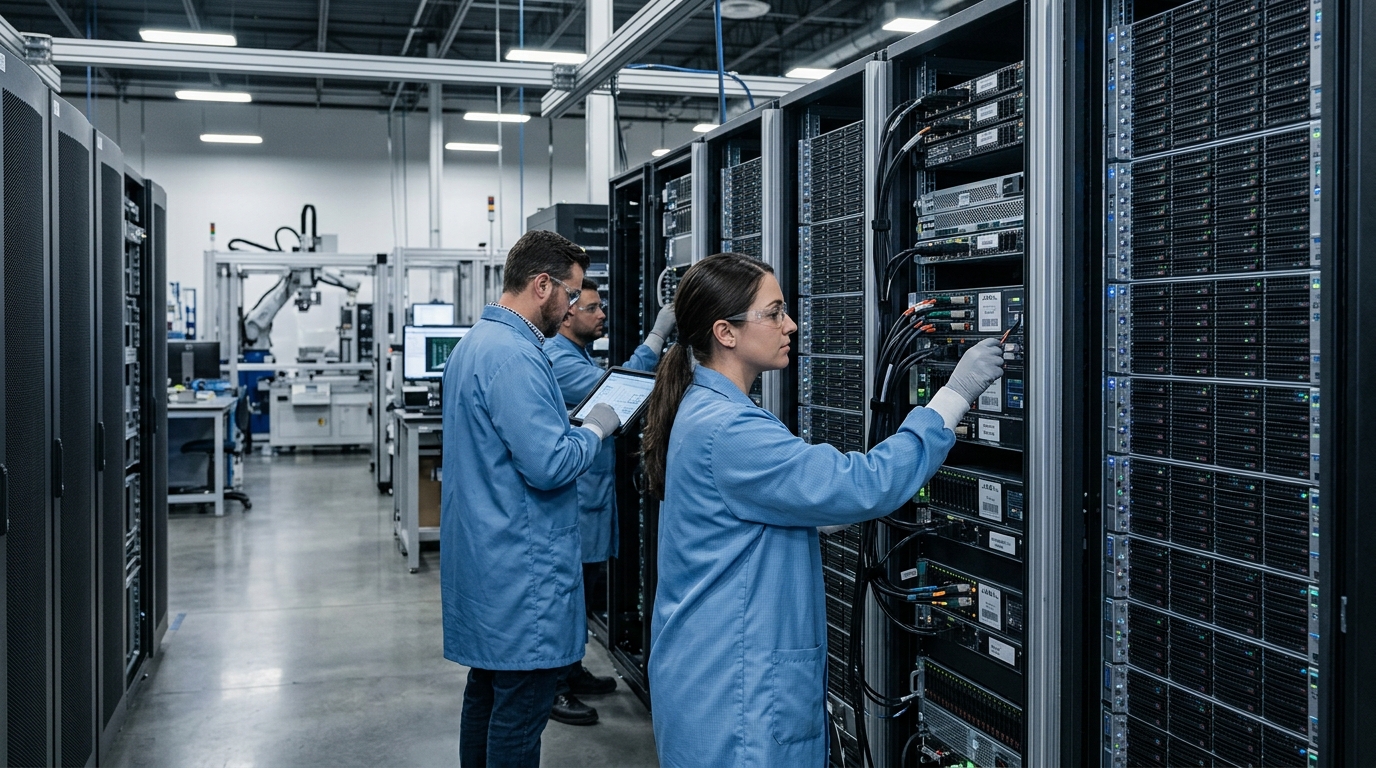
Jabil is an electronic manufacturing services company. It does not design chips. It does not sell cloud subscriptions. What it does is take on the engineering and manufacturing complexity that hyperscalers and AI hardware companies have decided is not core to their own operations: compute assembly, power systems, liquid cooling, full rack integration. Four of the six largest data center wins in fiscal 2026 began as design engagements, which signals something deeper than commodity contract work.
The market tends to reward the companies whose names appear on the product. Jabil’s name rarely does. That gap between contribution and credit is exactly where patient investors have historically found room.
With about $22 billion in projected AI revenue for fiscal 2027 and a business model that generates cash rather than consuming it, Jabil may be worth watching more closely than its stock price today suggests.
 Rising Star Stocks