
October 31, 2026
Bonus Content: Qualcomm’s Cars Are Carrying the Company as Apple Walks Out
Dear Investor,
Here’s a crypto stat that tells you everything about small coins…
Over the past 30 days, eight altcoins gained three times more than Bitcoin.
Then, in the very next week, six of those eight fell.
That’s micro coin investing in a nutshell. The moves are huge. In both directions. Fast.
Most people only think about the first half: finding the coin before it runs. And that matters.
But the investors who actually come out ahead are the ones who know the second half too.
When to take profits. How much to sell. How to avoid riding a 200% gain all the way back down to zero.
Because in micro coins, the difference between a life-changing win and a painful story is usually not the buy. It’s the exit.
That’s why Micro Coin Revolution doesn’t stop at telling you how to buy…
You’ll get the process we use to find small coins early. And, most importantly, you’ll see how we decide when to get out.
Altcoin momentum is building. Make sure you have a plan for both halves of the trade.
See the Micro Coin Revolution Presentation now.
To your massive success,
Bryce Paul
Crypto 101
Qualcomm’s Cars Are Carrying the Company as Apple Walks Out
The semiconductor sector just got a hard message from Intel. On October 29, the company reported that higher memory prices are weighing on PC demand, warned PC unit volumes could decline roughly 12% in 2026 and another 10% in 2027, and sent chipmakers into a broad selloff. Qualcomm fell about 11% in that session alone. AMD sank about 11%. The market treated every handset-adjacent name the same way.
That reaction may be the wrong read on Qualcomm.
The company closes its fiscal year Wednesday after the bell. The earnings release is scheduled for Wednesday, November 4, 2026, after the close. Analyst consensus sits around $2.17 per share on $10.14 billion in revenue, down sharply from $3.00 and $11.27 billion a year ago. The headline decline is real. But the story underneath it is more nuanced than the sector selloff suggests, and it centers on two businesses that most models barely touch: automotive and connected devices.
The Segment Nobody Is Sizing
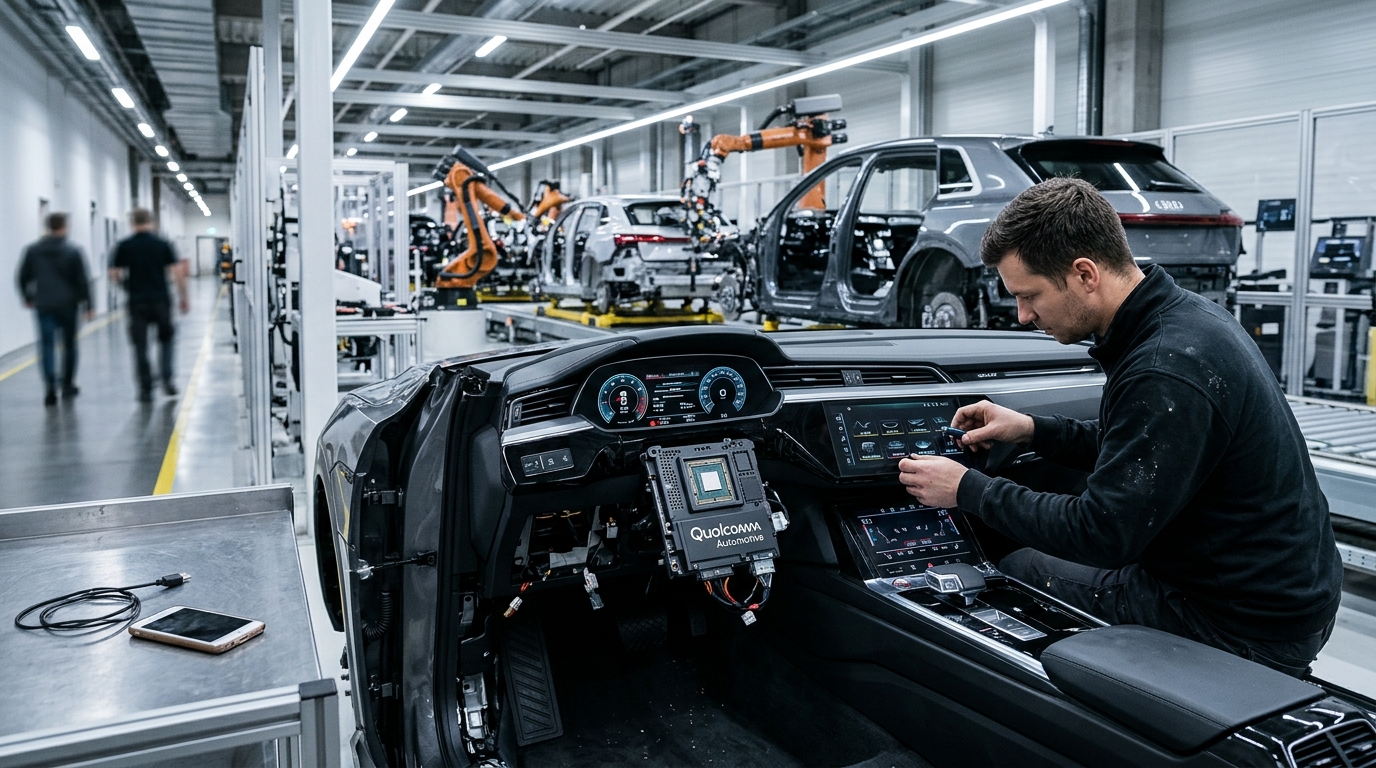
Qualcomm’s automotive revenue has moved from a footnote to a structural growth engine in roughly three years. In Q1 fiscal 2026 it was $1.1 billion, up 15% year over year. By Q2, it hit about $1.3 billion, up 38%, with management calling it a record and noting the company had crossed $5 billion in annualized automotive revenue for the first time. In Q3, it reached about $1.6 billion, up 61% year over year. Management has also talked about an annualized automotive revenue run rate above $6 billion exiting fiscal 2026.
For context: Nvidia reported full-year fiscal 2026 automotive revenue of $3.2 billion. Qualcomm is on pace to exceed that figure on an annualized basis.
The design-win pipeline stands at roughly $45 billion, representing committed builds across multiple vehicle generations. A BMW agreement made Qualcomm the lead compute silicon provider for digital cockpit and next-generation ADAS/automated driving systems across future model programs. More than 75 million vehicles already run Qualcomm Snapdragon Cockpit platforms. These are not speculative wins. They are contracted revenue converting to recognized dollars over a multi-year ramp.
IoT added $1.8 billion in Q3, up 9%. Combined, automotive and IoT grew 28% year over year last quarter, carrying the company while handsets contracted.
The Apple Problem, Quantified
Apple is replacing Qualcomm modems with its own silicon. Management confirmed on the Q3 call that Qualcomm’s share of the upcoming iPhone launch would be materially below an earlier 20% estimate, with Apple product revenue expected to fall roughly 50% sequentially in the fiscal fourth quarter. Analysts estimate Apple’s full exit from Qualcomm’s modem and RF business could eventually leave a multibillion-dollar annual revenue gap later this decade.
That is a real headwind. The question Wednesday night is whether the automotive run-rate and IoT trajectory are large enough and growing fast enough to matter before that gap fully opens. Management’s projection that non-handset revenue growth will accelerate from roughly 24% in fiscal 2026 to greater than 60% in fiscal 2027 is the number that deserves scrutiny on the call.
What the Selloff Gets Wrong
Intel’s memory warning is legitimately bad for PC-exposed names. Qualcomm’s handset exposure is real, and Q4 handset revenue is expected near $5.2 billion, down roughly 25% year over year. Nobody disputes the drag.
But Broadcom, which fell about 5% in the same session, draws its growth from hyperscaler AI custom chips, a market Qualcomm is also entering via a multi-generational product collaboration with Amazon to build AI data center infrastructure. Qualcomm has said it is targeting about $5 billion in data center revenue in fiscal 2027. The sector-wide brush that punished QCOM about 11% alongside AMD treats those businesses as identical. They are not.
Broadcom is not the only entrenched rival Qualcomm faces in custom silicon for hyperscalers. Marvell has already built a commanding position in the custom AI chip market that Bank of America estimates could reach $300 billion by 2030.
Risks Worth Watching
The automotive ramp is real but slow to monetize at scale. Design wins convert over years, not quarters, and any softening in global auto production could delay revenue recognition. Margin pressure is also live: Q4 QCT EBT margin is guided to 23–25%, down from 29% a year ago, as supply-chain costs work through the income statement. And Qualcomm’s data center ambitions face entrenched competition from Broadcom and Marvell, both of which ship custom silicon to hyperscalers at volume today.
What Wednesday Reveals
The fiscal fourth-quarter report will close one chapter and open another. Investors watching only the EPS decline from $3.00 to the $2.17 consensus are reading last year’s company. The number that actually matters is how fast automotive and IoT are compounding relative to the rate at which Apple revenue is leaving. If automotive delivers another record quarter near 60% growth as guided, and management raises the fiscal 2027 non-handset outlook, the stock’s trailing earnings multiple may look less like risk and more like a re-entry point.
The cars are already carrying this company. Wednesday’s report tells you whether they can carry it far enough.
 Rising Star Stocks