
October 29, 2026
Bonus Content: Carvana Sold 217,000 Cars and Made $483M. The 10-Year Yield Is at 5%
Hi,
In 1965, about 42% of American adults shared the same habit. By 2022, it was under 12%.
You can probably guess the habit. The industry that may be next is the surprise.
Along the way, the companies behind that first habit agreed to an estimated $206 billion in settlement payments.
The industry didn’t vanish. But the customers, the rules and the money all moved.
Now a similar kind of pressure may be building around another industry, one the world can’t live without.
Here’s the twist: people could quit that first habit. Nobody can quit pest control.
So if the pressure keeps building, the demand doesn’t disappear. It has to go somewhere.
Our research desk boiled the whole story down to a 60-second read. It starts with one question:
Carvana Sold 217,000 Cars and Made $483M. The 10-Year Yield Is at 5%
Four years ago, Carvana’s stock traded for less than $1 a share (split-adjusted). In December 2022 alone, it had dropped 99% from its August 2021 peak. Analysts debated chapter eleven. Short sellers built careers on its collapse. The company that was supposed to digitize used-car retail looked, for a moment, like a cautionary tale about leverage and ambition arriving in the wrong order.
Tuesday night, that same company reported the best quarter in its history.
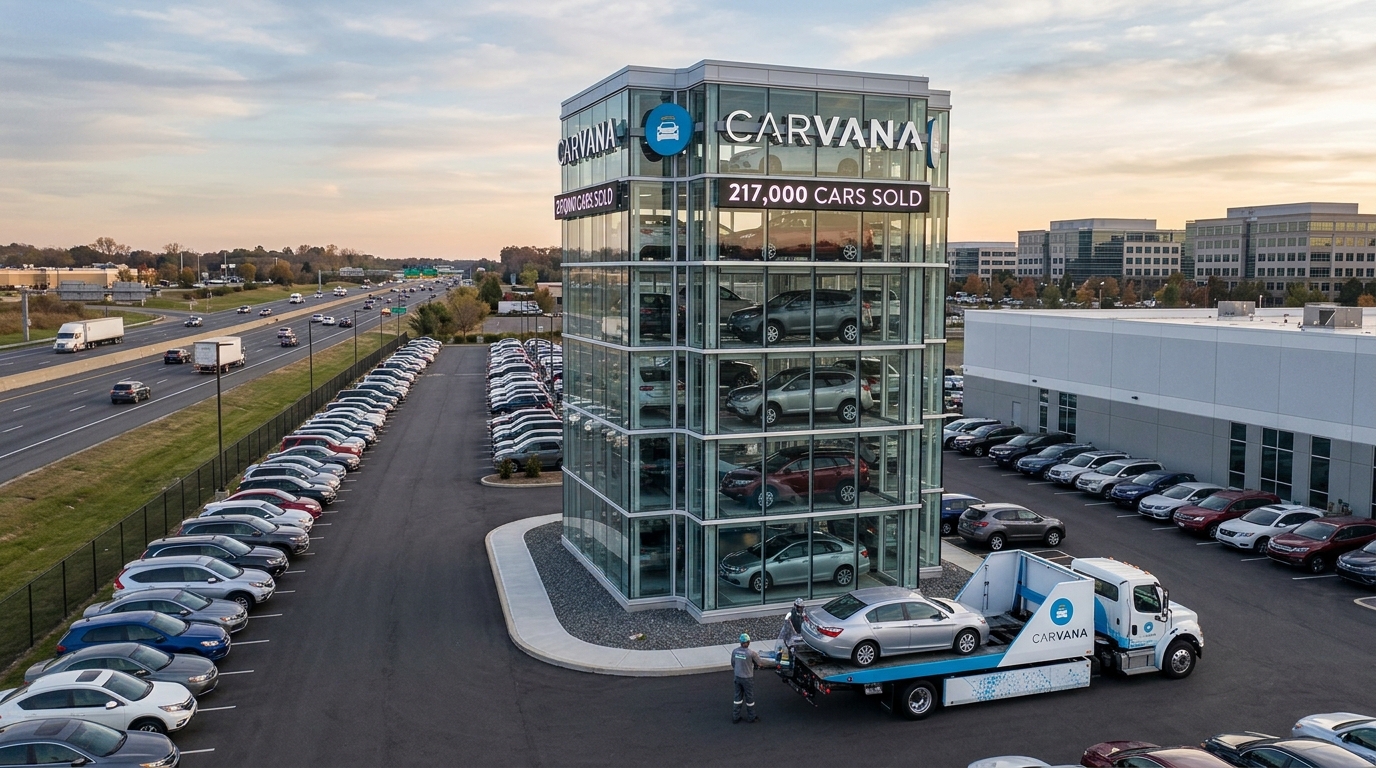
In Q3 2026, Carvana sold 217,385 retail units, up 39% year-over-year, for total revenue of $8.04 billion, up 42%, both all-time quarterly records. Net income came in at $483 million with a 6.0% margin, alongside record adjusted EBITDA of $800 million at a 10.0% margin. Those numbers landed against a backdrop that was supposed to kill the used-car business: the 10-year Treasury yield sits near 5%.
What the Comeback Actually Required
The rebound kicked off in 2023, when a group of creditors led by Apollo Global Management agreed to a deal that reduced Carvana’s total debt load by more than $1.2 billion. That bought time. Management used it to rebuild from the cost line in, not the revenue line out. The result is a business that now generates adjusted EBITDA at a run rate over $3 billion and net income at a run rate of almost $2 billion, both nearly double what they were two years ago.
Carvana is now the most profitable automotive retailer with margins approximately twice the industry average, a distinction it has held for ten consecutive quarters. CarMax, which has gained ground on Carvana in 2026 while CVNA was under pressure from guidance concerns earlier in the year, operates with a structurally thinner margin profile. The gap widened again this week.
The broader automotive retail picture adds context here. New-vehicle sales fell nearly 7% in August even as hybrid lineups posted record months, a split that shapes the used-car supply Carvana depends on.
Supply Is the Ceiling, Not Demand
Here is the angle most coverage misses. This was not a demand story. Management said it wants inventory availability to grow faster. While Carvana slightly outproduced retail unit sales in the quarter, the growth rate of vehicles immediately available on the website remains below the company’s sales growth rate. CEO Ernie Garcia said the company would add many thousands of more reconditioned vehicles immediately if it could, but increasing capacity requires continued work in its inspection and reconditioning centers.
The company produced more than 200,000 vehicles during the quarter for the first time, setting a record for reconditioned vehicle production. That is the operational bottleneck: reconditioning throughput, not consumer willingness to buy. Carvana has been bringing reconditioning to new facilities, expanding production capacity and inventory in markets like Charlotte. Each new inspection and reconditioning center costs money before it produces a single saleable car. The model is deliberately overbuilding capacity ahead of demand.
The Market They Are Chasing
Despite its growth, Carvana holds just over 2% of the used-vehicle market and about 1.5% of the overall automotive market. The automotive retail industry saw approximately 38 million used auto sales in the United States in 2025, according to Cox Automotive, and remains highly fragmented. Garcia noted on the call that Carvana has been the second-largest seller of used cars in the country for some time, and said the company is now knocking on the door of becoming the largest.
Carvana ended the quarter with net debt equal to 0.8 times trailing 12-month adjusted EBITDA and adjusted EBITDA covering interest expense by 6.9 times, both company records. For a company that was discussing debt covenants in survival terms not long ago, that is a meaningful shift in the credit picture.
The rate environment framing this story is worth examining on its own terms. The equity risk premium has nearly disappeared as the 10-year Treasury yield pushes bonds ahead of stocks on a trailing basis, which is the same rate pressure Carvana is outgrowing.
Risks Worth Watching
Adjusted EBITDA margin declined to 10.0% from 11.3%, mainly due to a mix shift toward higher-priced vehicles and lower other GPU as Carvana offered customers lower interest rates. That compression deserves attention. Consumer demand remains highly contingent on financing affordability, and the company’s volume is sensitive to where interest rates move.
Management expects a sequential increase in retail units in the fourth quarter and projects full-year 2026 adjusted EBITDA at the higher end of its $2.7 billion to $3.0 billion range. After the Q2 guidance underwhelmed the Street and pushed CVNA down roughly 30% year-to-date by late summer, these numbers arriving above fear could matter for sentiment.
The Bigger Picture
Carvana’s Q3 is not just a company story. It is a test case for whether a capital-light, vertically integrated digital retailer can take durable share from fragmented physical dealers even when borrowing costs are elevated. So far, the answer appears to be yes, provided the supply chain keeps pace. The company has reiterated long-term targets of 3 million annual units and a 13.5% adjusted EBITDA margin. At an 870,000-unit annual run rate today, the runway is long and the reconditioning network is the instrument that will determine how fast they get there. Worth watching closely.
 Rising Star Stocks