November 1, 2026
Bonus Content: Walmart’s Holiday Moment Arrives as Forecasters Split
Dear Friend,
In 1976, a Chevron drilling team tapped an energy source so powerful it could run a city.
No fuel costs. No carbon. No supply chain.
They proved it worked. Then they killed the project.
Unocal proved it worked. Killed it.
Texaco proved it worked. Killed it.
Three of the largest oil companies on Earth confirmed the same thing.
And all three buried the results for the same reason: it would have destroyed their core business.
For fifty years, the official line was “the technology isn’t ready.”
The technology was fine. The threat was too big.
Now one company has spent sixty years perfecting what Big Oil refused to touch.
Google just locked in a 15-year contract. Bill Gates wrote a $100 million check. And on November 17th, the government hands it a competitive edge no other energy source gets.
Big Oil had fifty years to act. They chose not to.
See the company that didn’t wait >>
“The Buck Stops Here,”
Kelly Maguire
Behind the Markets
Walmart’s Holiday Moment Arrives as Forecasters Split
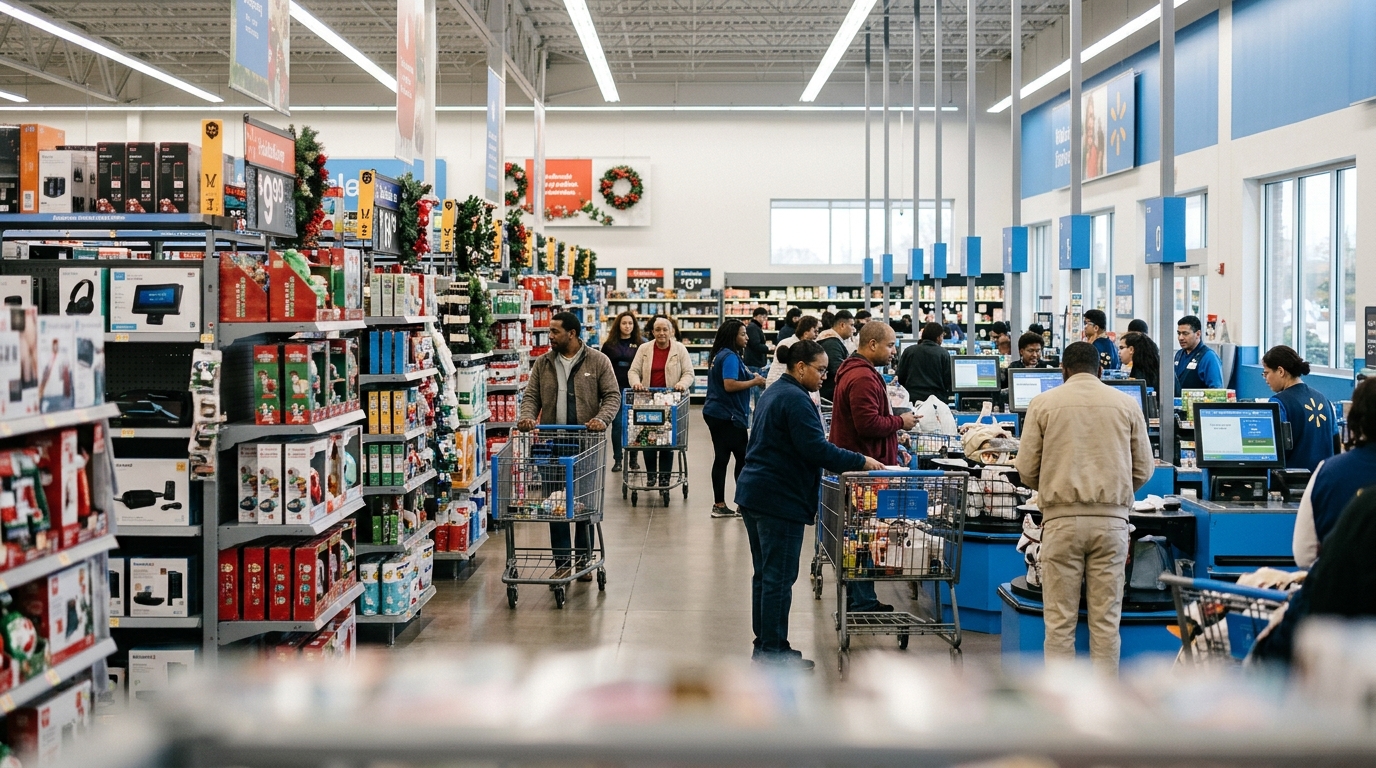
The holiday season starts today. And depending on who you believe, it will either be the strongest in four years or quietly held together with buy now, pay later installments and a lot of wishful thinking.
Market Temperature
The gap between forecasts is hard to ignore. The National Retail Federation projects November and December retail sales to grow 4.2% over 2025, reaching $1.013 trillion, a figure that would be a new record for the NRF’s November to December holiday season measure. The Mastercard Economics Institute, drawing on SpendingPulse data covering in-store and online spending across all forms of payment, puts that growth at 5.5% year over year. EY-Parthenon sits between them at 5.2%, calling it the strongest gain since 2021.
That 130-basis-point spread between NRF and Mastercard is not a rounding error. It represents tens of billions in sales. The more important question is what is underneath either number.
Mastercard’s holiday outlook is in nominal terms and is not adjusted for inflation. NRF reaches a similar conclusion, saying about half of its projected holiday growth is expected to come from real consumer spending rather than price increases.
The backdrop makes this even harder to read cleanly. The Conference Board’s Consumer Confidence Index dropped 6.7 points in September to 81.9, its lowest level since April 2014, as households grew more pessimistic about both current conditions and the six-month outlook. U.S. on-highway diesel hit $6.35 per gallon in the week ending October 26, according to the Energy Information Administration, a price that flows directly into logistics costs and squeezes lower-income household budgets before anyone buys a single gift.
Analysts warn that middle- and lower-income consumers may be relying on credit and buy now, pay later options to fund their holiday purchases. Buy now, pay later is on track for another record holiday season, with Adobe projecting Americans will spend $21.3 billion online via BNPL in November and December, up 6.6% from last year. About a third of consumers say they are entering the season with existing credit card debt. These are not the spending patterns of a confident consumer. They are the patterns of a stretched one.
Why Walmart Now
If Mastercard’s 5.5% call is right and consumers are borrowing to get there, the retailer positioned to capture that spending is not the one selling aspirational merchandise at full price. It is the one that has already been winning on value for two years running.
Walmart (WMT) enters this season in a structurally different place than its peers. The stock trades near $123.51 with a market cap approaching $980 billion and trailing twelve-month revenue of $735.84 billion, up about 6.2% year over year. Last holiday quarter, Walmart reported that holiday-quarter sales rose nearly 6%, with gains in e-commerce, advertising, and its third-party marketplace. Those are not the numbers of a retailer coasting on low prices alone.
Walmart is funding more than 11,000 price rollbacks using $2.9 billion in tariff refunds, a move executives have framed as a market share play. Walmart U.S. CEO David Guggina has offered a preview of the retailer’s holiday strategy as shoppers continue to seek value across income levels, and the company’s emphasis on value has helped it maintain its position of preference with increasingly strained consumers.
The income-mixing story is also real. Walmart gained about 20 basis points of discount and club spending share year over year in Q3 2026 among households earning more than $150,000. Higher-income households are now a meaningful part of Walmart’s customer base, which broadens the brand’s exposure precisely as a bifurcated consumer environment rewards both ends of the income spectrum.
Risks Worth Watching
Walmart is not without complications. In the quarter ended July 31, 2026, U.S. comparable sales growth of 2.6%, excluding fuel, trailed Wall Street’s expectation of roughly the mid-3% range. CFO John David Rainey noted it was “prudent to remain cautious” given what he called “arguably a softer consumer environment.” The stock already prices in a premium: WMT’s trailing price-to-earnings ratio has recently been in the low-to-mid 40s, and most commonly cited forward P/E estimates are around the low 40s. At nearly $1 trillion in market cap, the upside ceiling is narrower than it was two years ago.
A holiday season that disappoints relative to forecasts, or where real unit volumes underperform even as dollar sales hold up on inflation, could pressure margins without delivering the volume to justify them.
Logistics costs add another layer of pressure on margin math. Transpacific container rates have more than doubled from early-year lows, a cost that lands on retailers before a single unit reaches the shelf.
The Bigger Picture
The divergence between consumer confidence and consumer spending has been the defining tension of this economic cycle. Forecasters lean on a labor market that is still adding jobs and on consumers who have kept spending through three years of gloomy surveys, but pre-season indicators and shoppers’ own spending plans are flat to down, and most projected growth is price, not volume.
That context is precisely why a value-oriented, omnichannel retailer with pricing power, a growing advertising business, and momentum with higher-income households is worth tracking into November. When Walmart’s own shopper panel was asked what would make holiday shopping easier, 70.2% said lower prices and 57.4% said more deals and promotions. Walmart is the answer to that question at scale.
If the season lands closer to NRF’s 4.2% than Mastercard’s 5.5%, Walmart’s defensive positioning still holds. If Mastercard is right and consumers spend through their discomfort, Walmart captures volume across every income bracket. The asymmetry favors the stock either way. Worth keeping on the radar.
 Rising Star Stocks