July 3, 2026
Rivian Surged. The R2 Just Changed the Math.
Featured: Rivian Surged. The R2 Just Changed the Math.
New to Trading Options? Try THIS
An Easy Options Strategy For Beginners:
Get the Strategy + the “Battle-Tested” ticker today – FREE

✓ How the 11-Hour Options Strategy works – explained in plain English, from A to Z…
✓ The three things you need to start trading options today.
✓ Why this single-focused window has so much more potential than grinding through charts all day (and lets you actively trade while still LIVING your life).
✓ See a simple 3-question filter you can use to help protect yourself before ever placing a trade.
✓ And the exact “rinse and repeat” ticker used nearly 900 times with a 95.3% win rate, just to get you started.
Send me my Free Copy of the 11-Hour Options For Beginners Guide – NOW
To your trading success,
Dave Aquino
Base Camp Trading
FEATURED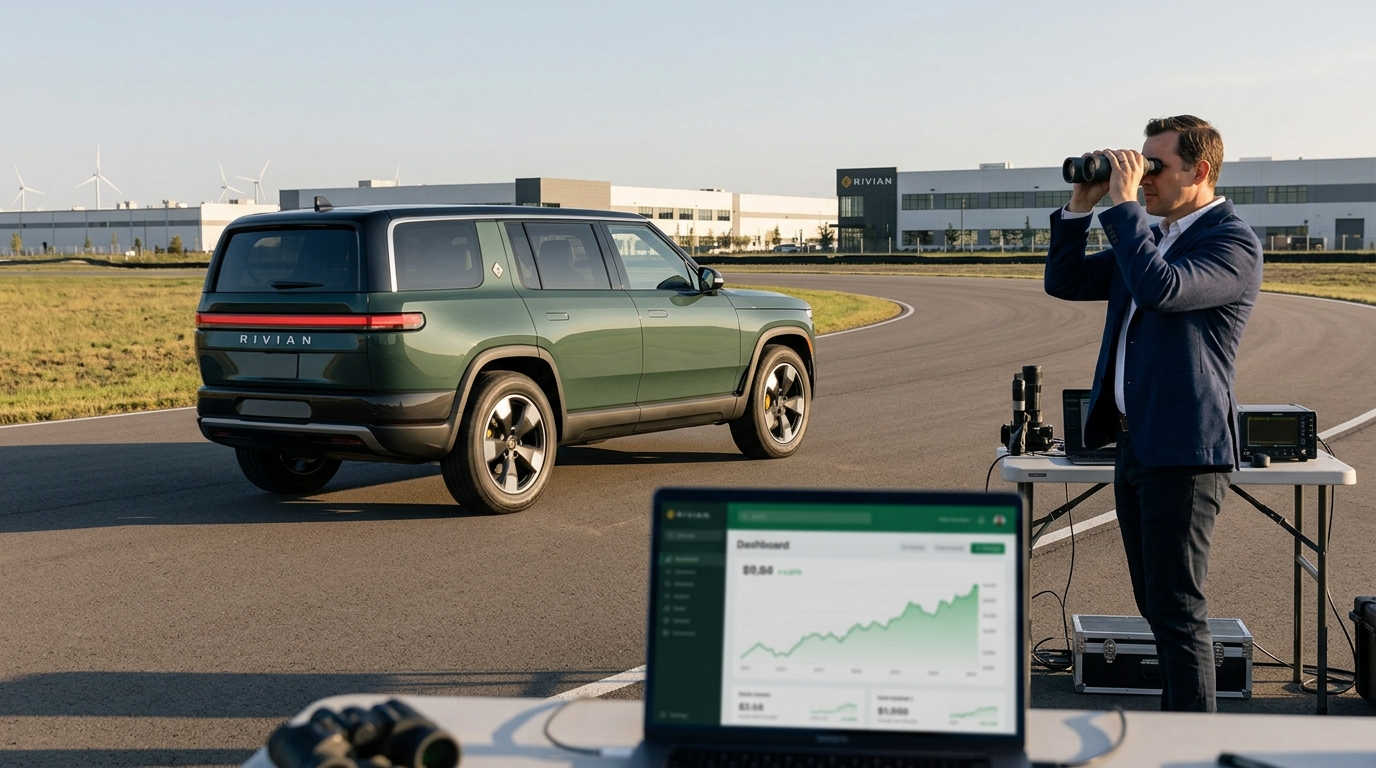
Rivian Surged. The R2 Just Changed the Math.
Rivian has spent most of 2026 being ignored. July 2nd changed that, at least for a day.
The company delivered 12,194 vehicles in Q2, blowing past its own guidance range of 9,000 to 11,000 units. Shares hit an intraday high of $19.79, the highest level since January, before closing up about 8% at $18.63. The reason wasn’t just the number itself. It was what came with it.
Management raised full-year 2026 delivery guidance to 65,000-70,000 vehicles, up from a prior range of 62,000-67,000. That revision landed above analyst consensus of roughly 63,138 units. And it came directly on the heels of the R2’s first customer deliveries.
Why the R2 Is the Whole Story
The R1S and R1T are genuinely good vehicles. But they start near $80,000. That price point was never going to get Rivian to scale, and everyone knew it.
The R2 changes the equation. The launch Performance trim starts at $57,990 and goes head-to-head with the refreshed Tesla Model Y Performance. A Premium trim at $53,990 is expected in late 2026. The Standard Long Range version at $48,490 arrives in the first half of 2027. And a base entry-level model targeting around $45,000 follows in late 2027.
Your 82% Discount For Life-Changing Dividends
Time is running out on our 4th of July special! For just $9 – an 82% discount – you could set yourself up for massive dividends as high as 140% – no options trade involved, just buying and holding ETFs. Don’t miss out on boosting your income with this limited-time deal.
First deliveries to reservation holders started in June, produced at the Normal, Illinois facility. Early R2 volumes contributed directly to Q2’s beat alongside continued EDV commercial van growth and R1 demand. Slight tangent, but it matters: this is also a context where broader U.S. EV sales fell roughly 27% year over year in Q1. Rivian’s beat is company-specific, not sector-led.
What’s interesting is the short squeeze dynamic here. Roughly 150 million Rivian shares were sold short in mid-June, equal to about 12% of the float. When a heavily shorted stock gets a clean operating surprise on top of a guidance raise, the move tends to outrun the headline data. That’s exactly what happened on July 2nd.
The Numbers
- Q2 deliveries: 12,194 vehicles (vs. guidance of 9,000-11,000)
- Q2 production: 12,613 vehicles
- Full-year 2026 guidance: 65,000-70,000 (raised from 62,000-67,000)
- Q1 consolidated gross profit: $119 million; automotive gross profit negative at -$62 million
- Q1 adjusted EBITDA loss: -$472 million
- Full-year 2026 adjusted EBITDA guidance: -$1.8B to -$2.1B
- Cash and short-term investments (end of Q1): $4.83 billion
- Volkswagen equity investment: $1 billion received April 30
Full Q2 financials are due July 30.
The Part That’s Still Complicated
EBIT margin sits around -58%. Net loss per quarter is roughly $416 million. Free cash flow burn came in at -$1.075 billion in Q1. The R2 launch is a positive signal on demand, but the path to positive automotive gross margins is still a 2027-2028 story at the earliest. Rivian’s own Q1 call flagged that R2 launch complexity will weigh on automotive gross profit in Q2 and Q3, with improvement expected in Q4 as production scales.
The guidance raise is meaningful, but it requires 42,000 to 46,000 additional deliveries across Q3 and Q4 combined. That’s a roughly 15-25% sequential step-up from Q2 levels every quarter. With the R2 still in early production ramp, execution risk is real.
One more thing worth flagging: Uber has committed up to $1.25 billion to deploy autonomous R2 robotaxis, starting with an initial 10,000 vehicles in San Francisco and Miami beginning in 2028, with options to scale to 50,000 across 25 cities by 2031. That deal adds a long-term demand floor to the R2 story, but it does nothing for the near-term cash burn problem. And the autonomous hardware needed for those vehicles doesn’t even begin shipping until late 2026.
The $400 Million Clue
A little-known industrial company just landed the largest order in its history: $400 million.
The project centers on on-site power generation, the kind companies turn to when waiting on utilities isn’t an option. What’s interesting is the timing. New orders are surging, backlog has climbed to $1.8 billion, and the biggest contracts keep getting bigger.
Three Scenarios Worth Thinking Through
If execution holds: R2 ramp accelerates through Q3. Automotive gross margin turns positive by Q4 2026, as management guided. The $45,000 Standard variant in late 2027 drives meaningful volume. The Uber robotaxi deal cements a long-term revenue stream. Stock builds toward $25 and above.
If it grinds sideways: R2 volumes scale roughly as guided. Automotive margins remain negative but improve quarter over quarter. Cash burn stays elevated. Stock consolidates in the $17-$22 range through year-end as investors wait for the July 30 financials to confirm direction.
If the ramp slips: Production constraints slow R2 volume. Automotive margins don’t improve materially through the year. Cash burn forces a dilutive raise. The technical double-top near $19 holds and the stock retreats toward $15.
What to Watch
The July 30 earnings call is the next real test. The number that matters most is automotive gross margin. Volume growth without margin improvement just means Rivian is losing money faster. The R2 opens the addressable market, but profitability still requires the lower-priced Standard models at scale. That doesn’t arrive until 2027. Until then, this is a momentum trade on a high-burn growth story with genuine long-term optionality.
Worth a closer look before July 30.
For informational purposes only.
 Rising Star Stocks