July 4, 2026
Oil Is Down. The Refiner Trade Is Not.
Featured: Oil Is Down. The Refiner Trade Is Not.
Editor’s Note: For three decades, veteran analyst Eric Fry has built his track record by identifying what Wall Street’s biggest winners need before they need it. Today he’s issuing a rare public warning to every Mag 7 holder – and naming the one “mission-critical” company Nvidia just placed a multibillion-dollar bet on. Watch his full briefing here or read his open letter below.
Dear Reader,
If you own Nvidia, Microsoft, Amazon, Meta, Apple, Alphabet, or Tesla…
I’m urging you to take this warning seriously.
The AI boom is running into a problem that Wall Street has badly underestimated:
Physical reality.
Bottlenecks like power… cooling… land… and raw materials.
These are the unglamorous constraints that can derail even the biggest AI winners.
When they do, they’ll punish investors who think the Mag 7 can keep rising forever.
Because when hyperscalers announce trillion-dollar AI ambitions, too many investors focus on the headline-making promises.
I focus on the reality standing in their way.
And right now, one bottleneck has become so important that Nvidia just opened its checkbook.
The AI giant struck a deal to buy 3 million shares of a “mission critical” hardware supplier.
The stock instantly surged.
But buried in the contract is the part I believe investors cannot afford to ignore…
A clause that could allow Nvidia to buy 15 million more shares.
At today’s prices, that could represent as much as $3.2 billion in potential buying power tied to this one company – an amount that could send this company’s stock soaring.
And that’s exactly why I’ve been telling readers for nearly a year:
Dump Nvidia. Buy this stock instead.
Sincerely,
Eric Fry
Senior Macro-Investment Analyst, InvestorPlace
FEATURED
Oil Is Down. The Refiner Trade Is Not.
Crude oil just fell back to levels not seen since before the Middle East conflict erupted in late February. WTI was trading near $114 in early April. As of this week, it’s hovering around $69 per barrel. That’s a 39% collapse in roughly three months.
And yet.
Crack spreads – the gap between what refiners pay for crude and what they sell the finished products for – are still behaving as if oil were trading near $110. That disconnect is not an accident. It’s the part of this energy story that most people are skipping right over, and it’s where the real opportunity may be quietly forming.
Don’t dive into options blind – get a “battle-tested” strategy FREE today – ticker included
Ready to dive into options? Don’t go in blind. Dave Aquino’s 11-Hour Options for Beginners guide is so much more than just theory. Inside, he gives you a detailed, plain English walkthrough of his “rinse and repeat” strategy for consistent income in crazy markets, PLUS the exact ticker he’s used nearly 900 times with a 95.3% success rate.
Claim your copy of Dave’s 11-Hour Options for Beginners guide…HERE
What’s Actually Driving This
The US-Iran ceasefire has put meaningful downward pressure on crude. Washington and Tehran signed a 60-day memorandum of understanding on June 17, and the US Treasury issued a 60-day sanctions waiver shortly after, paving the way for Iranian oil exports to resume. Tanker traffic through the Strait of Hormuz is recovering. Saudi Arabia’s crude exports have rebounded to roughly 90% of pre-war levels. The UAE has restored exports to over 3.9 million barrels per day. Total daily Hormuz flows have pushed back above 10 million barrels.
Crude futures are responding accordingly. Brent posted its biggest monthly decline since 2020 in June.
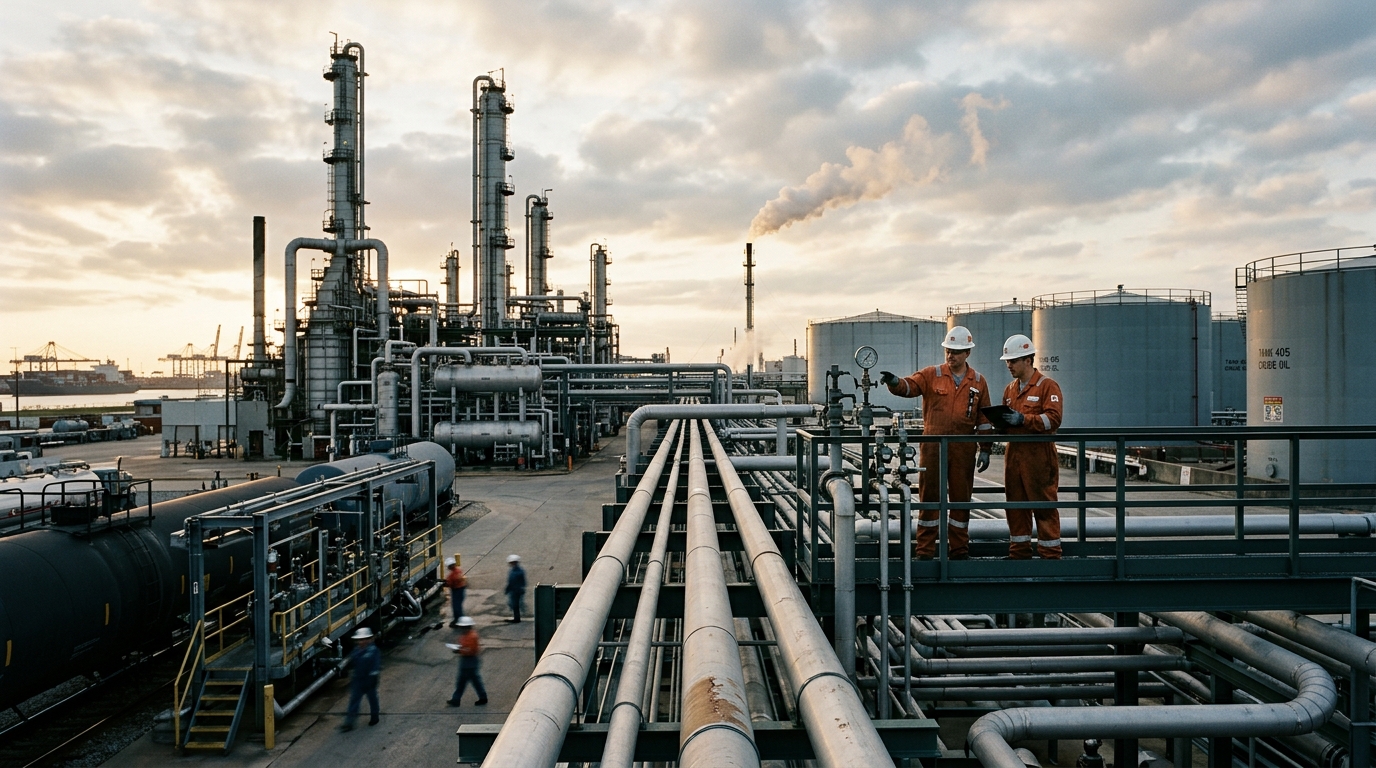
Here’s where it gets interesting. Refined product markets have not followed crude lower at the same pace. The reason is structural, not cyclical. Global refinery outages due to the Middle East conflict averaged 3.51 million barrels per day in April alone – up from 2.51 million bpd in March – as refineries in North Asia cut runs due to crude shortages. Separately, Ukrainian drone strikes against Russian refining infrastructure have resulted in roughly 0.7 to 0.8 million barrels per day of permanent capacity losses. Russia currently has 25-50% of its national refining capacity running dark. That supply gap does not heal overnight just because a ceasefire is holding.
Add to that the closure of the Phillips 66 Wilmington facility and the Valero Benicia refinery in California, which together removed roughly 17.5% of the state’s refining capacity. California is now reliant on Gulf Coast product and imports that are, frankly, harder and more expensive to move.
US refiners are currently running close to 95% utilization, deferring spring maintenance to capture elevated margins while they last. Gasoline and diesel margins have been cited as high as $22 and $50 per barrel respectively in some forecasts for Q4 2026. That’s not a margin environment that disappears just because crude slides.
“My system said ‘SELL’ right before this stock tanked. Today, I’m shouting ‘BUY NOW’ before it soars.”
In 2023, Marc Chaikin’s system flashed bearish on an automotive company no one had yet heard of. The stock crashed 35%. Today, his system rates this company “Very Bullish” and Marc calls it a screaming buy thanks to a new “groundbreaking partnership” with Nvidia that hands this company the keys to the self-driving kingdom on a silver platter.
The Q1 Numbers That Matter
Valero (VLO) just delivered Q1 2026 EPS of $4.22, blowing past the $3.16 consensus estimate by more than 33%. Net income came in at $1.3 billion, a dramatic reversal from a $595 million loss in Q1 2025. Refining operating income reached $1.8 billion, up from a $530 million loss a year earlier. US Gulf Coast distillate margins hit $27.60 per barrel, compared to $16.69 per barrel in Q1 2025. Throughput volumes averaged 2.9 million barrels per day. Revenue climbed 7% year over year to $32.38 billion.
That’s three consecutive quarters of earnings beats, with an average surprise of roughly 45% over the trailing four quarters.
Slight tangent, but it matters: Valero also raised its quarterly dividend 6% to $1.20 per share and returned $938 million to shareholders in the quarter. A $230 million fluid catalytic cracking optimization project at the St. Charles refinery is still on track to come online in Q3. That adds high-value product output at exactly the moment the margin environment might need it most.
Marathon Petroleum (MPC) told a similar story. Q1 2026 adjusted EPS came in at $1.65, more than doubling the analyst consensus of $0.75. Refining and marketing margin reached $17.74 per barrel – a 32.6% increase over the prior year – as supply disruptions from the near-closure of the Strait of Hormuz pushed global fuel markets into a structural supply gap. The company processed nearly 3 million barrels per day at 89% utilization, logging its lowest unplanned downtime in a decade. Marathon also guided for 94% utilization in Q2, and front-loaded roughly 40% of its full-year planned maintenance into Q1 to maximize availability heading into the summer.
Marathon returned over $1 billion to shareholders in Q1 2026, including $750 million in buybacks, and authorized an additional $5 billion repurchase program.
The Q2 Window
Here’s what I’m watching right now. Valero reports Q2 2026 results on July 30. Marathon reports August 4. Both reports will cover the quarter where the Iran conflict was most acute and where refining margins were arguably at their most extreme. The market’s reaction to those reports – whether the current stock prices have already priced in the beat, or whether there’s still room – will say a lot about how investors are interpreting margin sustainability.
Consensus for Valero’s full-year 2026 EPS growth is around 15.7%. Marathon is projected at 18.8% full-year EPS growth year over year. Those are not small numbers for downstream energy names.
The risks here are real. If the US-Iran deal holds and Hormuz flows fully normalize, crude supply could rise faster than expected, squeezing margins. The IEA projects the oil market could see a surplus of 3.8 million barrels per day in 2026 – the largest glut since the pandemic. OPEC+ has already moved to increase production multiple times this year. And Gulf Coast refineries along the Houston Ship Channel have already been seen running at reduced utilization because the economics don’t support full capacity in a lower-margin world.
The tension in this trade is exactly that: crude is falling, but the product market has not followed at the same speed. Whether that lag closes slowly – or snaps shut quickly – is the question Q2 earnings will start to answer.
Mag 7’s relentless assault on Nvidia’s future
Nvidia’s biggest customers are now buying and selling chips to each other. That means, the virtual monopoly that fueled NVDA’s $4 trillion market cap is OVER. If you currently own NVDA, here’s a better alternative. Their competition is scarce, which puts them in a hugely advantageous spot. This supplier’s stock has outperformed Nvidia’s by 50X since July.
Click to get the full details on this urgent “Nvidia alternative” right here.
The Part People Skip
Most energy coverage right now is focused on the crude price. That’s the obvious number. What’s less obvious is that consumers don’t buy crude. They buy gasoline, diesel, and jet fuel. As long as product markets remain tighter than crude markets – because of structural refinery outages, capacity closures, and demand that hasn’t meaningfully softened – refiners can keep capturing a margin that the headline crude price doesn’t tell you about.
The question going into late July is whether that margin story holds through Q2, or whether it was a one-quarter phenomenon tied to a conflict that’s now de-escalating. The answer will be in the numbers. And those numbers are coming fast.
This content is for informational purposes only and does not constitute investment advice. All figures referenced reflect publicly available data as of early July 2026. Past performance does not guarantee future results. Always conduct your own research before making any investment decisions.
 Rising Star Stocks